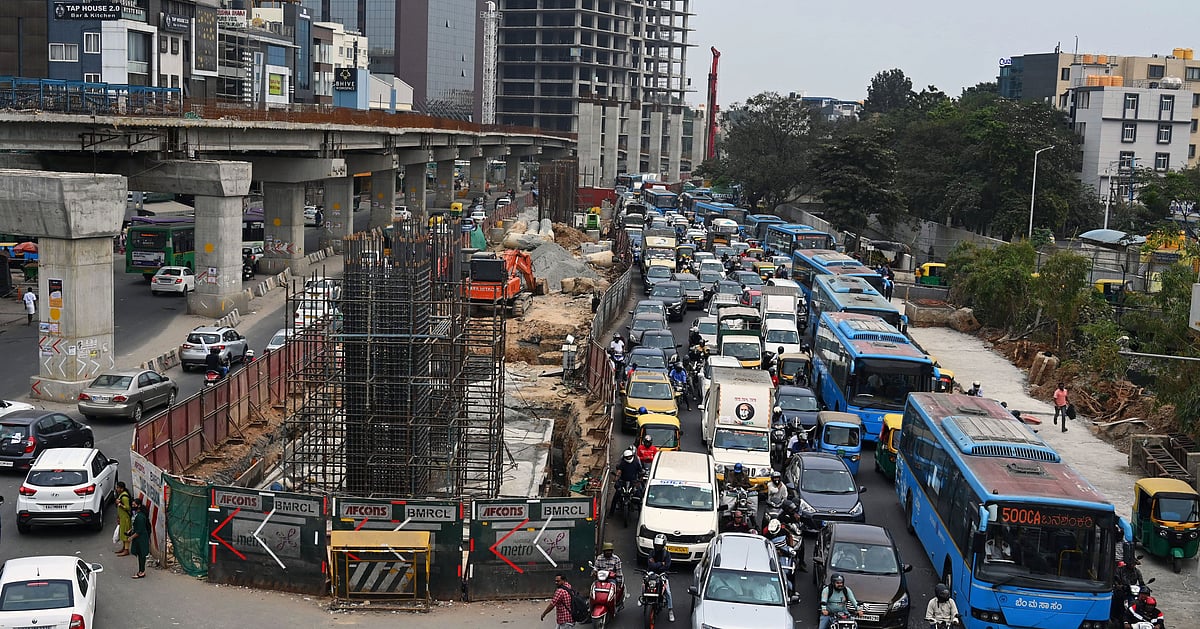
Bengaluru Urban Growth Puts Infrastructure Under Strain
Bengaluru’s rapid expansion is putting transport networks, civic infrastructure and climate resilience under growing pressure, with the state’s Greater Bengaluru leadership now confronting the long-term consequences of unplanned urbanisation. The city’s growth has strengthened its position as a technology and employment hub, but rising vehicle ownership, congestion, changing rainfall patterns and infrastructure gaps are increasingly shaping the quality of urban life.
The scale of Bengaluru urban growth is visible in the pressure on its roads. The city now has roughly 1.5 crore vehicles when locally registered and other vehicles using its network are considered, while its population is also estimated at around 1.5 crore. Earlier assessments have linked the city’s infrastructure stress to decades of dispersed development, unauthorised layouts and weak coordination between agencies. Traffic, however, cannot be addressed simply by adding road capacity. Authorities are considering tunnel corridors and road improvements, but the wider mobility strategy also includes expanding public transport. Plans outlined by the Greater Bengaluru administration include increasing the BMTC bus fleet by 4,500 vehicles, expanding the Metro network towards 250 km and completing 148 km of suburban rail by 2030.The environmental cost of Bengaluru urban growth is equally significant. Increasing built-up areas and hard surfaces can reduce natural water absorption, making intense rainfall more difficult to manage.
The government has indicated plans for extensive stormwater-drain remodelling, while better coordination between road, utility and drainage works is becoming increasingly important as extreme rainfall events place existing systems under stress. Governance is another central challenge. The Greater Bengaluru Authority has been designed to bring multiple civic and infrastructure agencies into a more coordinated planning framework. A proposed GIS-based platform is intended to combine information on roads, utilities, streetlights and upcoming works, potentially reducing repeated road excavation and unnecessary public expenditure. For residents, the effectiveness of these reforms will ultimately be measured less by the scale of announced projects than by everyday outcomes: shorter journeys, reliable public transport, safer footpaths, functioning drainage and cleaner neighbourhoods.
Bengaluru’s next phase of growth therefore requires infrastructure to expand alongside the city, rather than after it. Aligning housing, employment, mobility, water management and green infrastructure could determine whether the city’s economic success remains compatible with liveability and climate resilience.