


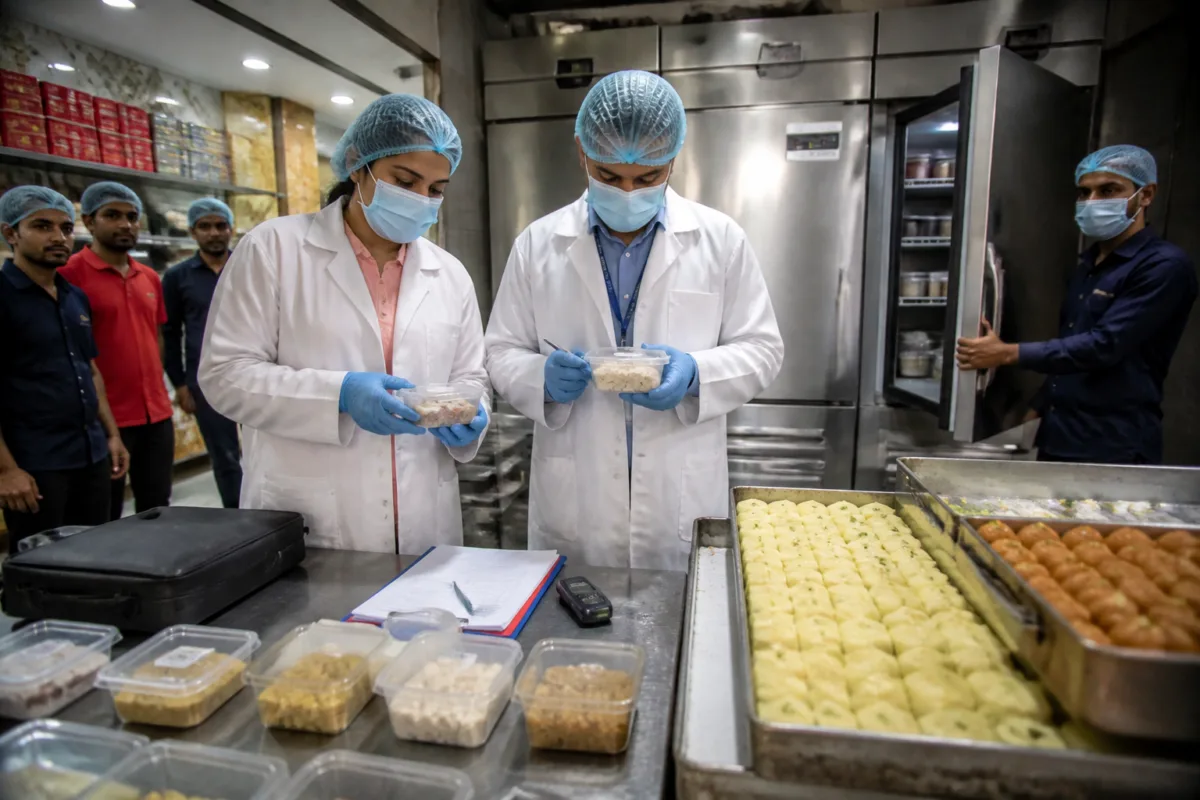
Delhi sweet shop raids have exposed more than unhygienic kitchens. They have also revealed a persistent gap between detecting food-safety violations and completing enforcement action against those responsible. The inspections, conducted by the Delhi food safety department on Tuesday, found insects, dirty equipment, open waste bins, unsafe storage and workers handling food without gloves at several establishments. The department collected samples, but the figures cited in the report show that inspections have not consistently translated into convictions or licence cancellations.
The immediate concern is consumer safety. During the festive season, customers buy sweets on the assumption that the products have been prepared, stored and packaged under basic hygienic conditions. The reported findings challenge that assumption at a time when demand for sweets rises and products may move quickly from kitchens and storage rooms to retail counters. The problem is therefore not limited to one shop or one defective batch. It concerns the ability of an urban food system to maintain standards across preparation, storage, documentation and enforcement.
At Evergreen Sweet House in Okhla Phase II, inspectors reportedly found a large number of insects in the storage area. Employees were handling food without gloves and without adequate cleanliness, while water and food-product testing reports were not available at the premises. The department collected samples of boondi dana and khoya from the establishment. The report also identified shortcomings at Kalighata Sweets, Bhikharam Chandmal, Aman Mithaiwala, Grover Sweet Corner, Methi Foods and Singla Sweets.
The problems described across these establishments included poor cleanliness, inadequate storage and insufficient protection against insects. In some places, food-safety licences were not displayed. Documents relating to packaging and employee training were also incomplete. These are not merely back-room administrative lapses. They affect whether consumers can identify a licensed outlet, whether the business can demonstrate compliance and whether the department can establish that food was handled through documented procedures.
The inspection findings become more significant when placed against Delhi’s wider enforcement record. Between 2022-23 and 2024-25, the department examined 9,169 food samples. Of these, 535 did not meet the prescribed standards. The annual figures show 255 non-compliant samples out of 3,133 in 2022-23, 150 out of 3,412 in 2023-24 and 130 out of 2,624 in 2024-25.
The numbers indicate that non-compliance was recorded in each of the three years. The proportion fell from about 8.1 per cent in 2022-23 to roughly 4.4 per cent in 2023-24 and about 5 per cent in 2024-25. But the report does not establish whether this change reflects improved compliance, differences in sampling, changes in the types of products tested or other administrative factors. The data does establish that violations continued despite repeated sampling.
The more serious gap appears after the sample is collected. The report states that convictions were secured in only 38 cases during the period, while just two licences were cancelled. A non-compliant sample does not automatically establish the full legal outcome of a case, and the supplied report does not provide the time taken, the status of all proceedings or the reasons for each outcome. Even so, the contrast between 535 samples failing to meet standards and 38 convictions raises a clear public-accountability question: what happens between detection and final action?
That question matters because inspections are only one part of a regulatory system. A raid can identify a contaminated product, an unsafe workplace or a missing document. Public protection depends on what follows: sample testing, notice, adjudication or prosecution where applicable, corrective action, repeat inspection and, in serious or repeated cases, closure or licence cancellation. If the public sees only the inspection but not the final disposition, it cannot assess whether the system is correcting the problem or merely recording it.
The report points to another example from September, when more than 4,100 kilograms of suspected adulterated or counterfeit khoya, paneer and chhena were destroyed. At the Mori Gate khoya market, 22 of 30 samples were reported to be unsafe, while 19 of 59 ghee samples were unsafe and four were described as substandard. These figures are significant because they indicate that the risk may extend beyond individual sweet shops to the supply chain through which ingredients reach retailers.
The available information does not show how the destroyed material entered the market, which suppliers were responsible, whether repeat offenders were identified or what action followed against businesses linked to the failed samples. It also does not show whether the same establishments were inspected again after corrective directions. Those missing details are central to understanding whether enforcement is preventive or largely reactive.
The administrative issue is partly one of transparency. The report says the department publicises raids prominently but does not disclose final outcomes with the same visibility. If that pattern is accurate, the public receives information about the beginning of enforcement without equivalent information about its conclusion. A transparent system would allow residents to track, at least in aggregate, the number of samples collected, failures confirmed, notices issued, cases filed, convictions secured, penalties imposed, licences suspended or cancelled and repeat violations recorded.
Such disclosure would also distinguish different kinds of failures. A missing licence display, an incomplete employee-training document, unsafe storage and adulteration are not identical violations. They may require different corrective measures and may carry different legal consequences. Without outcome-level information, a single headline figure can conceal whether the department is dealing effectively with serious risks or mainly documenting procedural shortcomings.
There is also a question of inspection coverage. The report gives the total number of samples tested across three financial years but does not state how many sweet shops operate in Delhi, how often individual outlets are inspected or how samples are selected. It therefore cannot establish the overall prevalence of unsafe food across the city. The figures should not be read as a citywide estimate of all violations. They do, however, show that failures were found repeatedly and that enforcement outcomes were substantially fewer than non-compliant samples.
For residents, the practical risk is created at the point where regulation becomes invisible. Customers generally cannot inspect a storage room, verify the origin of khoya or determine whether a shop’s water and food-testing reports are current. They depend on the department’s licensing, inspection and enforcement systems to reduce that information gap. When insects are found in storage areas or workers handle food in visibly unhygienic conditions, the failure is not only within a shop. It also tests whether routine oversight reaches the places where food is prepared and stored.
The report’s account of missing documents is particularly important in this context. Records are not a substitute for cleanliness, but they provide an administrative trail. Water-testing reports, food-product testing records, packaging documents and employee-training records can help regulators establish whether a business has a functioning compliance process. When those records are absent or incomplete, inspectors have less evidence to assess past practice and follow up on corrective action.
The Delhi government’s position was sought for the report, but the health minister did not respond to phone calls or a message. That leaves questions about the department’s response unanswered, including how many notices were issued after the raids, whether any premises faced temporary closure, when the collected samples would be tested and whether the affected establishments would undergo follow-up inspections.
The evidence therefore confirms two connected realities. Delhi’s food safety department is conducting inspections and finding violations in sweet shops and related markets. At the same time, the available enforcement figures show a much smaller number of convictions and licence cancellations than non-compliant samples. The supplied report does not establish why that gap exists, but it makes the gap measurable enough to demand a clearer public record.
The next important information is not another raid photograph. It is the outcome: sample-test results, notices, case status, penalties, repeat inspections and action against licences where violations are confirmed. Until those stages are disclosed consistently, residents can see how violations are discovered but not whether the system is capable of closing the enforcement loop.

