


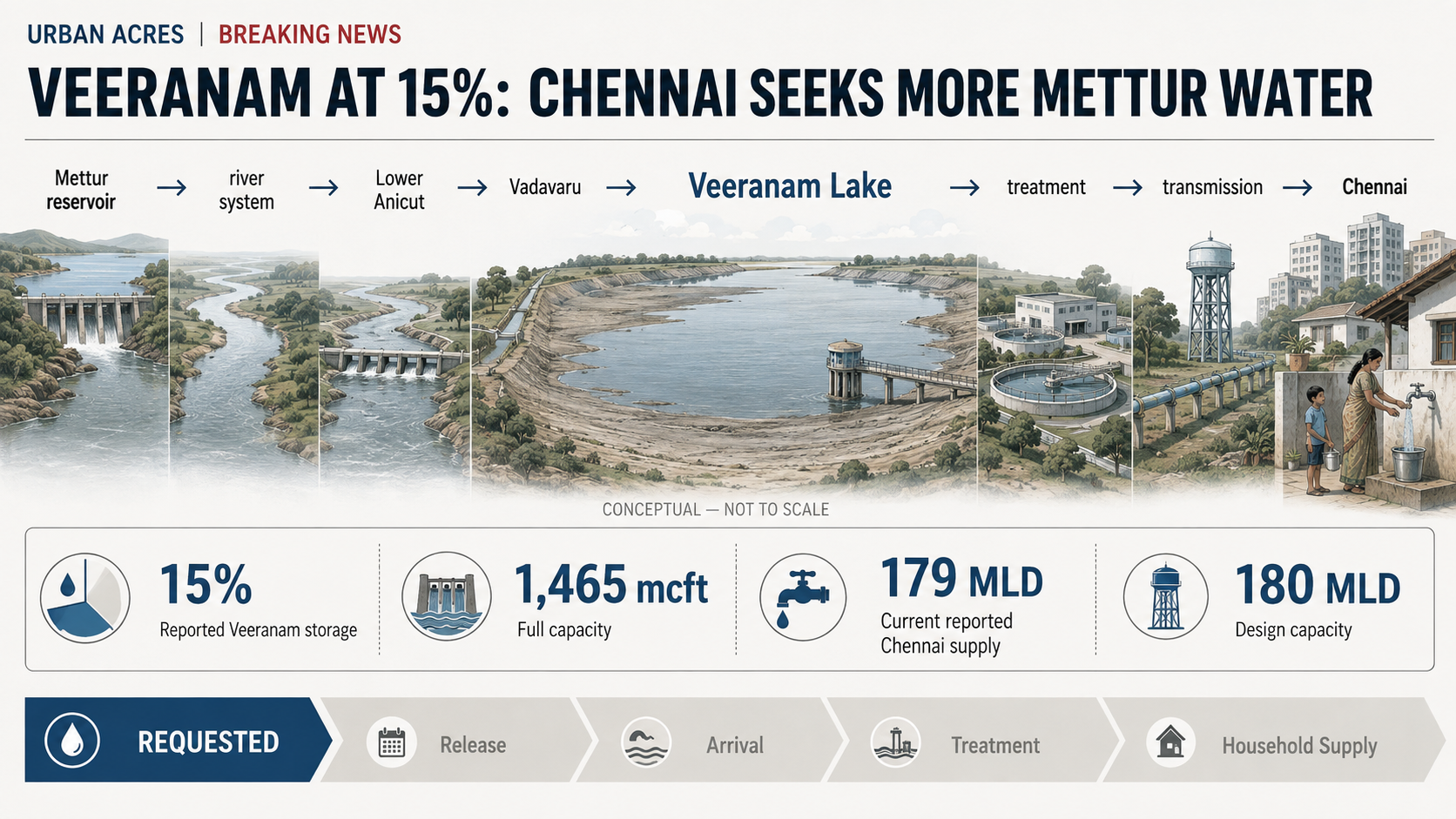
The Chennai Metropolitan Water Supply and Sewerage Board has sought an additional release from Mettur to replenish Veeranam Lake while the reservoir continues to supply roughly 179 million litres a day to the city. The crucial qualification is that a request for additional water is not yet evidence that a specified release has been sanctioned, reached Veeranam or strengthened household supply.
Metrowater seeks upstream replenishment
Chennai’s water utility has sought an additional release from Mettur Dam to augment Veeranam Lake, one of the city’s distant surface-water sources, as the tank’s storage has reportedly fallen to about 15% of its 1,465-million-cubic-foot capacity.
The lake nevertheless continues to provide about 179 million litres a day to Chennai, according to the current report — almost equivalent to the 180-MLD design capacity of the New Veeranam water-supply system. Officials expect water to reach the reservoir in the first week of September.
That expected arrival should still be treated as an operational projection, rather than as completed augmentation, until the Water Resources Department discloses the release quantum and actual inflow is measured at Veeranam.
Veeranam has already gone through one drawdown-replenishment cycle this year
The latest position is not Chennai’s first Veeranam warning in 2026.
On June 22, the lake contained 421 mcft, or 28.79% of capacity, while Metro Water was drawing about 180 MLD. By early July, storage had fallen further to approximately 265 mcft.
A subsequent release from Mettur produced nearly 1,000 cusecs of inflow and raised the lake’s storage to about 375 mcft within two days.
The latest reported level of around 15% therefore shows that the July replenishment provided operating relief but did not remove the underlying dependence on continuing upstream inflows.
The water must move through an entire source-to-city chain
Veeranam is not filled directly from Chennai’s local catchments.
The tank receives Cauvery-system water through the Lower Anicut and Vadavaru system. After storage and treatment, water is transmitted over a long distance into Chennai’s distribution network.
Tamil Nadu’s own policy documentation describes Veeranam as a 1,465-mcft reservoir connected to the Cauvery system through the Lower Anicut and Vadavar Canal and identifies the New Veeranam project as a 180-MLD urban water source.
The correct service chain is therefore:
Mettur storage → upstream release → river/canal conveyance → Lower Anicut → Vadavaru → Veeranam storage → treatment → bulk transmission → Chennai distribution → household service
Mettur itself is entering a different operating phase
The request comes immediately before the State’s planned September 1 opening of Mettur for Cauvery-delta irrigation.
As of August 29, Mettur’s level had risen to 89.95 feet, with storage reported at 52.59 TMC and an inflow of 6,702 cusecs. About 2,000 cusecs was being released for drinking-water requirements.
The State has announced a 45-day irrigation release beginning September 1, with actual operations subject to storage and inflow conditions.
Those developments make the Water Resources Department’s operating plan especially important. It must simultaneously manage reservoir availability, downstream agricultural demand and drinking-water requirements.
That does not automatically mean the two uses are in conflict. It means the allocation and routing decisions should be transparent enough for both sets of users to understand them.
Financial context
There is no new ₹-crore project announcement in this story.
No new capital investment, contract value, Budget allocation or sanctioned infrastructure cost has been established by the current event.
This is an operational water-resource decision within existing infrastructure.
Any attempt to attach the historical cost of the New Veeranam project to this fresh release request would misrepresent the financial nature of the news.
Chennai’s water security cannot be inferred from Veeranam alone
Low Veeranam storage is significant, but it should not be converted into a citywide crisis claim without current source-wise water-balance data.
Chennai’s supply portfolio also includes local reservoirs, Krishna water, desalination and groundwater. Earlier this year, Krishna inflows were helping the city preserve storage in its other major reservoirs even as Veeranam was declining.
The most useful current disclosure from CMWSSB would therefore not be a single Veeranam percentage.
It would be a daily metropolitan water balance showing:
source storage + inflow + extraction + treatment output + transmitted quantity + distribution quantity + service level.
That is the information required to determine whether a low reservoir level is merely an operational management issue or is beginning to affect residents.
