


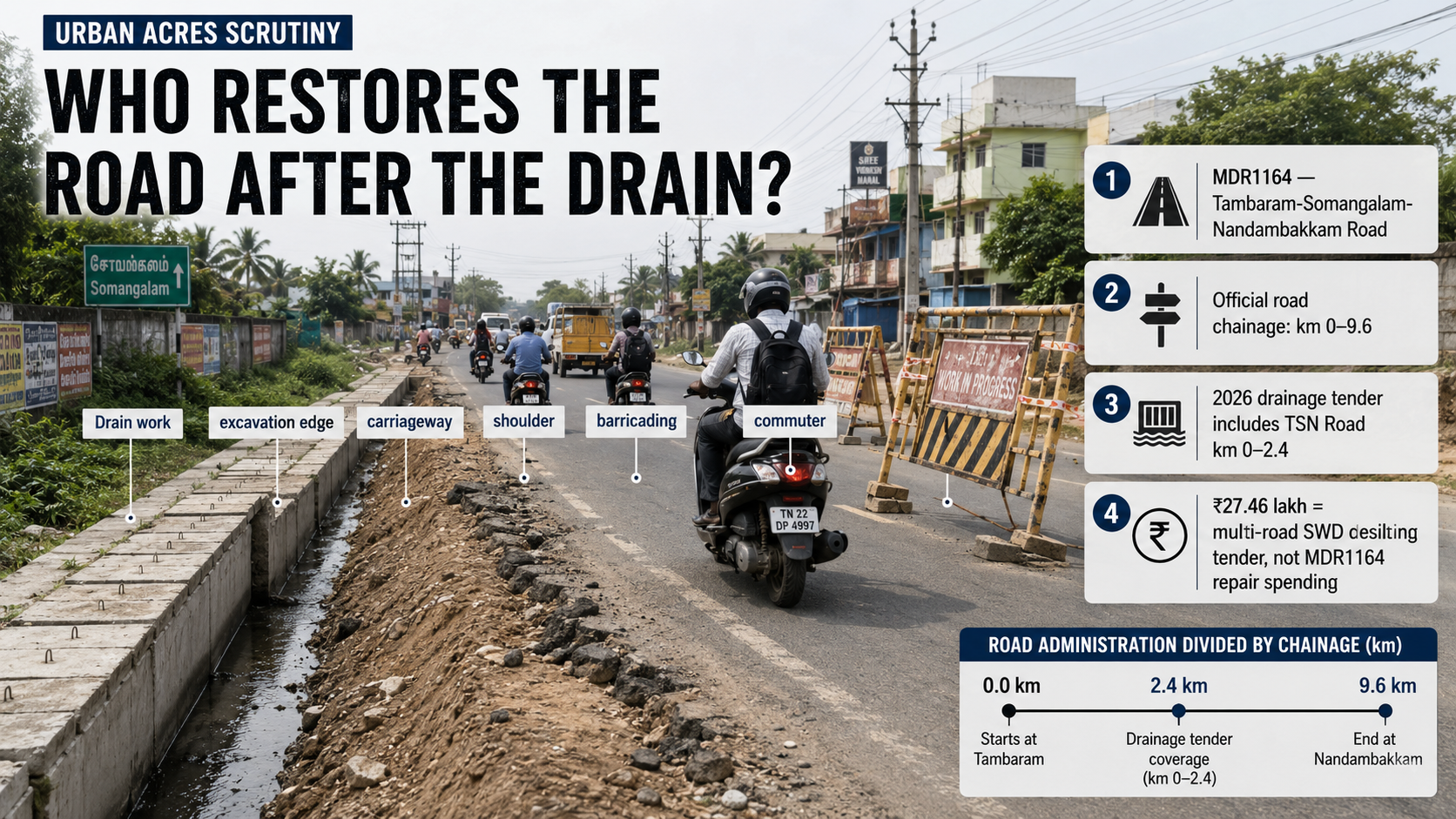
Residents are reporting potholes, uneven road edges and incomplete restoration along the Tambaram-Somangalam corridor. But the immediate accountability question is narrower than widening: who must restore each damaged chainage of MDR1164, and by when?
The deteriorating condition of the Tambaram-Somangalam corridor has returned to public attention after residents reported potholes, uneven surfaces, muddy shoulders and sections that they say were not properly restored following storm-water-drain works.
DT Next reported on August 30 that commuters have raised safety concerns along the route, which carries residential, educational and industrial traffic between the Tambaram side and settlements including Naduveerapattu and Somangalam. Highways officials told the newspaper that repairs to damaged portions were being pursued.
A recent fatal collision has sharpened those concerns. The report says a Tambaram Corporation employee returning after a night shift died after his two-wheeler collided with another vehicle on the road. There is, however, an important evidentiary limit: no police finding reviewed by Urban Acres establishes that potholes, drainage works or the road surface caused the collision. Resident claims that accidents have become frequent similarly require confirmation through police crash records.
That distinction matters because there are actually three different questions on this corridor: whether today’s carriageway is adequately maintained; whether storm-water works were followed by proper restoration; and whether the road ultimately requires additional capacity.
They should not be collapsed into one widening demand.
The road is a Highways asset
Tamil Nadu’s statutory Highways inventory identifies the road as Tambaram-Somangalam-Nandambakkam Road, MDR1164. The government list assigns km 0-2.4 to the Chennai City Roads Highways C&M division and separately records km 2.4-9.6 in the adjoining divisional inventory.
That chainage split is not bureaucratic trivia.
If defects lie on different portions of the corridor, the division responsible for the repair, the maintenance contract covering it and the engineer supervising the work may differ. A resident merely being told that the road “belongs to Highways” is therefore insufficient accountability.
A useful public response would identify each damaged location by chainage and state the responsible division, existing contractor, restoration status and completion date.
Drainage work creates a road-restoration obligation
Recent procurement records show that drainage infrastructure on the Tambaram portion of the corridor remains an active Highways responsibility.
A 2026 tender valued at ₹27.46 lakh covered storm-water-drain desilting across several Tambaram roads, explicitly including TSN Road from km 0/0 to 2/4. The package also covered sections of GST Road, Rajendra Prasad Road, Darga Road and Chitlapakkam Road. Its value therefore cannot be presented as ₹27.46 lakh spent specifically on Tambaram-Somangalam Road.
More importantly, that procurement is for drain desilting, not wholesale carriageway reconstruction.
The distinction illustrates the central problem Urban Acres should scrutinise:
Drain construction or maintenance → excavation protection → backfilling → compaction → carriageway restoration → shoulder restoration → safe barricading → final inspection.
A functioning drain accompanied by an unsafe riding surface is not a completed urban-service outcome.
Widening cannot substitute for maintenance
Residents have also asked authorities to widen the corridor. Highways officials told DT Next that such expansion requires Forest Department clearance.
That may be a legitimate project constraint. Forest land, right-of-way limitations and statutory clearances can materially affect road widening.
But Urban Acres did not locate a current public DPR, administrative sanction, forest-clearance application, sanctioned cost, tender or contract establishing that a widening project has reached implementation.
The project stage should therefore remain:
Need/possible proposal → clearance requirement reported → current formal approval status unknown.
That does not affect the maintenance obligation on the road that already exists.
A narrow road may legitimately require years to widen. It should not require years to eliminate dangerous potholes, restore excavated edges, stabilise shoulders or replace fallen barricades.
Recent maintenance procurement raises a specific question
Highways floated broader maintenance contracts for Tambaram Sections I and II on August 28, valued at ₹31.17 lakh and ₹14.09 lakh respectively and running up to March 2027. The available indexed tender summaries do not specify whether MDR1164 falls within either package.
That should now be disclosed.
If the corridor is already included, the public needs the chainages, contractor, service-level requirements and mobilisation date.
If it is not, Highways should identify the separate repair mechanism being referred to when officials say “steps are being taken”.
This corridor has seen earlier infrastructure complaints
The present controversy is also not the first involving drainage-road interfaces around Somangalam and Darkas. In August 2024, DT Next reported the collapse of a newly constructed rainwater canal and small bridge on the Darkas-Somangalam route. Two months later, residents protested over the delay in restoring the affected infrastructure.
Those earlier incidents should not be automatically blamed for today’s road defects—the physical locations and contracts may differ.
But together they justify a broader scrutiny question: is infrastructure being closed out as a complete corridor asset, or as isolated drainage and road contracts whose interfaces remain unmanaged?
For commuters, that administrative distinction disappears at the tyre-road interface.
The measurable outcome is simple: a road that drains during rain, remains safely motorable afterward and does not leave pedestrians or two-wheeler riders negotiating unprotected edges, loose surfaces or failed barricading.
That is the standard against which the next Highways response should be measured.
