


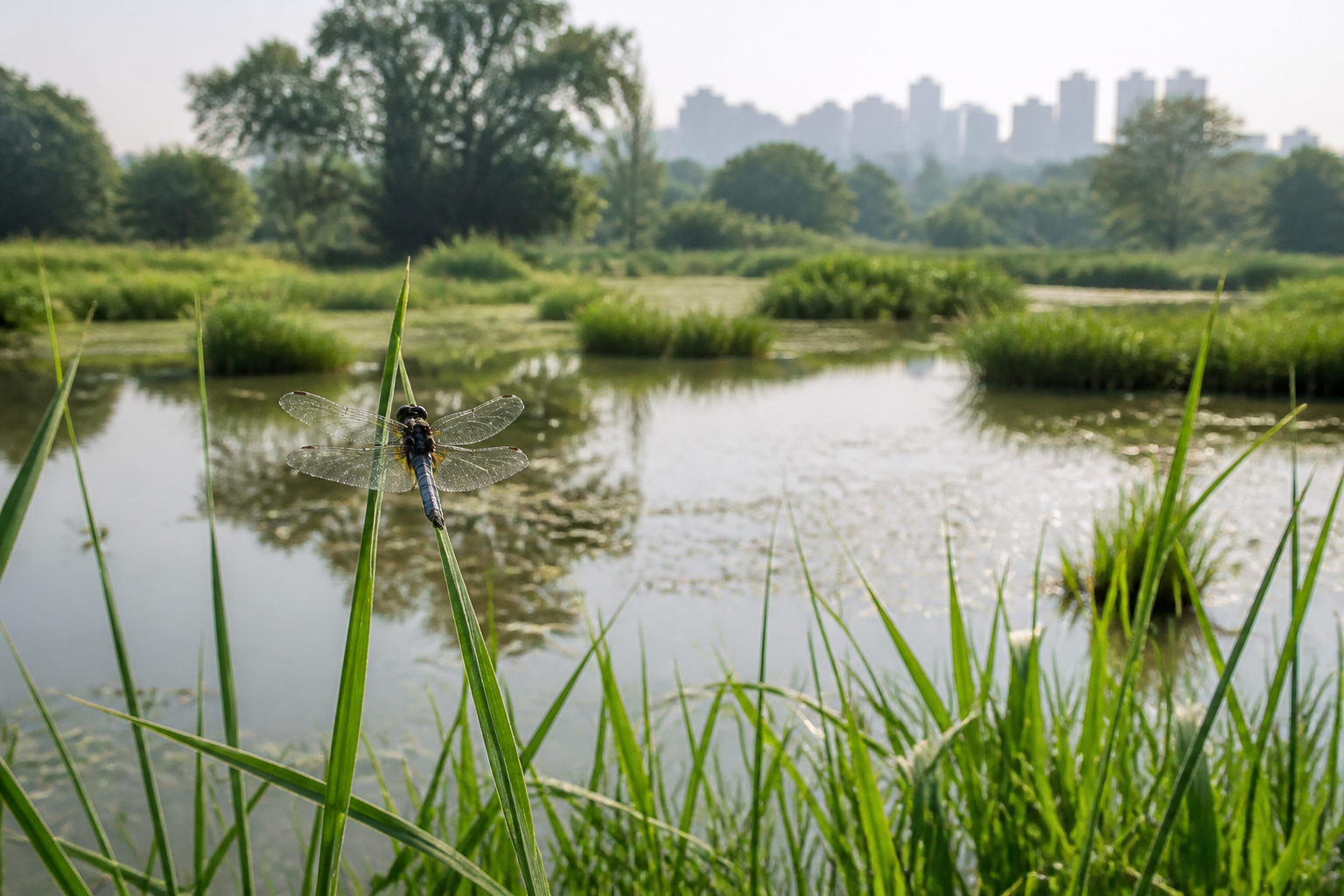
A three-day survey across seven Delhi biodiversity parks has recorded two dragonfly and damselfly species not previously listed in the parks, offering a useful measure of how restored urban habitats can support ecological life inside a rapidly built-up capital. The survey also recorded 11,154 individuals across the seven sites, placing water-dependent insects at the centre of a larger question: whether Delhi’s biodiversity parks are functioning as connected ecological infrastructure rather than simply as green spaces.
The species were recorded in two different landscape systems. The Yellow-tailed Ashy Skimmer was seen at the Aravalli Biodiversity Park, while the Blue Grass Dart was recorded at the Yamuna Biodiversity Park. Scientists, researchers and college students conducted the survey from 17 to 19 September, documenting dragonflies and damselflies across all seven parks managed by the Delhi Development Authority.
The findings are significant because these insects depend heavily on water and habitat conditions. Their life cycle is linked to ponds, wetlands, seasonal water bodies, grasslands and forest areas. Much of a dragonfly’s life is spent in the nymph stage in water, which means changes in water quality and habitat structure can affect their presence. The survey therefore offers more than a species count: it provides an indication of whether particular urban landscapes are retaining the conditions required by aquatic and semi-aquatic life.
That relationship makes biodiversity parks different from conventional ornamental parks. A landscaped park may provide shade, recreation and visual relief, but a biodiversity park is expected to recreate or protect a wider ecological system. In Delhi, the survey locations include floodplain, Aravalli and wetland-linked environments. The presence of dragonflies across these sites suggests that the city’s remaining and restored habitats can perform ecological functions even while surrounded by dense construction.
The distribution of species and individuals, however, was uneven. The Yamuna Biodiversity Park recorded 23 species in the latest survey, up from 21 in 2025. The Aravalli Biodiversity Park recorded 16 species, followed by 22 at Kamla Nehru Ridge, 12 at Tughlaqabad, 13 at Neela Hauz, four at Tilpath Valley and 15 at the Kalindi Biodiversity Park. Across the seven parks, Kalindi recorded the highest number of individuals at 4,234, while Kamla Nehru Ridge recorded 2,520.
These figures show why urban biodiversity cannot be assessed only by counting the number of parks on a map. The ecological value of each site depends on the quality and continuity of its habitat, the presence of water, and the ability of species to use the landscape for breeding and feeding. The contrast between four recorded species at Tilpath Valley and 23 at Yamuna Biodiversity Park points to differences in habitat conditions or ecological opportunity, although the supplied survey account does not establish the precise reasons for that variation.
The year-on-year increase at Yamuna Biodiversity Park is also useful, but it should be read carefully. A rise from 21 to 23 recorded species may indicate improved habitat conditions, wider survey coverage or natural variation in detection. The source material does not provide enough information to determine which factor was most important. What it does establish is that the park’s recorded dragonfly diversity has increased over the period covered by the surveys.
Dragonflies also connect biodiversity to everyday urban concerns. The survey account describes adult dragonflies as natural predators of mosquitoes, with an adult capable of consuming between 30 and 100 mosquitoes a day. Dragonfly nymphs also feed on mosquito larvae while living in water. This does not make biodiversity parks a substitute for municipal vector-control systems, but it shows how ecological processes can contribute to the regulation of urban insect populations.
The more important signal is the relationship between mosquito predators and water quality. Dragonflies require water for reproduction, yet polluted water or major changes to aquatic habitat can reduce their ability to survive. In this sense, a park that supports dragonflies must retain more than trees and open land. It needs functioning water bodies, suitable vegetation and habitat conditions that allow the insects to complete their life cycle.
India has about 600 known species in the Odonata group, which includes dragonflies and damselflies. Delhi is reported to have records of 51 species so far. The city’s floodplains along the Yamuna, Aravalli landscapes, wetlands, seasonal water bodies, grasslands and forest patches form the principal habitat systems identified in the survey account. These areas are fragmented, but together they show how ecological value can be distributed across different parts of the metropolitan landscape.
This has implications for how urban authorities define infrastructure. Roads, drains and water-supply networks are usually treated as essential city systems because their functions are visible and measurable. Biodiversity parks are less frequently discussed in the same institutional language. Yet the survey indicates that these spaces support water-linked species, provide habitat and contribute to natural predator-prey relationships. Their performance depends on maintenance and ecological management, not simply on land being left undeveloped.
The role of the Delhi Development Authority is central because the seven surveyed parks fall within its network. The survey itself involved scientists, researchers and students, creating a monitoring mechanism that can help track changes over time. Repeated surveys are particularly important for distinguishing a sustained ecological trend from a one-time observation. The supplied material does not specify a formal monitoring framework, budget or management response, so those aspects remain outside what can be concluded from the findings.
The survey also highlights the value of species-level monitoring in a city where environmental change is often discussed through broad indicators such as tree cover or open space. A dragonfly count can reveal whether water bodies and surrounding habitats are supporting a complete ecological cycle. It can also identify differences between sites that may appear similar when viewed only through satellite imagery or area measurements.
At the same time, the numbers should not be converted into a simple claim that Delhi’s biodiversity has broadly recovered. The survey covers seven parks and one group of insects. It establishes new records in the Aravalli and Yamuna parks, a higher recorded count at Yamuna compared with 2025, and substantial variation in abundance across locations. It does not, on its own, measure the full health of Delhi’s waterways, the condition of every biodiversity park or the city’s overall ecological trajectory.
The larger urban question is whether Delhi can protect ecological functions while continuing to expand and densify. Biodiversity parks offer one answer by preserving or rebuilding habitats within the metropolitan area, but their success depends on the quality of water, vegetation and connected landscapes. The dragonfly survey makes that relationship visible through a group of insects whose survival is closely tied to aquatic conditions.
What the evidence confirms is that Delhi’s biodiversity parks are supporting a measurable range of dragonfly and damselfly life, including two species newly recorded in the surveyed parks. It also confirms that the parks differ considerably in species diversity and abundance. The developments that deserve monitoring are whether future surveys record sustained increases, whether lower-count sites improve, and how consistently habitat and water conditions are maintained across the network.
