


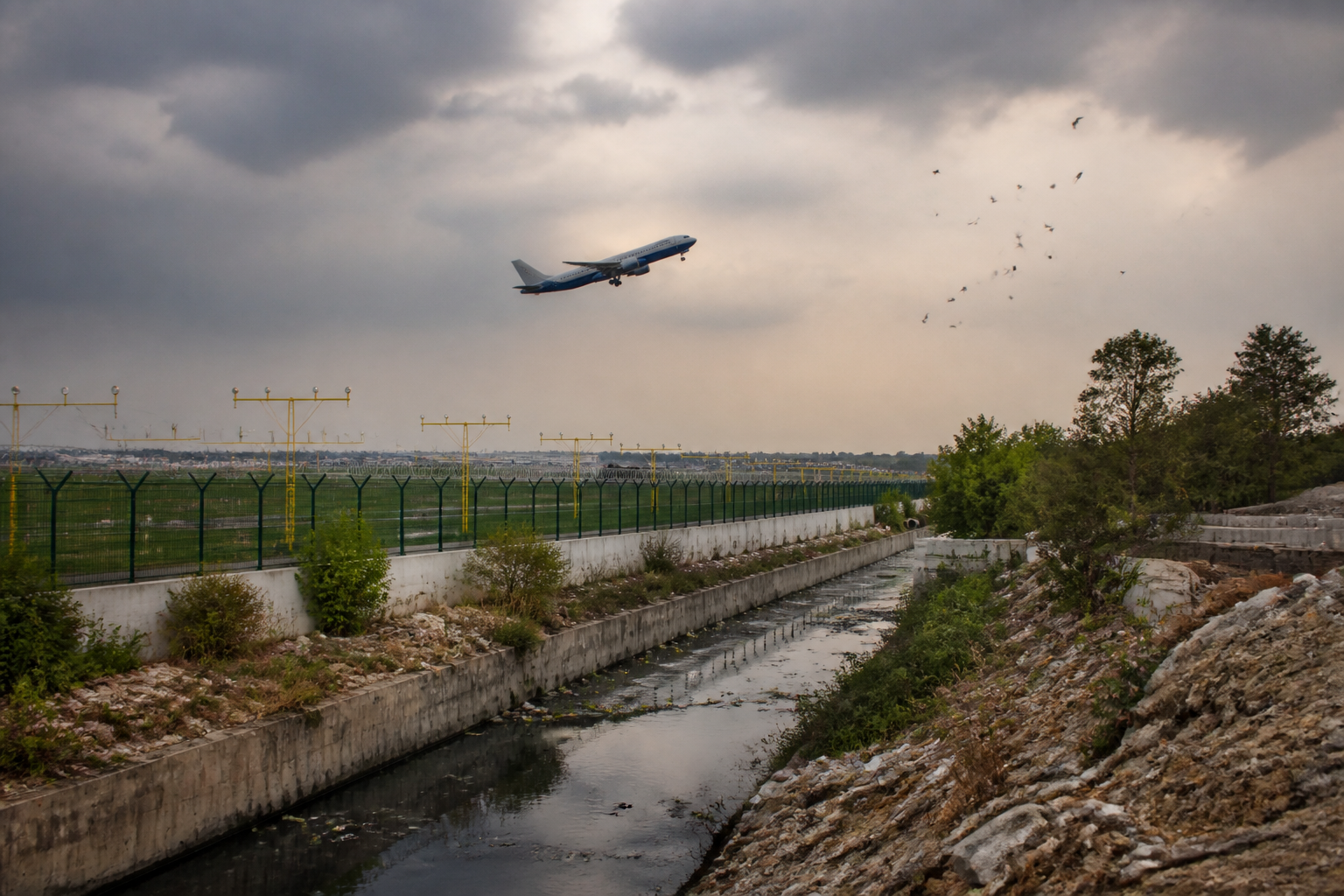
Bird hits near Delhi’s Indira Gandhi International Airport reportedly doubled in 2025 compared with the previous year, turning an aviation hazard into a wider test of how the capital manages waste, sewage, informal markets and land around critical infrastructure. Delhi International Airport Limited (DIAL), which operates the airport, told the Airport Environment Management Committee that an average of two bird-hit incidents were being reported every day.
The immediate concern is aviation safety. Birds flying across runway approaches can collide with aircraft during take-off and landing, when planes are at relatively low altitude and have limited room to manoeuvre. DIAL told the committee that discarded waste, sewage and illegal meat shops around the airport were attracting birds into flight paths. The company asked the committee for concrete action to prevent the incidents.
The report does not provide the absolute annual number of bird-hit incidents for 2024 and 2025. It does, however, identify a clear trend: the frequency in 2025 was described as twice that of 2024, with the current average put at two incidents a day. That combination matters because bird strikes are not only an airport operations issue. They can indicate failures in the management of land, drains, waste and food sources in the airport’s surrounding zone.
The Airport Environment Management Committee’s response shows the institutional structure of the problem. DIAL can identify the operational risk, but many of the causes lie outside the airport boundary and fall under different public agencies, local administrations and private or informal operators. The committee directed the Kapashera sub-divisional magistrate to inspect areas around the airport. The inspection found sewage flowing near Rangpuri Hill, where people were also dumping waste.
That site illustrates how a basic civic-service failure can become an aviation hazard. Standing or flowing sewage and accumulated waste create food and water sources for birds. Once birds begin using such locations regularly, the risk is carried into nearby airspace. The inspection found that the Delhi Jal Board was required to build a sewage treatment plant in the area, but the project had reportedly remained pending for one and a half years even after land became available. The committee’s chair asked the water utility to complete the plant quickly.
The delay is significant not because a treatment plant alone can eliminate bird hits, but because it demonstrates the dependence of airport safety on infrastructure outside the terminal and runway system. A treatment plant, drainage network and reliable waste-disposal system are usually treated as municipal or utility functions. Near an airport, they also form part of the risk-control system for aircraft operations. The absence or delay of one facility can therefore create consequences across an entirely different administrative domain.
The same pattern appears at Indira Market, where waste from a chicken market is reportedly being thrown into a drain. That waste attracts birds, creating another concentration point near the airport. The issue is not simply that a market generates waste. It is that the waste is entering a drainage channel instead of being collected and processed through a controlled system, allowing an ordinary sanitation problem to become a recurring aviation risk.
The airport’s Dwarka-side surroundings present different but related problems. Along the railway track leading from runway number 10 towards Dwarka, demolition has reportedly taken place and construction debris has been dumped on both sides of the track. In Dwarka Sector 8, pigeons are being fed, drawing large numbers of birds to the area. The committee has asked the concerned departments to address these issues.
Together, the locations show that the risk is distributed rather than concentrated at a single site. Rangpuri has a sewage and dumping problem. Indira Market has waste associated with a poultry market. The railway-track corridor has demolition debris. Dwarka Sector 8 has deliberate feeding of pigeons. Each location involves a different activity, but all can influence the movement and concentration of birds near flight paths.
The technical danger of a bird strike depends on the point of impact and the aircraft’s operating condition. If a bird enters a jet engine, an event known as bird ingestion, it can damage fan blades and compressors and may lead to engine failure. A collision with the cockpit windshield can also damage the glass and make it difficult for the aircraft to be controlled because of the pressure and airflow at altitude. The source report notes that such incidents occur mostly at low altitude, particularly during take-off and landing.
Past accidents show why the issue is treated as a serious safety concern. The report refers to a December 2024 aircraft accident in South Korea in which 179 people died after a bird strike, and to a 2012 crash in Kathmandu during take-off that killed 19 people. It also lists two more recent incidents in which passengers were reported safe: a British Airways flight from London to Chennai that suffered a bird hit while landing on 13 July 2026, and an Air India flight arriving from Delhi that encountered a bird in Patna on 24 August 2026.
These examples do not establish that a similar accident is imminent at Delhi airport. They do establish the range of consequences associated with bird strikes, from aircraft damage and operational disruption to, in the worst cases, loss of life. The Delhi case is therefore best understood as a prevention problem: the city and airport authorities are dealing with environmental conditions that can be identified and reduced before they contribute to a major incident.
The governance challenge is coordination. DIAL operates the airport, while sewage infrastructure is linked to the Delhi Jal Board. Local administration is involved in inspections, and other departments are responsible for railway-side land, demolition debris, markets and neighbourhood activities. The Airport Environment Management Committee can direct departments to act, but the effectiveness of those directions depends on each agency completing work within its own jurisdiction.
This arrangement creates a familiar urban blind spot. Agencies often manage assets according to administrative boundaries, while hazards move across those boundaries. Birds do not distinguish between airport land, a drain, a railway corridor, a market or a residential neighbourhood. A waste pile outside the operational perimeter can still affect the runway environment. The same is true of untreated sewage, food waste and large-scale feeding of birds.
The available evidence points to an infrastructure and enforcement gap rather than a single technical failure. The sewage treatment plant has reportedly been delayed despite land availability. Market waste is entering a drain. Debris has been dumped beside a railway track. Bird feeding continues in a location identified as problematic. In each case, the corrective action is known in broad terms, but the reported recurrence of incidents suggests that identification has not yet translated into sustained control.
The data available in the report is limited but important: an average of two bird-hit incidents a day, a doubling in 2025 over 2024, a sewage-treatment project pending for one and a half years, and several distinct bird-attracting sites around the airport. The report does not establish how many aircraft were damaged, how many flights were delayed, or whether any incident caused injuries. Those questions remain necessary for assessing the operational and economic scale of the problem.
What is established is that airport safety is being shaped by everyday urban management. Waste collection, sewage treatment, market regulation, demolition controls and public behaviour are not peripheral to aviation safety when they occur near runway approaches. They are part of the wider safety environment in which aircraft operate.
The next test will be whether the committee’s instructions lead to measurable changes on the ground. The Delhi Jal Board’s sewage-treatment plant, removal of market waste from drains, clearance of demolition debris and management of pigeon feeding in Dwarka are the immediate actions identified in the report. Until those steps are completed and the bird-hit trend is reassessed, Delhi’s airport will remain dependent on civic systems beyond the runway fence to reduce a risk that is already rising.
