


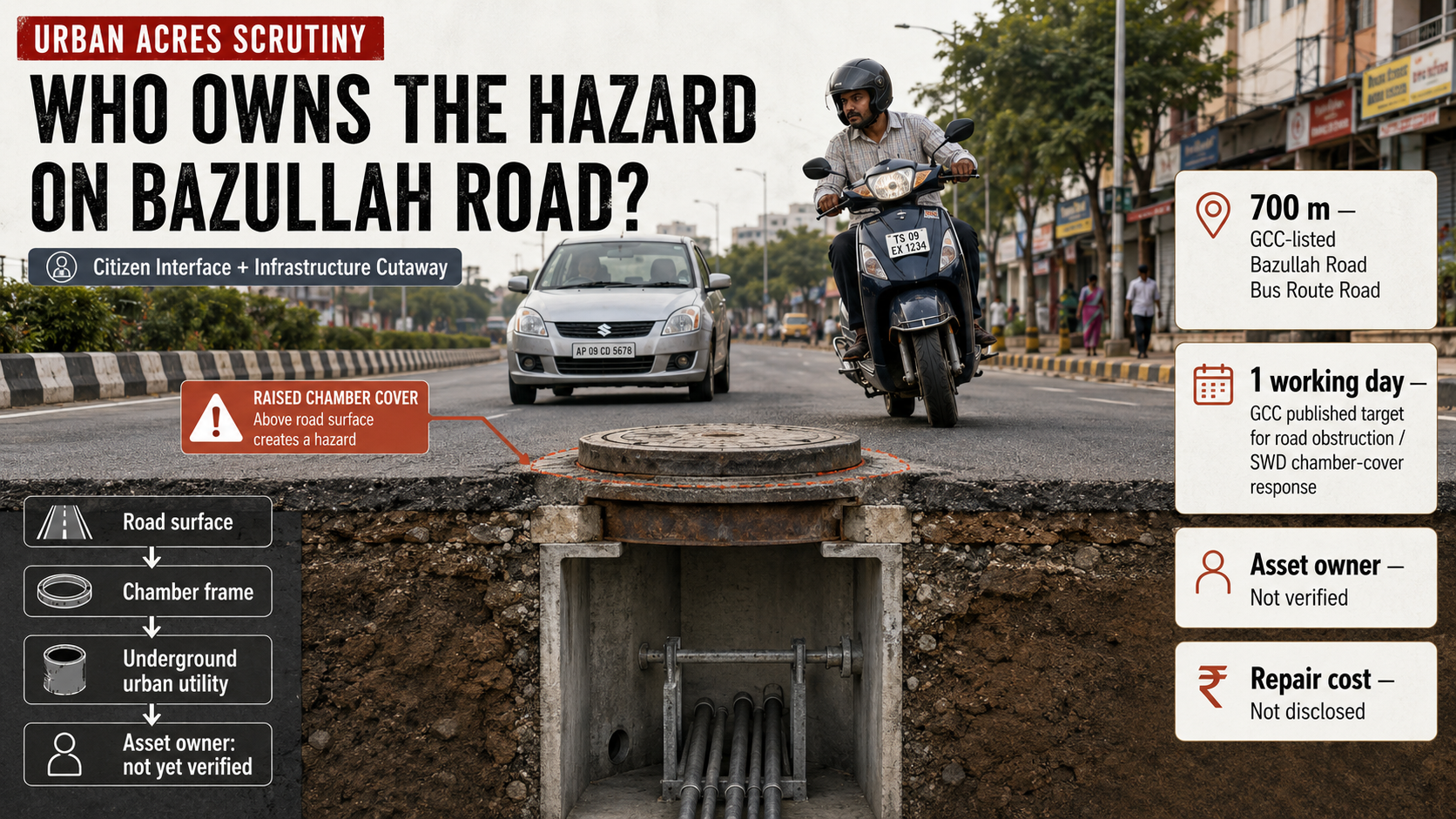
A raised manhole cover on Chennai’s Bazullah Road is creating a hazard for motorists, turning what appears to be a small maintenance defect into a test of how quickly the city’s road and underground-utility systems can resolve a problem at their physical interface.
The Hindu reported the condition on August 29, saying cars risk scraping their undersides while two-wheelers face a potentially more serious road-safety threat.
The report is new. The defect may not be.
No evidence reviewed by Urban Acres establishes when the manhole became raised. That distinction matters: a recently published civic complaint should not automatically be presented as a newly occurring event.
Bazullah Road is part of GCC’s road-maintenance network
Greater Chennai Corporation’s published list of Bus Route Roads identifies Bazullah Road in Zone X and records a length of about 700 metres.
The Corporation says its Roads Department is responsible for improvement and maintenance of Bus Route Roads, including resurfacing and carriageway works.
The outstanding question is what lies beneath the raised cover.
A manhole visible on a road may provide access to stormwater drainage, sewerage or another utility system. The material reviewed by Urban Acres does not identify which agency owns this particular chamber.
That ownership question matters administratively. It should not matter to the road user.
A person riding through Bazullah Road encounters one carriageway, not separate GCC, sewerage, telecom or drainage jurisdictions.
If it is a stormwater chamber, GCC’s standard is explicit
For its stormwater system, GCC says manhole doors and slabs at road crossings should be flush with the road surface.
A protruding cover is therefore more than an aesthetic defect. Road-surface continuity is itself part of safe infrastructure performance.
GCC also publishes comparatively short complaint-resolution standards. Its Road Maintenance page specifies one working day for the removal of an obstruction from a road and one working day for replacement of a stormwater-drain chamber cover; potholes and road cuts carry a two-day target.
Those standards create a measurable question for Bazullah Road: when was the defect first reported, when was it inspected, and when was the road returned to a safe level?
Chennai already recognises the road-utility interface problem
The larger governance issue is not hypothetical.
In January 2026, GCC approved a Council resolution addressing unauthorised road cutting and delays in permitted utility works. The Corporation said road cuts by service departments, utility agencies, contractors and others could cause traffic disruption, safety concerns, damage to road surfaces and repeated restoration expenditure. It also acknowledged cases where authorised works were not completed within stipulated time limits.
That resolution cannot be used to claim that road cutting caused the Bazullah Road manhole problem. There is currently no evidence of that causal link.
But it demonstrates that GCC already recognises the broader institutional problem: a road can deteriorate at precisely the places where different urban systems intersect.
Existing projects must not be confused with this repair
Bazullah Road has also figured in earlier public works.
GCC’s February 2026 tender bulletin included the road in a ₹9.0565-crore footpath-redevelopment package covering three roads.
Older GCC documents also identify substantial stormwater works involving the Bazullah Road catchment and a ₹24.07-crore Bazullah Road package under Singara Chennai 2.0 in 2022.
Neither number should be described as money being spent to fix the present manhole.
Urban Acres could not verify the current contract status of the 2026 footpath package from a primary award document, nor establish any relationship between those works and the present hazard.
What would constitute resolution?
A photograph showing workers attending the location would not, by itself, establish that the problem was resolved.
The relevant service outcome is simpler:
The cover and surrounding carriageway must provide a continuous, structurally secure and safe running surface.
The agency should therefore disclose the chamber owner, exact location, complaint and inspection times, cause of the level difference, responsible maintenance entity and final completion time.
Where immediate repair cannot be completed, the location should at minimum be made conspicuous and physically safe until permanent restoration takes place.
The Bazullah Road case is small in capital value but useful as a governance test. Indian cities often measure road performance through kilometres relaid, tenders issued or expenditure sanctioned. Residents experience those investments differently: one pothole, trench, loose cover or raised chamber at a time.
For a road user, the institutional diagram underneath the asphalt is irrelevant.
The test is whether the road is safe.
