


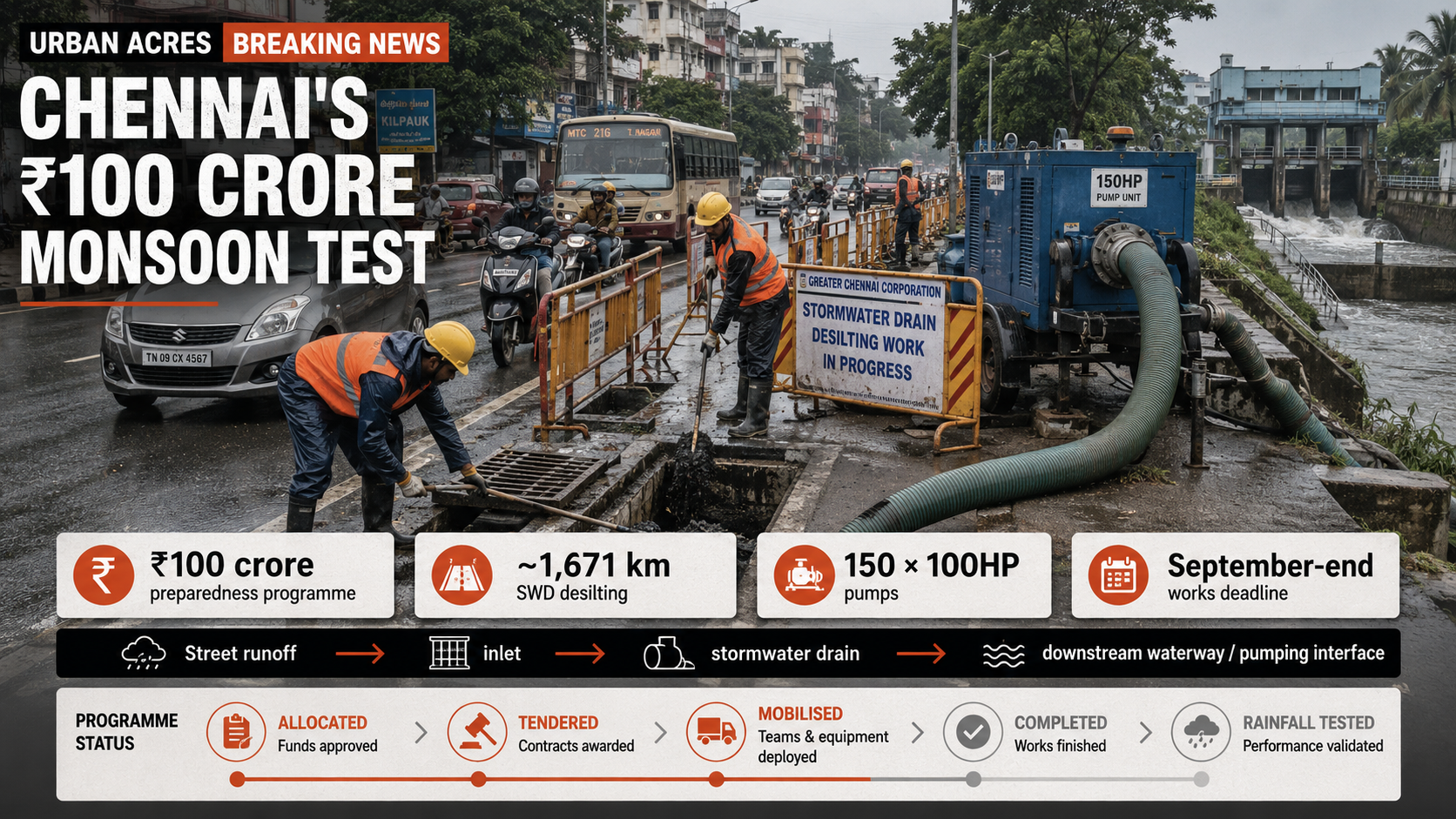
Greater Chennai Corporation has put a ₹100-crore value on its current Northeast Monsoon preparedness programme, covering drainage desilting, road repairs, pumping, emergency supplies and additional workers. But the figure represents a mix of allocations, estimates, tenders and works already under way — not ₹100 crore already spent — and the September deadline measures completion of preparedness activities rather than proof that Chennai will be free of flooding.
Greater Chennai Corporation formally disclosed the ₹100-crore programme on August 28, directing officials to complete monsoon-preparedness works by the end of September. The announcement qualifies as a fresh development, but several of its largest financial components were already disclosed earlier this month under a ₹58.15-crore package that had received administrative approval.
That overlap matters.
The ₹10 crore provided for ward-level monsoon works, ₹22 crore for road restoration and ₹15 lakh for equipment repairs were already part of the earlier package. Pumping provision also appeared previously at roughly ₹26 crore and is now stated as ₹26.53 crore. The latest ₹100-crore number should therefore be treated as an expansion or consolidation of the programme, rather than being added to the earlier ₹58.15 crore.
The most substantial separately identified new line is ₹22.46 crore for desilting roughly 1,671 km of stormwater drains. GCC has also included 15,000 emergency kits, temporary personnel for pumping operations and drone-based inspections of waterways in the package.
But project-stage discipline is essential.
The official release says road-restoration tenders have been sought zone-wise. Tenders have also been invited for 150 high-capacity 100HP pumps and pumping equipment mounted on 500 hired tractors. These are procurement-stage measures; an allocation or tender does not demonstrate that equipment has been mobilised at vulnerable locations.
Similarly, desilting 1,671 km of drains is an important maintenance output, but flood performance depends on the entire hydraulic chain. Street inlets must admit runoff; local drains must connect to larger drains; downstream waterways and outfalls must remain functional; pumps must have sufficient capacity, power and operators; and temporary construction or utility works must not obstruct the flow path.
That systems test is particularly relevant in Chennai. GCC itself notes that the city’s relatively flat terrain and tidal effects make effective stormwater drainage necessary to control water stagnation.
The deadline has changed
The September target also needs context.
On June 28, the Commissioner was reported to have directed completion of all ongoing stormwater-drain works by August, including work on missing network links. By August 9, GCC’s working deadline for ongoing projects, particularly stormwater drains, was being described as the end of September.
The evidence reviewed does not establish whether the later deadline reflects additional scope, revised sequencing or slippage. GCC should clarify that rather than allowing two different completion commitments to coexist without explanation.
The ₹100-crore figure also needs a full ledger
Urban Acres’ arithmetic on the individual figures disclosed in the August 28 release produces ₹86.54 crore.
That leaves ₹13.46 crore of the stated ₹100-crore programme without a specifically priced line item in the release.
Other activities are mentioned — including new drain connections, waterbody works, removal of invasive vegetation, dangerous-tree work and equipment preparation — and the balance may cover some of these. But the public document does not say so.
For a programme with a fixed September deadline, GCC should publish a work-level ledger showing the ₹100 crore in full: administrative sanction, tender value, contractor, work order, mobilisation date, expenditure, physical progress and completion status.
Financial capacity is another execution question
The monsoon programme is also being undertaken while GCC faces wider cash-flow and procurement pressure.
At the Corporation Council meeting, councillors raised concerns about the pace of drainage, desilting and road works. Separate reporting from that meeting said ₹2,090 crore of GCC bills were pending as of August 19 and that a ₹300-crore overdraft facility was approved for immediate cash-flow requirements and critical expenditure.
That does not establish that the ₹100-crore monsoon programme will be delayed. But where key components remain at tender or mobilisation stage, contractor payments, administrative approvals and work orders become legitimate readiness indicators.
The public test begins after completion
The strongest evidence of preparedness will not be the amount allocated by September 30.
It will be what happens when intense rain reaches locations that previously experienced repeated waterlogging.
For each vulnerable point, GCC should be able to show the problem, intervention, responsible agency, completion date, pumping arrangement where needed and actual performance after heavy rainfall.
Monsoon preparedness should therefore move from an expenditure ledger to a service-outcome ledger: not simply how much was desilted, but whether water leaves streets safely and quickly.
