


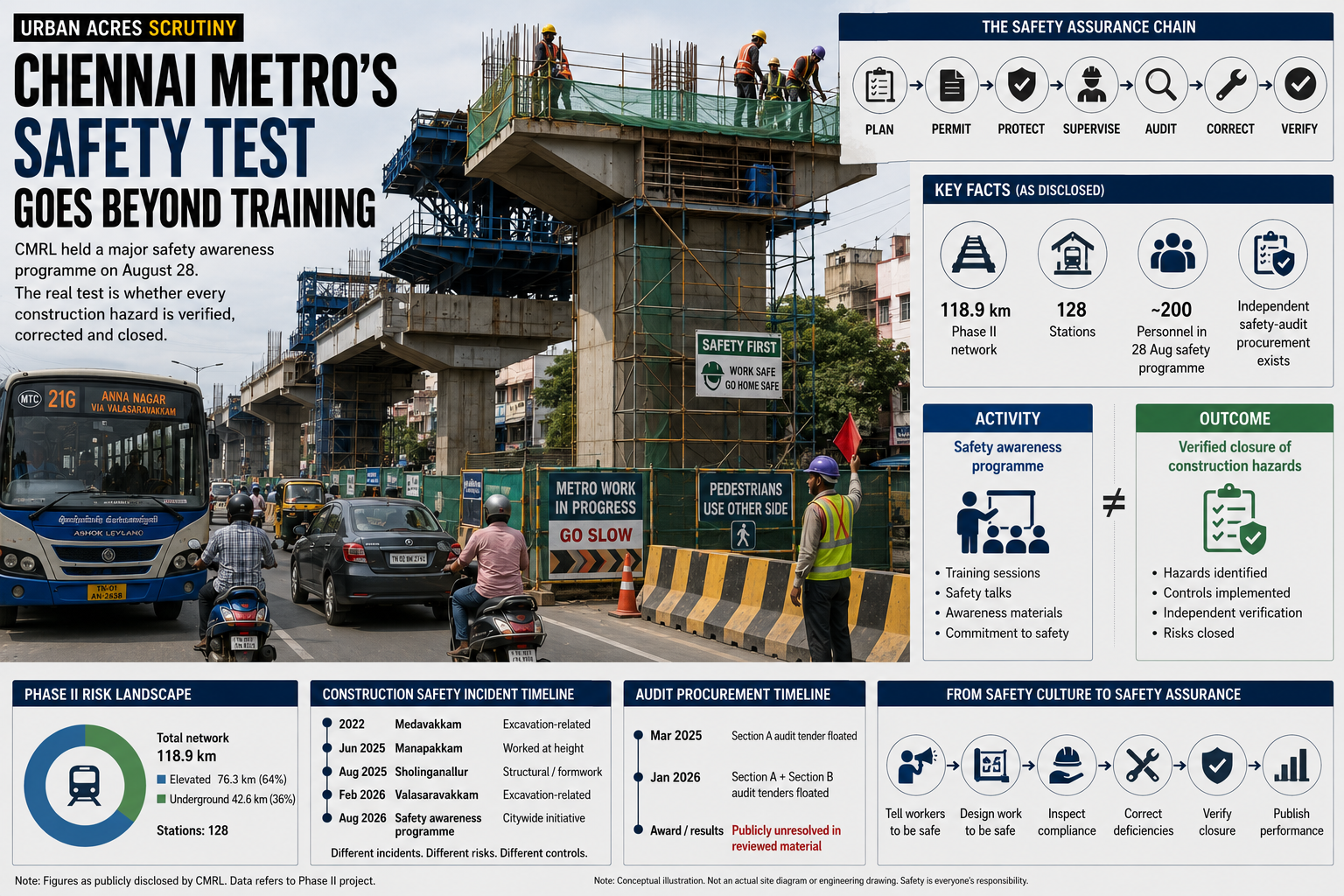
Chennai Metro Rail Limited has brought around 200 engineers, supervisors and foremen together for a special construction-safety programme, but the more consequential question for its 118.9-km Phase II expansion is whether safety requirements are being consistently enforced—and independently verified—across the network’s numerous construction packages.
CMRL conducted the programme at MetroS in Nandanam on 28 August, with officials from Tamil Nadu’s Directorate of Industrial Safety and Health participating. According to the agency, sessions addressed accident prevention, unsafe working conditions, statutory requirements, safe systems of work and effective supervision. Participants came from CMRL, its General Consultant and Phase II contractors.
That is a legitimate safety intervention. It should not, however, be confused with evidence of improved safety performance.
Safety has to operate through the construction chain
Chennai Metro Phase II is not one construction site. It is a ₹63,246-crore network extending across 118.9 km and 128 stations, comprising elevated and underground works spread over three corridors. CMRL’s published configuration includes 76.3 km of elevated infrastructure and 42.6 km underground.
That creates very different risk environments: excavations, temporary works, lifting, girder erection, working at height, load testing, tunnelling, utility diversion and construction next to live traffic.
A metropolitan project of this scale therefore cannot measure safety primarily by training attendance.
The relevant chain is:
Design and method statement → temporary-works approval → work permit → competent supervision → equipment inspection → fall/lifting protection → execution → independent audit → incident reporting → corrective action → verified closure.
A failure at any interface can undermine the rest of the system.
Serious incidents have involved different construction risks
The current safety programme follows an established record of serious Phase II incidents, although Urban Acres finds no evidence that they all resulted from the same systemic failure.
In June 2022, contract worker K Ravi died after a soil cave-in while carrying out utility-related work at a Metro construction site near Medavakkam. Police subsequently booked three people in connection with alleged negligence.
In June 2025—not June 2026, as the chronology of the triggering DT Next article could lead readers to infer—two large I-girders collapsed near Manapakkam, killing motorcyclist C Ramesh. CMRL subsequently attributed the failure to temporary steel support and launched an inquiry and broader safety review. Later reporting said contractor Larsen & Toubro was penalised ₹1 crore while the General Consultant was also held responsible by CMRL’s inquiry.
Two months later, during a load test near Sholinganallur, worker Bikee Paswan died and another worker was injured after a rope or cable associated with the testing system failed. CMRL officials said the structure had already borne its design load and that the incident occurred during additional loading used to test the safety margin.
Then, in February 2026, 23-year-old L Soray Ganjhu died after falling from an elevated section at Valasaravakkam. Contemporary reporting said investigators were examining whether mandatory harnesses and safety nets had been provided and properly used; The New Indian Express reported an initial finding that no safety net was installed at the location where the work was being undertaken.
These are not interchangeable cases. Excavation collapse, temporary-support failure, testing-equipment failure and fall protection involve different engineering and supervisory controls.
That makes package-level audit evidence more important, not less.
CMRL has taken safety actions—but their outcomes need clearer disclosure
It would be inaccurate to suggest that CMRL has responded only through awareness campaigns.
After the Manapakkam collapse, CMRL reported an inquiry and safety audit, and punitive action was subsequently reported against responsible construction parties.
There is also a longer procurement trail for independent safety scrutiny.
CMRL published a tender in March 2025 for an independent Phase II civil-and-track safety audit for Section A. In January 2026 it published two further bids, Sections A and B, explicitly seeking independent safety audits intended to enhance compliance with safe systems of work.
But the public material reviewed by Urban Acres does not establish whether those January assignments were awarded, who received them, how many work sites have been audited, what deficiencies were recorded, or what proportion of corrective actions have been closed.
That is now more useful information than another general assurance that safety is a priority.
Training is necessary; verification is the outcome
There is also an important counterargument.
Large civil-engineering projects carry inherent occupational and public-safety risk. The existence of accidents does not by itself prove that an entire project’s safety-management system is defective. CMRL has undertaken inquiries, imposed at least one reported major contractor penalty, commissioned or procured safety-audit work and now conducted further frontline training.
Those measures matter.
But the appropriate accountability threshold for a publicly financed metropolitan project is not whether safety activity exists. It is whether that activity can be shown to change behaviour and eliminate recurring hazards.
For example, a programme on working at height should ultimately be measurable through inspection records for lifelines, safety nets, harness anchorage and permits. Temporary structural support should be tied to independent design checking and documented inspection. Load-testing procedures should identify equipment, exclusion zones and authorised supervisors. Excavations should have shoring, access and competent-person checks.
In other words, CMRL needs to move the public conversation from safety awareness to safety assurance.
What CMRL should disclose
A useful Phase II construction-safety dashboard would not need to reveal commercially sensitive engineering information.
For each civil package it could disclose contractor, major subcontractors, monthly work hours, lost-time injuries, serious incidents, near misses, safety inspections, independent audits, major non-conformities, stop-work notices, corrective actions due, corrective actions closed and penalties imposed.
It should also distinguish worker safety from third-party safety where construction interfaces with public roads.
And because multiple victims identified in the public record were workers from outside Tamil Nadu, CMRL should state whether safety induction and toolbox training are available in languages understood by migrant workers and whether subcontract labour receives the same induction, PPE and stop-work protections as directly employed personnel.
The new training programme is therefore worth reporting—but not as the conclusion of the safety story.
The measurable milestone is not how many people attended a session. It is whether unsafe conditions are identified before somebody is injured, whether contractors correct them, and whether CMRL can demonstrate that those corrections remain in force across the construction network
