


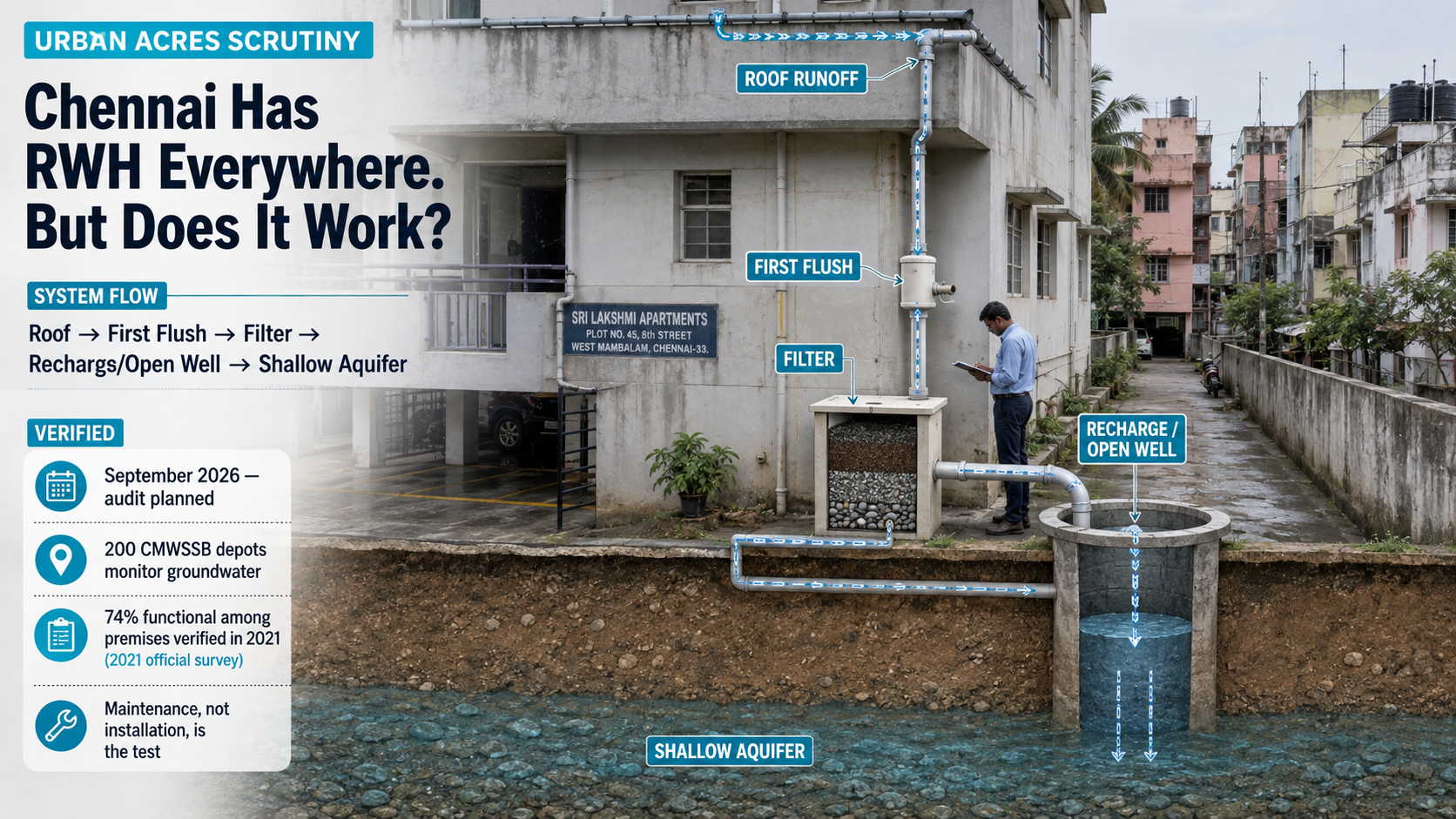
Chennai Metropolitan Water Supply and Sewerage Board is preparing to inspect rainwater-harvesting structures from September, ahead of the city’s critical northeast monsoon season. The reported programme will combine inspection with public awareness and renewed attention to maintaining systems installed across residential and other properties.
But this should not be understood as a new rainwater-harvesting policy.
Chennai has spent more than two decades requiring, promoting and periodically inspecting rainwater-harvesting infrastructure. Tamil Nadu’s own Municipal Administration and Water Supply policy documents say CMWSSB runs its awareness campaign every year before the monsoon. The policy question in 2026 is consequently no longer whether Chennai believes in rainwater harvesting. It is whether the city can demonstrate that the structures already required across its built environment remain functional.
That distinction matters.
A recharge pit that has filled with sediment, a disconnected rooftop pipe, an unclean filter or an unusable open-well connection may exist physically while contributing little to actual rainwater capture. CMWSSB’s own maintenance guidance requires clean terraces and filters, appropriate first-flush arrangements and periodic upkeep of collection systems.
Chennai has already seen the compliance-versus-functionality gap
The city has repeatedly surveyed RWH assets.
During a major 2021 drive, Tamil Nadu reported a universe of approximately 10.94 lakh buildings. Of the 7.82 lakh premises actually verified, about 74% were found to have functional rainwater-harvesting structures. The remaining premises required further sensitisation or rehabilitation.
Another inspection effort was planned in 2023, concentrating particularly on multi-storeyed and commercial properties. Contemporary reporting said the preceding survey had identified poorly maintained systems in a significant number of properties.
The present report says only 65% of buildings surveyed in 2023 had functioning systems. Urban Acres could not independently locate that precise number in a primary CMWSSB publication, so it should be treated as a reported figure until Metrowater releases its underlying survey data.
Either way, the pattern is clear: having an RWH structure on paper is not the same as harvesting rain effectively.
The infrastructure chain matters
For an individual building, useful rainwater harvesting is a service chain:
Roof/campus runoff → first-flush separation → filtration → storage or recharge → functioning well/aquifer interface → periodic maintenance
Failure at any one point can reduce the value of the entire system.
CMWSSB itself recognises that Chennai cannot use a single technical design everywhere. Its guidance differentiates sandy areas, clay areas and hard-rock zones and describes percolation pits, recharge wells and open-well recharge arrangements according to local ground conditions.
This makes a simple binary inspection — “RWH present / absent” — inadequate.
The September exercise should record whether the structure is correctly connected, unclogged, appropriately designed for the site and capable of accepting water.
Groundwater data provide an outcome measure — but not simple causation
Chennai already possesses a useful monitoring network.
CMWSSB operates digital water-level recorders across its 200 depots. The State’s 2024-25 policy note reported that Chennai’s average groundwater depth improved from 5.59 metres before the 2023 monsoon to 2.95 metres afterwards.
The 2.64-metre movement is important evidence of seasonal aquifer response.
It is not, however, a standalone measure of RWH programme performance.
Rainfall distribution, groundwater abstraction, soil and aquifer conditions, surface-water infiltration, recharge through water bodies and other interventions all influence groundwater levels. Claiming that household RWH alone produced the movement would overstate the available evidence.
A stronger evaluation would therefore correlate RWH functionality with local rainfall and depot- or ward-level groundwater behaviour over several seasons.
Enforcement is split across the urban system
The institutional structure also deserves attention.
CMWSSB is responsible for the water-service interface and maintains an RWH Cell, 15 area offices and 200 depots. Its consumer rules explicitly place responsibility on property users to install and maintain RWH systems.
Building regulation involves another interface. Chennai’s Climate Action Plan identifies GCC’s Town Planning Department as the lead institution for strengthening RWH bylaw implementation in new construction, supported by CMWSSB and other GCC functions.
The practical test is therefore not simply whether Metrowater engineers conduct inspections. It is whether defects move through a clear institutional chain:
inspection → notice/advice → repair responsibility → deadline → re-inspection → closure
Without that chain, a September audit risks becoming another inventory rather than an asset-management system.
What Chennai should publish after the audit
The 2026 programme could become considerably more useful if CMWSSB publishes the outcome at depot or ward level.
At minimum, residents should be able to see:
- number of properties inspected;
- number with working systems;
- number absent;
- number damaged or clogged;
- number requiring redesign;
- notices or repair instructions issued;
- repairs subsequently completed;
- re-inspection results;
- groundwater depth by monitoring location;
- rainfall recorded over the same period.
Chennai already has the regulatory framework, institutional footprint and groundwater sensors.
The unresolved question is whether those components will now be integrated into a measurable maintenance system.
For a city dependent on a highly seasonal rainfall regime, that is more consequential than another awareness campaign.
