


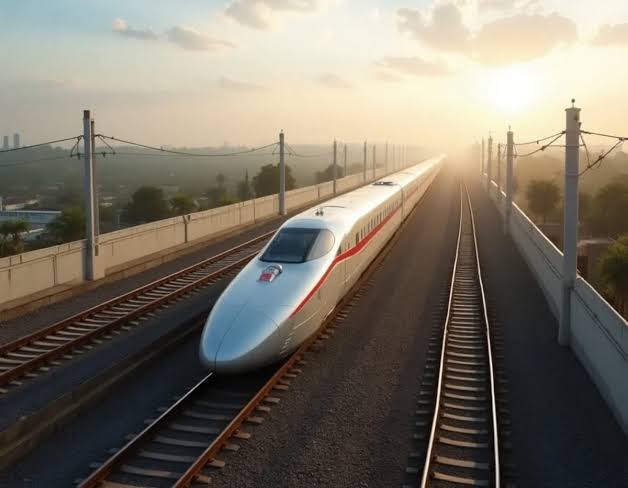
The Mumbai–Ahmedabad High-Speed Rail project has entered another important construction phase, with railway electrification advancing across the 508-km corridor. The work brings the first Indian high-speed rail system closer to testing and eventual operations, while also raising the importance of station integration, urban access and reliable power infrastructure along the route.
The Ahmedabad Bullet Train project is being built across Gujarat, Maharashtra and the Union Territory of Dadra and Nagar Haveli. The corridor is designed for trains operating at up to 320 kmph, with 12 stations planned between Mumbai and Ahmedabad. Government data released in July said overall project execution had reached about 80%, with the first operating section expected to be introduced between Surat and Bilimora in 2027 before the service is extended progressively towards Ahmedabad and Mumbai. Electrification is a particularly complex component because high-speed trains require a stable power supply and specialised overhead equipment. The project is using a 2×25 kV overhead traction system, being deployed in India for the first time for high-speed rail. Fourteen traction substations will distribute power along the corridor, supported by switching posts and separate distribution substations for stations, signalling and maintenance facilities. The system also incorporates safety infrastructure suited to the corridor’s operating speeds. Traction substations and switching locations are being equipped with earthquake-detection sensors capable of triggering protective measures when seismic activity is detected. A centralised system will continuously monitor the electrical network and automate responses to faults.
For Ahmedabad, the significance extends beyond the train itself. The city’s bullet train station is being developed as a multimodal interchange connecting high-speed rail with conventional railway services, the Metro and city buses. Such integration will determine whether faster inter-city travel translates into practical gains for passengers rather than simply shifting congestion to station approaches. Construction is also reshaping infrastructure around the city. A major viaduct crossing over the Kalupur flyover was completed in May, while 23 of the corridor’s 31 crossings in Ahmedabad district had been completed at that stage. These works require careful coordination with existing roads, railway lines, canals and other urban infrastructure.
The broader economic impact could extend into engineering, manufacturing and specialised employment. Official project material says the corridor is helping develop domestic capabilities in high-speed railway components and construction methods, with the experience intended to inform future corridors. The next challenge is ensuring that this major transport investment is matched by efficient local connectivity and responsible development around stations. For Ahmedabad, the value of the Ahmedabad Bullet Train will ultimately be measured not only by speed, but by how effectively it connects people to jobs, services and regional economic opportunities without adding unnecessary pressure to the city’s roads and land systems
Also Read: Delhi Railway Parcel Services Face Independence Day Curbs
Ahmedabad Bullet Train Project Moves Into Power Phase
