


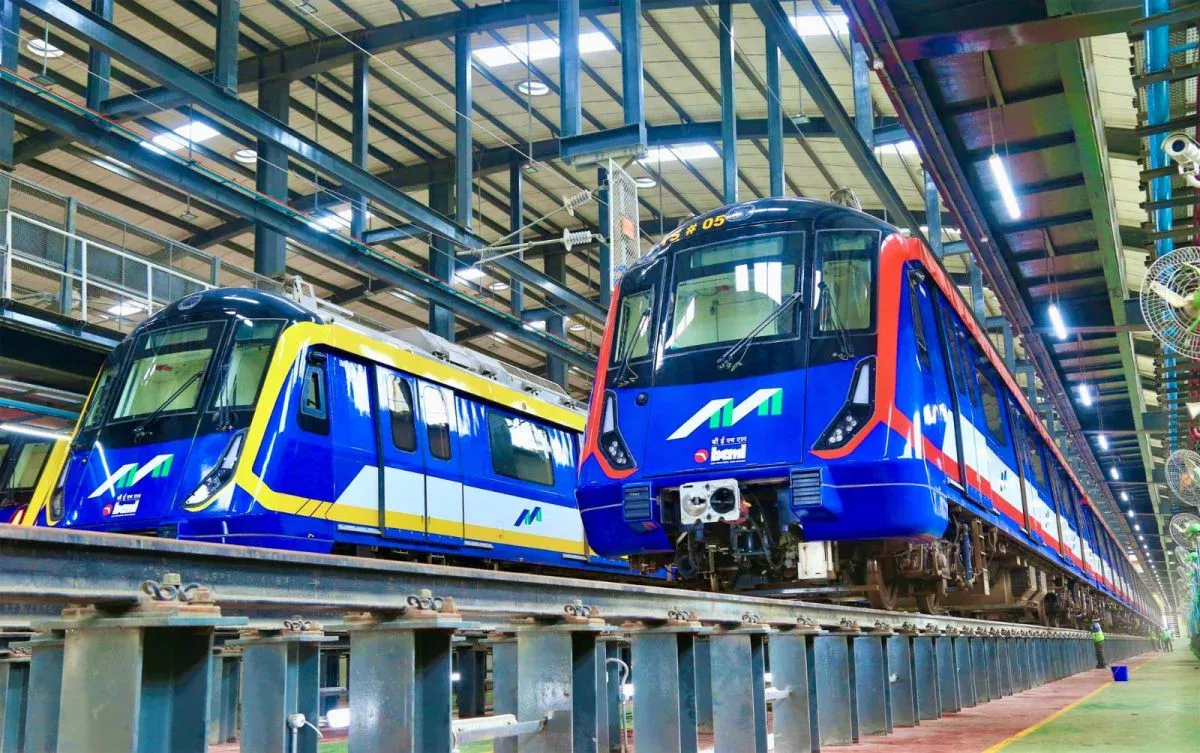
Mumbai’s eastern metropolitan belt could see a wider rapid transit footprint as fresh proposals seek to extend Mumbai Metro Line 5 beyond its under-construction corridor linking Thane, Bhiwandi and Kalyan. The suggested expansion, currently under review by regional planners, aims to strengthen connectivity across fast-growing residential clusters while easing mounting pressure on suburban rail and arterial roads.
During a recent infrastructure review, a senior Member of Parliament from the region proposed a phased Mumbai Metro Line 5 expansion through two additional spurs. One alignment would branch from Durgadi Naka, moving across Kalyan and Ulhasnagar towards Ambernath, with a potential onward link to Badlapur. A second spur has been suggested towards Titwala to distribute commuter load more evenly across the network.Officials from the Mumbai Metropolitan Region Development Authority are expected to undertake feasibility assessments, including ridership projections, land requirements and financial viability. Urban transport analysts note that the Mumbai Metro Line 5 expansion reflects a broader shift in planning priorities — from core city capacity augmentation to integrating peripheral growth centres within the metropolitan transit grid.
The Kalyan-Ambernath-Badlapur stretch has witnessed significant housing absorption in recent years, driven by relatively affordable property prices and improved road connectivity. However, daily commuting still relies heavily on the Central Railway suburban network, which remains among the most crowded rail systems in the world. Extending metro connectivity into these nodes could reduce last-mile road congestion and shorten commute times for thousands of workers travelling towards Thane and Mumbai’s employment hubs.The review meeting also assessed progress on Metro Lines 12 and 14, both of which are positioned to improve east–west and inter-district travel. Suggestions were made to examine further extensions within Thane district to ensure better intra-city connectivity, particularly for dense neighbourhoods that currently depend on buses and shared transport.
One notable idea under consideration is the development of select corridors as vertically stacked transport spines. Such double-decker configurations would combine ground-level roads, flyovers and elevated metro viaducts within the same right of way. Transport planners say this approach can optimise land use in built-up areas where acquisition is complex and costly, though it requires careful structural design and pedestrian integration.If implemented, the Mumbai Metro Line 5 expansion could reshape commuting patterns across the northeastern metropolitan arc. Experts caution, however, that expansion must be matched by integrated station planning, non-motorised transport access and affordable fare structures to maximise social and environmental returns.As the Mumbai Metropolitan Region continues to absorb population growth, the next phase of metro planning will test how effectively transport investments align with housing, jobs and climate goals. Detailed studies and funding approvals will determine whether these proposed extensions translate into a more connected and resilient urban region.
Mumbai Metro Line 5 expansion proposed
