


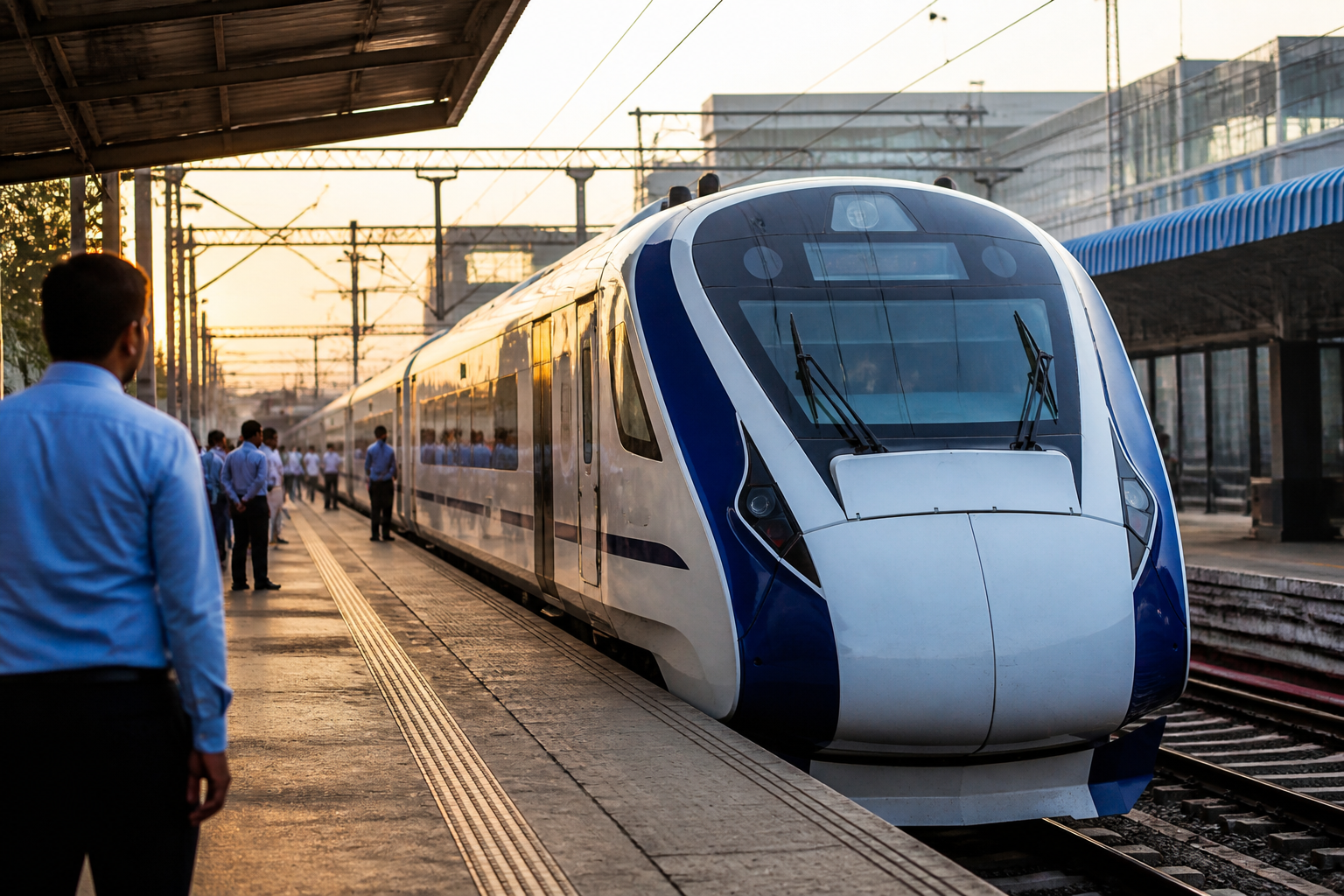
Vande Bharat Express is more than a faster train. Its arrival marks a structural change in how Indian Railways designs, powers and operates premium passenger services, moving from locomotive-hauled coaches towards self-propelled trainsets with distributed power, faster acceleration, integrated passenger systems and higher levels of domestic manufacturing.
That shift places Vande Bharat within a longer sequence of railway technology changes. Rajdhani Express broke a long-standing speed ceiling for Indian Railways in 1969. Shatabdi Express later established a faster and more comfortable model for daytime inter-city travel. Vande Bharat, introduced in 2019, built on both developments while changing the underlying engineering architecture of the train itself.
The significance of this transition is not limited to travel time. It involves the relationship between train design, track capacity, signalling, safety systems, passenger expectations and the ability of Indian manufacturers to develop increasingly complex rolling stock. The next stage, according to the account by The Times of India, is an indigenously designed high-speed train capable of 280 kmph for the Mumbai-Ahmedabad high-speed rail corridor.
## From speed ceiling to premium rail network
When the first Rajdhani Express began operating between New Delhi and Howrah in 1969, it represented a major change in Indian railway operations. The train covered 1,445 km in about 17 hours and 20 minutes, with three stoppages, at a speed of 120 kmph. Its introduction followed research by the Research Designs and Standards Organisation, or RDSO, into raising speeds on broad-gauge routes.
The source report states that the maximum operating speed on broad-gauge routes had been limited to 96 kmph. RDSO began a systematic study in 1960, and the Railway Board accepted recommendations in June 1968 that speeds on the Delhi-Howrah route could be increased without large-scale capital investment in tracks, bridges or signalling. Test and prototype rakes were run across the route once a month for eight months, with trials reaching 136 kmph.
The achievement was therefore not simply the launch of a premium train. It showed how changes in operating standards, testing and track performance could create a new class of inter-city service without rebuilding the entire railway network. Sudhanshu Mani, the retired ICF general manager who later led the Vande Bharat project, described the Rajdhani introduction as a watershed moment because track technology was improved to enable trains to run at 130 kmph. Tracks supporting the service came to be known as “Rajdhani-standard track”, he said in comments cited by TOI.
Rajdhani also established a service model built around overnight travel, air-conditioning, reserved accommodation and onboard provisions such as linen. The train connected the national capital with major cities while creating a branded benchmark for long-distance passenger travel.
Shatabdi Express, introduced in 1988, extended this model in a different direction. It was fully air-conditioned and fully reserved, with speeds reaching 140 kmph. Its daytime operation and chair-car design made faster inter-city travel possible on shorter and medium-distance routes. According to G Raghuram, advisor at The Infravision Foundation, Rajdhani and Shatabdi offered relatively faster travel than Mail and Express trains, while their brands allowed greater attention to service standards.
The two services also demonstrated that train technology and service design could be used together. Speed alone was not the only differentiator. The experience of reserved seating, air-conditioning, limited stops and a recognisable service identity became part of the value offered by premium rail travel.
## Vande Bharat changes the train architecture
Vande Bharat introduced the next major change in 2019. Originally called Train 18, the 16-coach all-air-conditioned trainset was designed and rolled out in 18 months. Unlike Rajdhani and Shatabdi services, it did not require a locomotive to pull the coaches. It entered the semi-high-speed self-propelled trainset category and was designed to operate at speeds of up to 180 kmph, with the possibility of being upgraded to 200 kmph.
The difference is important because the train’s power is distributed across the trainset. The source report describes this as a major engineering change that allows faster acceleration and deceleration. This can reduce journey times by up to 45% on several corridors, although the effect depends on the route, station pattern, track conditions and operating constraints.
A locomotive-hauled train concentrates propulsion at one end. A distributed-power train can spread traction through the formation, reducing the delay between power application and movement across the coaches. Raghuram told TOI that this arrangement improves acceleration and deceleration and can produce a smoother ride by reducing the transmission lag associated with locomotive-hauled trains.
The train’s passenger-facing features are part of the same technological package. Vande Bharat includes European-style seats, automatic doors, GPS-based passenger information systems, onboard infotainment, regenerative braking, sealed wider gangways and semi-permanent jerk-free couplers. Its suspension and mechanical design are intended to improve ride quality, while regenerative braking supports energy efficiency during operations.
The train also incorporates provision for KAVACH, India’s indigenous Automatic Train Protection system, which is certified to Safety Integrity Level-4. The source report says that Vande Bharat 3.0 can accelerate from zero to 100 kmph in about 52 seconds and offers lower noise and vibration levels. Around 90% of the trainsets and their systems are manufactured locally, according to the report.
This combination of trainset architecture, onboard systems and local production is why Vande Bharat represents a different kind of change from the introduction of a new branded service. It is a platform for developing capability across propulsion, braking, safety, interiors, passenger information and manufacturing.
## The institutional evolution behind the trains
The shift from Rajdhani to Shatabdi and then Vande Bharat was not a straight line. Indian Railways also introduced services such as Sampark Kranti, Duronto, Tejas and Humsafar, each addressing different combinations of route connectivity, stopping patterns and passenger amenities. These trains show that railway innovation has often taken place through experiments with both technology and service design.
The coach transition is equally important. Indian Railways initially used ICF-design coaches before adopting German Linke-Hofmann-Busch, or LHB, technology in 2003. The first LHB set was used for the Delhi-Mumbai Rajdhani. The source report notes that ICF coaches were non-telescopic, while LHB coaches added anti-climbing features designed to reduce the risk of coaches climbing over one another in a crash.
Indian Railways eventually stopped producing ICF-design coaches and moved towards LHB coaches and trainsets. This progression shows how safety standards and crashworthiness have developed alongside speed. A faster train cannot be assessed only through its maximum operating speed; its design must also address braking, couplers, suspension, coach integrity and the behaviour of the train in an accident.
Vande Bharat extends that process by integrating the coaches into a single trainset. Centrally controlled automatic plug doors and sealed gangways make the train function less like a group of separate coaches and more like a unified passenger system. The technological change is therefore visible both in the train’s external appearance and in its internal operating logic.
## Sleeper trains and the next manufacturing phase
The launch of the Vande Bharat sleeper variant in 2026 extends the trainset model to overnight travel. Two prototype rakes are reported to be operating between Howrah and Guwahati, while additional trainsets are being tested or manufactured. The sleeper version is intended to address a limitation of the original Vande Bharat, which was designed primarily for daytime journeys.
According to the source report, the sleeper trains are expected to offer passenger amenities and safety features superior to those of Rajdhani services. The report also states that about 260 Vande Bharat trains are expected to be rolled out in the coming years, covering high-density railway networks at speeds above 130 kmph and potentially reaching 160 kmph as the network is upgraded.
The manufacturing plan involves several institutions and companies. The first ten trainsets are being made by BEML in collaboration with ICF. Another 120 are assigned to Kinet, an Indo-Russian joint venture, and 80 to a BHEL-Titagarh Wagons consortium. ICF has also been tasked with producing 50 Vande Bharat sleeper trainsets, with more coaches and a full pantry for longer-distance overnight journeys.
These numbers indicate that the Vande Bharat programme is also an industrial policy exercise. Its success depends not only on whether trains can be built, but on whether production can be scaled, systems can be standardised, suppliers can support maintenance and the railway network can accommodate the resulting services.
## Why the network matters as much as the train
The history of premium trains shows that rolling stock can improve performance only when the surrounding railway system supports it. The Rajdhani programme required track studies and higher operating standards. Vande Bharat’s benefits similarly depend on track quality, signalling, safety systems, station layouts, maintenance arrangements and the number of stops on a route.
A train capable of 180 kmph does not automatically deliver an 180 kmph journey. Average speed is influenced by acceleration, deceleration, curves, crossings, congestion, signalling and station dwell times. Vande Bharat’s distributed power can make acceleration and braking more effective, but the network still determines how much of that capability can be used.
This is also why the source report connects Vande Bharat to India’s planned bullet trains. BEML is manufacturing an indigenously designed and developed high-speed trainset capable of 280 kmph, with trials expected in early 2027. The contract, valued at Rs 866.87 crore, covers two prototype bullet trains for the Mumbai-Ahmedabad high-speed rail corridor. A section of that corridor is scheduled to open in August 2027, according to the report.
The move from Vande Bharat to bullet trains represents a further increase in speed, but it also involves a more specialised infrastructure environment. The evidence supplied does not establish the full operating model or network-wide implications of that corridor. It does establish a sequence: India is moving from improving conventional broad-gauge services to developing trainsets for semi-high-speed and high-speed operations.
The larger urban question is how these technologies will reshape the geography of inter-city mobility. Rajdhani connected the national capital with major cities, Shatabdi strengthened daytime regional links and Vande Bharat is being deployed across high-density networks. Their public value will depend on how effectively faster services connect cities, how many passengers can access them and whether improvements extend beyond premium corridors.
The evidence confirms a significant technological progression in Indian Railways: from ICF coaches to LHB coaches, and from locomotive-hauled services to distributed-power trainsets. It also shows that the next phase is being built through domestic manufacturing partnerships, new sleeper configurations and a planned high-speed train. What remains to be established is how quickly these systems can be deployed at scale and how consistently the wider network can support their promised performance.
