


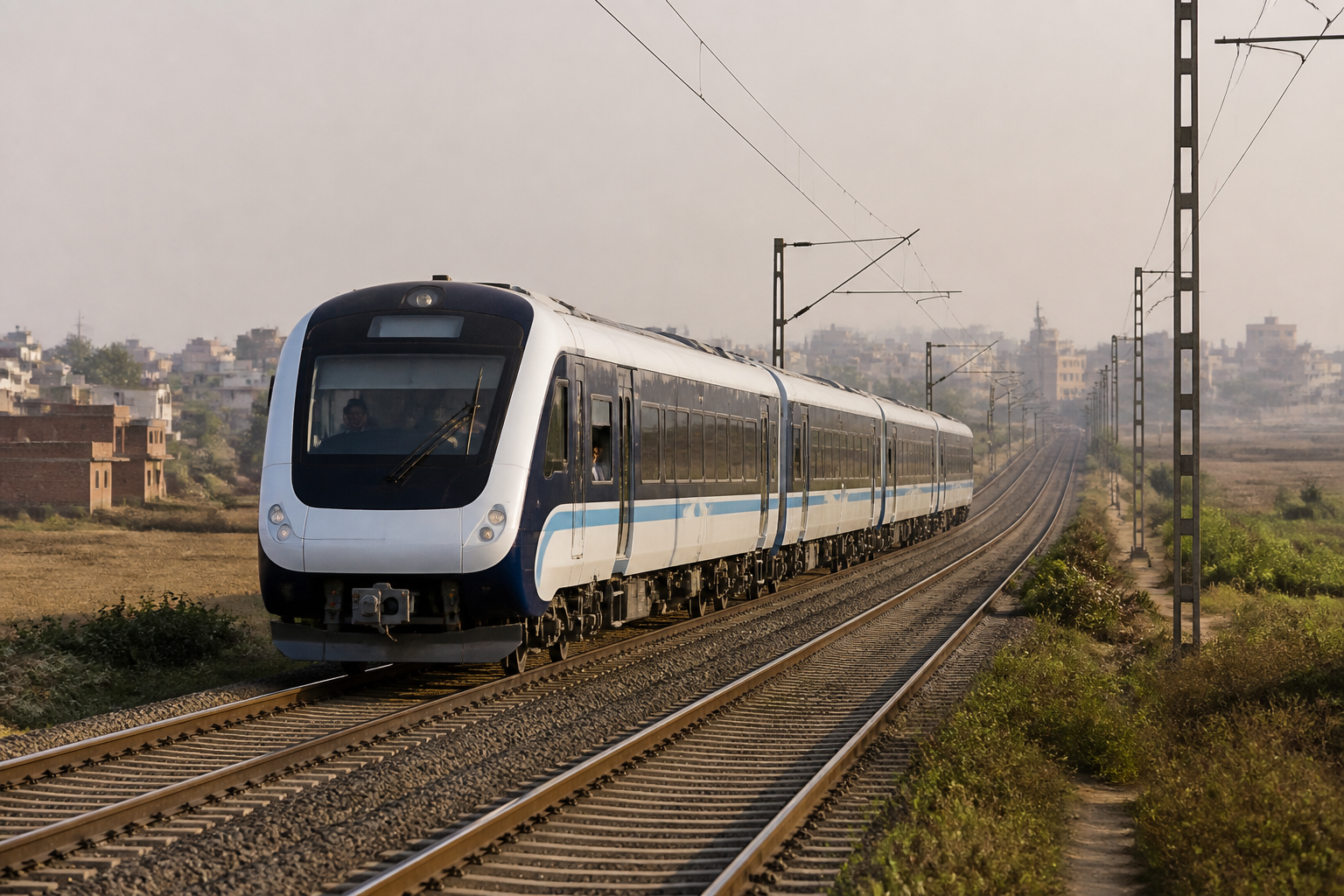
India’s hydrogen train has completed two months of operations on the 89-km Jind-Sonipat route, demonstrating that the technology can run in regular service but exposing a more basic transport problem: a technically advanced train cannot create demand on a weak passenger corridor. With only around 40 to 60 passengers reportedly travelling over the entire journey despite a maximum capacity of 2,600, Indian Railways is now considering extending the service towards Delhi.
That proposed extension changes the question from whether India can operate a hydrogen-powered train to whether the train has been placed on a route where its capacity, frequency and operating model match actual travel needs. The train was launched on July 17 as India’s first indigenous hydrogen-powered train and has been described by railway officials as a pilot project and technology demonstrator. Its successful operation is therefore an important engineering milestone, but the Jind-Sonipat experience also shows that clean propulsion is only one part of a viable passenger railway.
The current service replaced a DEMU train that had previously operated on the same route. Railway staff told the Press Trust of India that the earlier service had also recorded similarly low passenger numbers. Three other DEMU trains continue to operate on the corridor, and staff said none has attracted high passenger turnout. The reported pattern suggests that the low occupancy is not simply a consequence of the hydrogen train being new, unfamiliar or expensive to operate. The corridor itself appears to have limited daily demand under its present alignment and service pattern.
According to railway staff, the route does not connect significant concentrations of office commuters or industrial workers between Jind and Sonipat. Local passengers have consequently asked that the train be extended to Delhi, where a larger pool of commuters could make better use of its capacity. The proposal is being examined through trial runs and operational reviews, with a possible extension to Azadpur station near Delhi’s wholesale fruits and vegetables market.
The institutional significance of this proposal is that it places a technology pilot inside an existing commuter network rather than treating it as a closed demonstration. A train can prove that hydrogen fuel cells, onboard systems and railway operations work together, but passenger value depends on where the train stops, how often it runs, how it connects with other services and whether its seating and standing capacity fit the corridor. The figures from Jind-Sonipat underline that distinction. The train has reportedly operated successfully, but it has made only one round trip a day because of low ridership, although two return trips were initially expected.
The train’s physical design also creates a capacity question for any Delhi extension. It has 10 coaches and can carry up to 2,600 passengers, while a senior railway official said trains operating from Delhi need more than 18 to 20 coaches because of capacity constraints on the tracks. This does not establish that the hydrogen train cannot be extended, but it shows that the service would enter a corridor with different passenger volumes and infrastructure pressures from those on the existing route.
The operational problem is not limited to passenger capacity. Officials said the train can travel between 250 km and 300 km on a full tank, while the distance between Jind and Delhi is approximately 130 km. On the current fuel range, it can cover around 150 km in one direction. Refuelling is presently available only at Jind. The reported range may therefore be sufficient for a single movement towards Delhi, but the location and availability of refuelling infrastructure would remain part of the operating decision, particularly if the service is expected to make a return journey or undertake multiple trips.
This is where the hydrogen train becomes a governance and network-planning story rather than only a clean-technology story. The railway system must decide whether the pilot’s primary purpose is to demonstrate indigenous technology, provide a useful passenger service, or do both. Those objectives can overlap, but they do not automatically produce the same route. A technology demonstrator may be able to operate on a lightly used section, while a passenger service needs a market, convenient timings and adequate interchange with the wider network.
Railway officials have indicated that safety remains paramount and that a decision on the extension will be taken after due consideration. A group of experts is monitoring operations between Jind and Sonipat as well as trial runs for the Delhi extension. The supplied report does not provide a final approval, timetable, fare structure, capital cost or confirmed operating date for service to Delhi. The proposal therefore remains under consideration rather than an announced expansion.
The route alternatives suggested by local passengers point to another planning possibility. Instead of extending the train directly towards Delhi, the existing alignment could be converted into a circuit linking Jind, Sonipat, Panipat and Safidon before returning to Jind. One passenger suggested an approximately 180-km circuit, arguing that Panipat’s industrial activity could attract daily commuters and improve occupancy.
That suggestion highlights the importance of matching transport routes with actual urban and economic geography. The current Jind-Sonipat line may not pass through enough employment destinations to support strong two-way commuter flows. A route that includes an industrial area could serve a different travel market, although the supplied material does not establish whether the proposed circuit is operationally feasible, financially viable or compatible with existing railway traffic. It remains a local suggestion, not an approved plan.
The hydrogen train’s low ridership also complicates how success should be measured. As a pilot, it has reportedly achieved a significant technical objective: running the country’s first indigenous hydrogen-powered train in regular railway operations. Railway officials described it as the world’s longest and highest-powered hydrogen train, and placed India among a small group of countries, including Germany, Japan, China and the United States, exploring hydrogen-powered rail transport. Those claims establish the project’s technology and demonstration value, but they do not by themselves demonstrate that hydrogen is the most suitable propulsion option for every passenger corridor.
A passenger railway must be assessed through several connected measures. Reliability and safety determine whether it can run consistently. Range and refuelling determine how easily it can be scheduled. Coach capacity and track availability determine whether it can serve peak demand. Route design and station access determine whether people choose it over other modes. The Jind-Sonipat experience, as described by officials and railway staff, brings these measures together: the train is functioning, but the corridor is not generating enough passengers to support the originally planned frequency.
The case also shows why clean transport projects cannot be separated from land use and employment patterns. The report identifies a lack of office commuters and industrial workers between the two cities as a key reason for low turnout. In other words, the problem is not only railway supply. It is the spatial distribution of jobs and activities along the route. Extending the train to Delhi or routing it through Panipat would seek to connect the service to stronger destinations, but the evidence available so far does not show whether those changes would create sustained demand.
For Indian Railways, the next decision will involve balancing the visibility of a national technology project with the practical requirements of daily operations. Extending the train could improve its public utility if it connects more useful destinations. It could also introduce new constraints if the train’s 10-coach formation, one-way range, refuelling arrangements or track capacity do not fit Delhi-bound operations. The official monitoring process is therefore central to the project’s next phase.
The evidence currently confirms three things. India’s hydrogen train has been operating successfully as a pilot on the Jind-Sonipat route; passenger use has been very low compared with its stated capacity; and railway officials are examining an extension towards Delhi while considering safety and operational limitations. What remains unsettled is whether the final route will be Delhi-bound, circuit-based or unchanged, and whether any expansion will include the frequency and infrastructure needed to make the service useful.
The larger urban lesson is straightforward: cleaner propulsion can improve the environmental profile of transport, but it cannot substitute for route planning. The hydrogen train’s next test will not be only whether it can move without conventional diesel power. It will be whether the railway can place that capability within a corridor where people need to travel, trains can be scheduled efficiently and infrastructure can support the service.
