


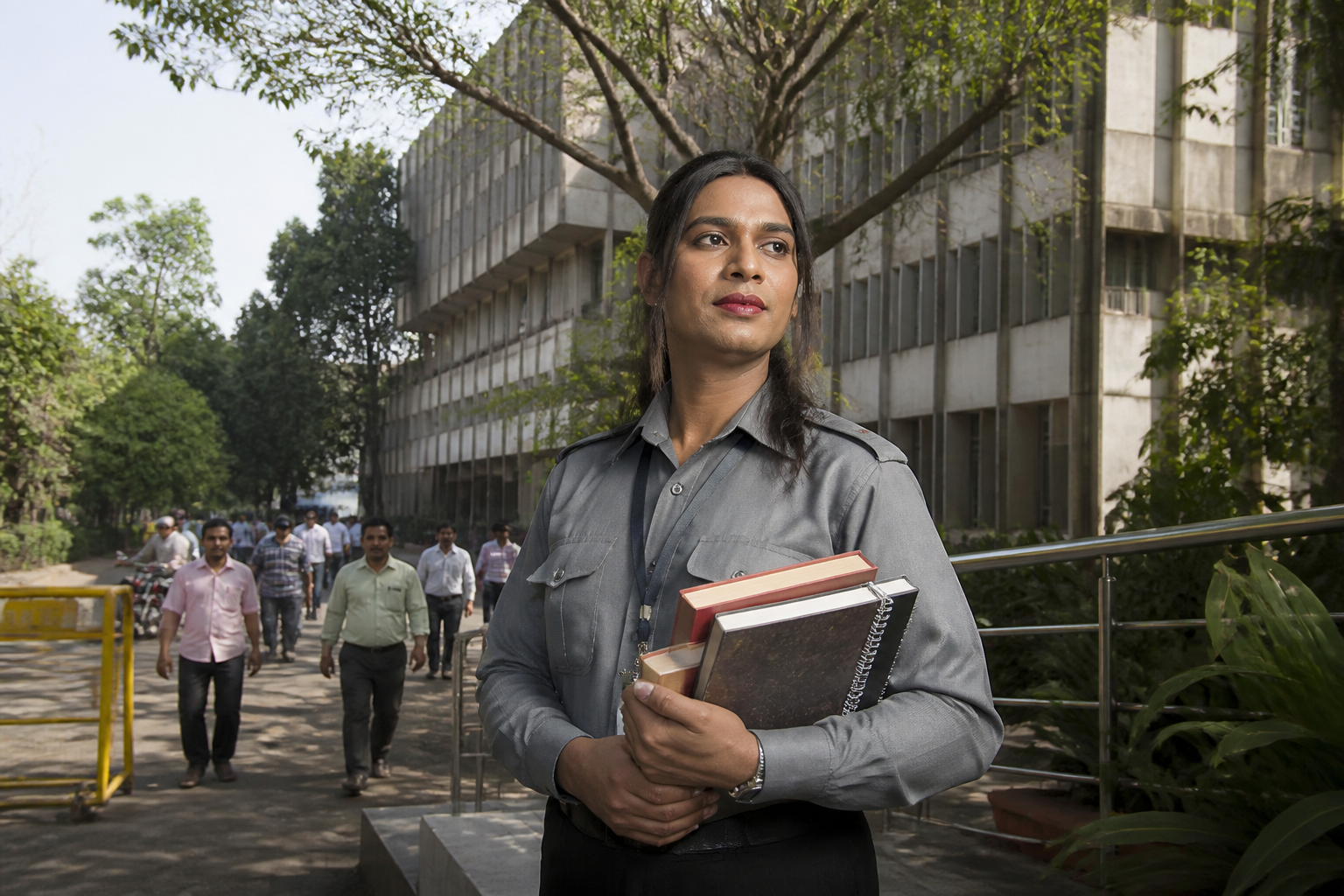
Vaidehi Wadekar’s journey from begging on Pune’s streets to working as a security guard with the Pune Municipal Corporation and studying law is more than a story of individual resilience. It reveals how access to dignified work in a city can depend on whether institutions are prepared to recognise identity without turning it into a barrier.
Wadekar is a second-year BA LLB student at SNBP College in Pimpri-Chinchwad. Alongside her studies, she works as a security guard at the PMC and participates in sensitisation programmes with the Pune police. Her work includes helping members of the transgender community understand their legal rights and encouraging wider society to move beyond stereotypes, according to a report by The Indian Express.
The significance of her present role lies partly in the institution she works for. A municipal corporation is not only an administrative employer. It is also one of the most visible public institutions in a city, responsible for civic services and public-facing establishments. When a transgender person works within such an institution, the question is not simply whether one individual has found employment. It is whether public systems can provide a workplace in which dignity is not conditional on conformity.
Wadekar’s earlier experience shows why that question matters. She was pursuing BTech in Nagpur when her walk, voice, mannerisms and body language became targets of ridicule from classmates and others around her. The report describes bullying and a lack of acceptance as factors that eventually led her to leave the city and come to Pune.
This part of the account places education at the centre of the employment question. Wadekar had entered a technical degree programme, but the formal opportunity to study was not enough to ensure that she could remain in the institution. The social environment around her became a barrier to continuing. Her experience suggests that access to education cannot be measured only by admission or enrolment. It also depends on whether students can move through classrooms and campuses without being subjected to humiliation because of their identity.
After arriving in Pune, Wadekar had no stable source of income or support and began begging outside shops and on the streets. She told The Indian Express that she wanted to be a woman and not a beggar. Her account connects identity, livelihood and dignity in direct terms: the absence of stable and accepting employment can push people into forms of work they did not choose, even when they are seeking a different path.
The report also records Wadekar’s description of the limited job roles available to transgender women and of circumstances that, in her words, can lead to begging, prostitution and performing at functions. She said that people in positions of authority within community structures also demanded a certain amount from those earning through such activities. These claims are presented as her account of the conditions she encountered and should not be generalised into a description of every transgender person’s experience. They do, however, show how constrained livelihood choices can become when mainstream employment remains inaccessible.
Pune’s role in this story is therefore not incidental. The city provided the setting in which Wadekar moved between street survival, private-sector employment, municipal work and legal education. Each transition depended on an institution or individual making space for her. An NGO helped her secure a job at a multinational company, where she eventually became a team leader and worked for nearly two years. The intervention was important because it connected her to formal employment rather than treating her circumstances only as a welfare issue.
But that opportunity also exposed the fragility of workplace inclusion. When the company’s administration changed, Wadekar said the workplace lost the sensitisation and understanding needed to create an inclusive environment for transgender and LGBTQ+ employees. She resigned rather than return to a situation in which, as her experience conveyed, dignity had become negotiable.
This is an institutional problem rather than simply an interpersonal one. Inclusion that depends on a particular manager, administration or internal champion can weaken when personnel change. For a workplace to remain accessible, acceptance has to be reflected in everyday systems: recruitment, supervision, grievance handling, professional progression and the treatment of identity at work. The supplied report does not establish whether such formal mechanisms existed at the company or at the PMC. It does show that sensitisation was decisive in Wadekar’s experience and that its absence affected her ability to remain in a job.
Her current position with the PMC places this issue inside the public sector. The report does not provide details about the recruitment process, her employment terms, the number of transgender employees in the civic body or any formal PMC policy. Those details would be necessary to assess whether her case reflects a broader institutional shift or remains an individual exception. What is established is that she now works in a municipal establishment while pursuing a law degree and engaging with the police on rights awareness.
That combination of work and study also changes how the city’s institutions are connected. Wadekar is not only receiving support from an organisation or holding a job. She is acquiring legal knowledge and using it in sensitisation work. Her role links employment, education, policing and access to rights. The institutional value of such work is practical: a person who has experienced exclusion can help explain legal rights to others who may not know how to approach formal systems.
The police sensitisation programmes described in the report are another important part of the urban picture. Police stations are among the institutions through which residents encounter the state, often during moments of vulnerability or conflict. The report does not specify the number of programmes, participating officers or outcomes, so their broader impact cannot be measured from the available material. It does establish that Wadekar is working with the Pune police to help members of the transgender community understand their legal rights and to encourage broader social acceptance.
Her story also raises a question about what cities mean by livelihood inclusion. Employment is often discussed as an economic outcome, but Wadekar’s experience shows that work is also tied to social recognition. She moved from begging to a private-sector leadership role, then left that job when the workplace became less sensitised, and later found a position with the PMC. The sequence indicates that obtaining a job is only one part of inclusion. Retaining it in a respectful environment is equally important.
The account further complicates the idea that formal qualifications automatically protect people from exclusion. Wadekar was pursuing BTech before leaving Nagpur. She is now studying law while working as a security guard. Her educational path demonstrates determination, but it also points to the uneven relationship between qualifications and opportunity. A person may have the ability to study, work and advance, yet still face barriers created by ridicule, institutional insensitivity or a narrow understanding of who belongs in a workplace.
For urban policy, the central lesson is not that individual courage can overcome structural barriers. Wadekar’s progress became possible through a series of openings: an NGO connection, a job in the private sector, access to municipal employment, a college place and participation in police sensitisation. The story does not say how many people without those openings remain excluded. That absence is itself a limit of the available evidence and a reason not to treat one successful trajectory as proof that the wider system is inclusive.
The strongest evidence in the report is therefore both personal and institutional. Wadekar’s testimony identifies the consequences of exclusion: leaving an educational institution, street begging and moving between unstable or unsupportive work environments. Her present roles show the value of public employment, education and rights-based engagement. Together, they demonstrate that the built and administrative life of a city is experienced through workplaces, colleges, police institutions and civic establishments—not only through roads, buildings or transport systems.
Pune’s public institutions now form the setting for the next stage of this story. Wadekar continues to work with the PMC, study law at SNBP College and assist police sensitisation programmes. The supplied report does not establish whether these experiences have produced formal policy changes or wider recruitment efforts. What it confirms is that dignity at work depends on more than being allowed through the door. It depends on whether the institution remains willing to make space after the door has opened.

