


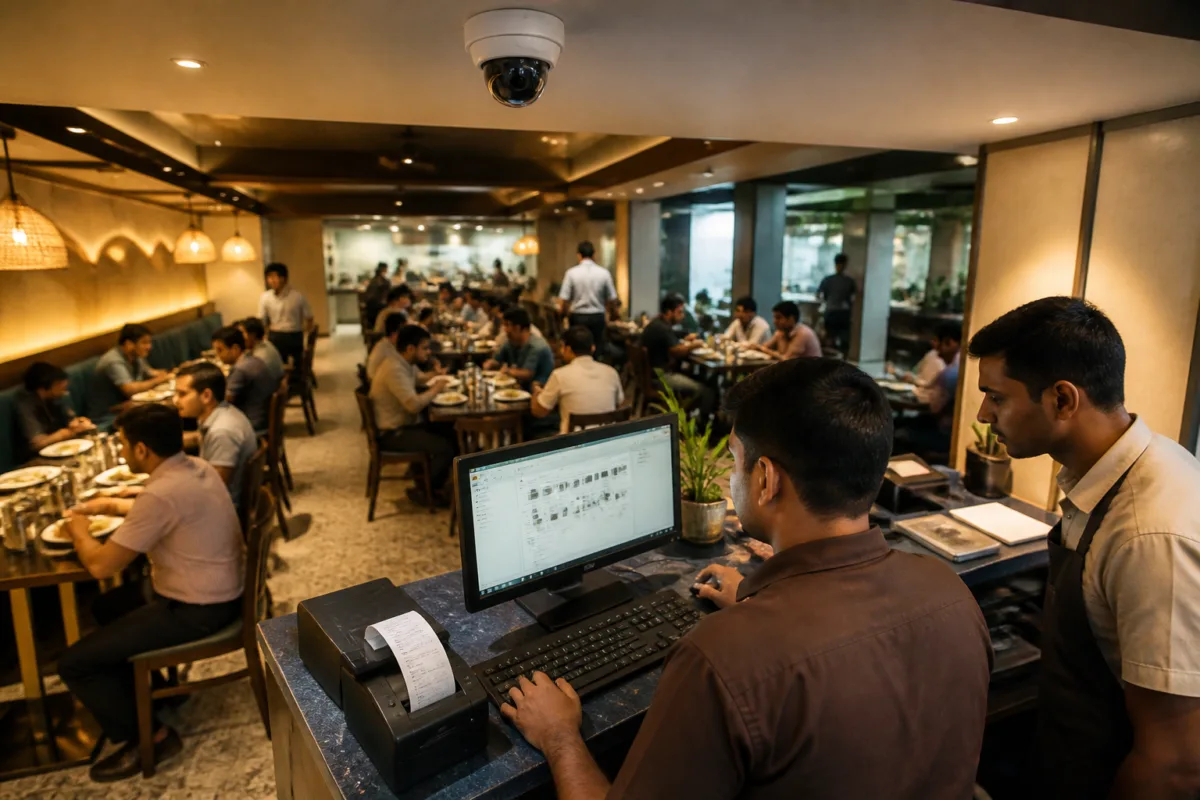
Businesses in Pune are beginning to use AI-assisted CCTV analysis not only for security, but also to monitor whether customers have paid their bills. The practice, reported by Punekar News through conversations with restaurant owners, illustrates how surveillance systems are moving into routine commercial operations—and how quickly questions about consent, accountability and personal data are following them.
The reported use is straightforward. During busy periods, restaurants and eateries may struggle to match customers, tables and payments. One business owner in Parvati Paytha told Punekar News that CCTV footage is uploaded to ChatGPT to identify a person suspected of not paying and generate a clearer image of that individual as a “defaulter”. Another restaurant owner said the business had not extensively used the method because its customers were generally honest, but that the technology could help track who had and had not paid during rush hours.
The significance lies less in the technical novelty of analysing an image than in the change of purpose. CCTV systems installed for security are being considered for payment monitoring and customer verification. In a city where restaurants, cafés and other high-footfall businesses routinely manage crowded interiors, this creates a new layer of operational surveillance that may not be visible to customers when they enter a premises.
The report places this development in the context of wider public use of artificial intelligence. Police and security authorities have deployed AI technologies to identify persons of interest in crowds during festive processions and rallies. Businesses are now exploring similar capabilities at a smaller scale, with a commercial objective rather than a public-security one. The shift shows how tools associated with crowd management can move into everyday transactions without requiring a large public infrastructure project or a dedicated technology department.
That low barrier to adoption is important. A business does not necessarily need to build a new surveillance network to experiment with AI-assisted monitoring. It may already possess CCTV footage and can use an external AI service to interpret it. The restaurant owners quoted in the report describe the technology as a way to pursue security and payment certainty without taking significant costs out of the business. This makes AI attractive to small and mid-sized establishments that may not have the resources to deploy specialised payment-monitoring systems.
But the same accessibility complicates oversight. When footage is uploaded to an external platform, the business is no longer dealing only with cameras, storage equipment and internal staff. The image may become part of a wider digital processing chain. The supplied report does not establish how long the footage is retained, who can access it, whether customers are informed, whether the images are deleted after a payment dispute is resolved, or whether a person identified as a suspected defaulter can challenge the conclusion.
Those unanswered questions matter because an AI-generated image or assessment is not the same as proof of non-payment. A crowded restaurant can produce obstructed views, incomplete footage and confusion between customers. A person may leave while another member of a group settles the bill. A payment may be made digitally after the customer has moved away from the table. The report does not provide evidence about the accuracy of the method, and the restaurant owners’ comments indicate that the technology is being explored rather than presented as a verified payment system.
The central risk, therefore, is not simply that a camera observes a customer. It is that an uncertain observation may be converted into a reputational label. The term “defaulter”, used in the reported account, carries consequences beyond the immediate transaction. If an image is shared among staff, circulated to other businesses or retained for future identification, a payment dispute could become a continuing record attached to an individual. The source material does not say that such sharing has occurred in Pune, but the possibility explains why the reported practice deserves scrutiny before it becomes routine.
## What AI CCTV payment monitoring changes
Traditional payment reconciliation is generally tied to bills, receipts, point-of-sale records and staff verification. AI-assisted CCTV analysis adds a visual layer: it attempts to connect a person in an image with a payment event. That can appear efficient during rush hours, but it also changes the relationship between a business and its customers. The customer is no longer only making a purchase; their movements and appearance may be assessed to resolve an accounting question.
This can blur the line between security and service delivery. A camera originally installed to deter theft may be repurposed to investigate a suspected unpaid bill. A system intended to record an incident may become a tool for identifying people who have not been formally accused of wrongdoing. The distinction is important for governance because the purpose for which data is collected often shapes how it should be accessed and used.
The source report does not indicate whether Pune’s restaurants have adopted common standards for this process. There is no information in the supplied material about uniform notices, consent procedures, retention periods, audit logs, access controls or a complaint mechanism. That absence should not be read as proof that no safeguards exist at individual establishments. It does show, however, that the practice is developing through business-level experimentation rather than through a publicly described citywide framework.
For customers, the practical experience may be difficult to assess. A CCTV camera is usually visible, but the use of artificial intelligence to interpret footage may not be. A person entering a restaurant may understand that security cameras are operating without knowing that images could be uploaded to an AI service for payment-related analysis. The difference between being recorded and being algorithmically assessed is central to the privacy question raised by this development.
## The legal framework mentioned in the report
Punekar News refers to India’s Digital Personal Data Protection Act, 2023, and the Digital Personal Data Protection Rules, 2025, as establishing a framework for processing and protecting digital personal data. The supplied report does not analyse how specific provisions apply to restaurant CCTV footage, AI-generated images or payment disputes. It therefore cannot establish whether a particular business practice is compliant or non-compliant.
What the legal reference does establish is that the use of customer footage is not merely a matter of convenience or internal management. It sits within a broader framework concerning the handling and protection of digital personal data. For businesses, that raises institutional questions: who is responsible for deciding the purpose of processing, how is access controlled, and what happens when an image is sent to an external technology platform?
The report also does not identify the AI service’s data-handling terms or explain whether the businesses involved have formal arrangements governing uploaded footage. That information would be necessary to assess the full chain of responsibility. A restaurant may control the camera, but an external platform may process the image. Without clarity on that relationship, customers may not know which entity holds the data or to whom concerns should be directed.
This is where a small operational decision becomes an urban governance issue. Digital systems increasingly sit inside ordinary spaces—restaurants, shops, transport hubs and housing complexes—while responsibility remains fragmented among property owners, technology providers, service operators and public regulators. The physical setting may be private, but the data generated within it can travel across several institutional boundaries.
## The evidence is early, but the pattern is significant
The evidence currently available is limited to a report based on conversations with business owners. It does not establish how widespread AI-assisted payment monitoring is across Pune, how many establishments use it, how often it produces a correct identification or whether customers have challenged its use. It also does not show that the practice is formally endorsed by the police, municipal authorities or any other public agency.
Those limitations are important. The reported examples should be understood as early signals of adoption, not as evidence of a citywide system. Yet the examples are still significant because they reveal the direction in which commercially available AI tools are being considered. A technology first associated in the report with police and security operations is now being discussed as a low-cost business-management aid.
The adoption logic is clear from the owners’ comments. Restaurants face periods of intense activity, and payment verification can become difficult when staff must manage multiple customers at once. AI-assisted review appears to offer a way to revisit footage after an incident rather than maintain continuous manual observation. That convenience may encourage more businesses to test similar applications, particularly if they believe the technology can improve security or reduce losses without major investment.
The institutional response, however, is not described in the supplied material. There is no reported statement from a data-protection authority, police department, municipal body or AI service provider on the specific practice. There is also no information on whether restaurants have been advised to use CCTV footage only for defined purposes or whether customers are notified when images are analysed.
That gap between adoption and public explanation is the central issue. Technology can enter a business faster than rules, staff training and customer-facing procedures can be developed. Once a workflow becomes normal, it may be harder to determine when footage was accessed, why it was used and whether a questionable identification influenced how a customer was treated.
## The bigger urban question
Pune’s reported experiment points to a wider transformation in the city’s built environment. Surveillance is no longer limited to cameras mounted in public places or systems managed by large institutions. It is becoming part of the operating infrastructure of everyday commercial spaces. The urban question is therefore not whether businesses should be allowed to use technology to protect revenue. It is how that use can remain proportionate, transparent and accountable when the technology analyses identifiable people.
The evidence confirms that at least some Pune businesses are exploring AI-assisted CCTV analysis for payment monitoring, while the legal and operational safeguards around the practice remain unclear in the supplied report. The next developments to monitor are whether more establishments adopt the method, whether businesses disclose how footage is processed, whether customers receive a way to contest misidentification, and whether regulators or technology providers issue clearer guidance on the use of AI in commercial surveillance.

