


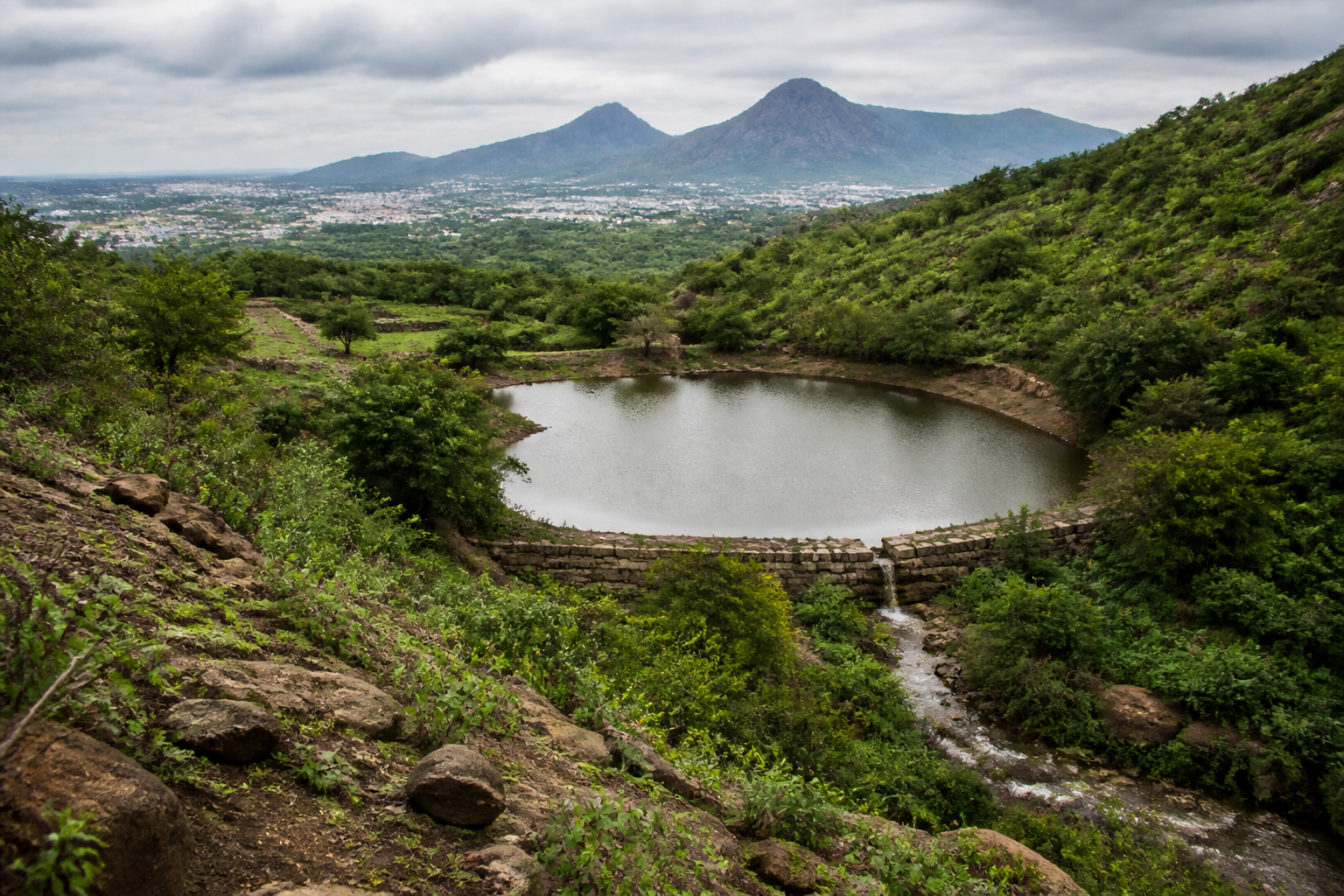
Tamil Nadu’s planned restoration of 962 hectares in the Tiruvannamalai hills is being presented as an ecological programme, but its immediate importance is more practical: how a fragile hillside absorbs rain, controls runoff and protects settlements below. The ₹10 crore project will divide the landscape into 16 micro-watersheds and use a ridge-to-valley approach to address soil erosion, poor drainage, forest fires, disappearing vegetation, silted water bodies and landslide risk.
The proposal follows a fatal landslide during Cyclone Fengal on December 1, 2024. According to Anwardeen, director of the Green Tamil Nadu Mission, heavy rain loosened the soil and caused a large boulder and mud to hit a house, killing seven members of a family. Samples were subsequently collected from the Annamalaiyar Hills to assess the possibility of further landslides.
That sequence places the project within a wider urban and regional challenge. Tiruvannamalai is a temple town, but the risks described in the report are not confined to the hill slopes. Water flowing through degraded catchments affects ponds, drainage channels, roads, homes and public spaces downstream. A failure on the hillside can therefore become a disaster-management problem for the settlement below. Restoring the hills is also an attempt to repair the infrastructure of water movement before extreme rainfall turns it into a hazard.
The project’s design is significant because it treats the hills as a connected watershed rather than as a collection of isolated sites. Under the ridge-to-valley approach, work will begin at the upper slopes and move down towards the valleys. Satellite mapping, drone surveys and detailed studies of land conditions, water flow and landslide risk will be used to determine where interventions are required.
The work is planned in stages. The first phase will focus on the most vulnerable locations and slope stabilisation. The second will address the wider watershed and repair water-harvesting structures. The final phase is intended to restore the area’s natural ecology on a larger scale. This sequence recognises that planting trees or repairing a pond alone cannot resolve a landscape problem if water continues to rush down unstable slopes.
Five ponds are due to be repaired through desilting, work on overflow channels and embankments, and treatment of the streams feeding them. Anwardeen said these measures could add approximately 3,341 cubic metres of water-storage capacity. The stated purpose is not only to retain more rainwater but also to help the landscape absorb rainfall and reduce the conditions that contribute to landslides.
That connection between water storage and slope safety is central to understanding the programme. A pond is often treated as a standalone water asset, while a check dam, trench or planted slope may be treated as a separate construction activity. In a functioning watershed, however, each element affects the others. The location and condition of an embankment influence how quickly water moves; the condition of a slope affects how much sediment reaches a pond; and the capacity of a pond affects where excess water flows during heavy rain.
The proposed spending plan reflects this integrated approach, although it also shows that ecological restoration depends on a mix of biological and physical interventions. The largest allocation, ₹2.5 crore, is for planting native trees and restoring ecology. Another ₹2 crore is earmarked for structures such as check dams and trenches to control runoff. ₹3 crore is planned for fire-prevention work and the repair of ponds and water bodies. The remaining funds will cover grassland restoration, natural slope-stabilisation methods, surveys, community involvement and maintenance.
The allocation also reveals a key implementation issue: restoration does not end when construction is completed or saplings are planted. The project includes maintenance as a budgeted activity, but the report does not specify the duration, agency responsibilities or performance indicators for that maintenance. Those details will matter because the risks identified in the hills—fire, erosion, clogged water bodies and disappearing vegetation—are recurring processes rather than one-time defects.
## From hill restoration to urban resilience
The Green Tamil Nadu Mission’s role, as described by Anwardeen, extends beyond the Tiruvannamalai project. The mission has undertaken initiatives ranging from urban afforestation to large-scale ecological restoration. It has partnered with the municipal administration and the water supply department on greening projects in urban local bodies, while also developing green corridors along state and national highways.
This institutional spread matters because ecological systems do not follow administrative boundaries. A hillside may fall under one set of departments, a pond under another, a road under a highways agency and an urban drainage network under a municipality. The Tiruvannamalai plan brings several of these concerns into one landscape: slope stability, water harvesting, fire prevention, biodiversity and disaster preparedness.
The report also mentions tree censuses and efforts to improve urban biodiversity across Tamil Nadu. These initiatives point to a shift from treating greenery as an aesthetic addition towards viewing vegetation as part of urban infrastructure. Trees, grasslands, ponds and drainage channels perform different functions, but together they influence heat, runoff, soil retention and the resilience of settlements.
The same logic appears in the mission’s other proposed or ongoing programmes. Ecological restoration across the Eastern Ghats is being pursued across nine districts, with a focus on restoration and tribal livelihoods. A bamboo restoration project in Dharmapuri combines ecological work with resource development and livelihood generation. The state has also proposed restoring and creating mangroves across 2,500 hectares, while mangrove-based interventions are being used in the restoration of the Buckingham Canal.
These examples are not identical to the Tiruvannamalai project. Mangroves address coastal ecosystems, bamboo restoration combines ecology with resource use, and hill restoration focuses on slopes and watersheds. But together they show an emerging policy pattern: nature-based work is being linked to water security, disaster resilience, biodiversity and livelihoods rather than being treated only as tree planting.
## The evidence and its limits
The available project figures establish the scale of the proposal. The intervention covers 962 hectares, is divided into 16 micro-watersheds, includes five ponds and is estimated to cost ₹10 crore. The planned pond repairs are expected to create about 3,341 cubic metres of additional storage. The report also identifies the December 2024 landslide and its seven fatalities as the immediate human context for the work.
What the supplied material does not establish is how the 962 hectares were selected, how many households or public assets are located in the risk area, or what reduction in landslide risk the programme is expected to achieve. It also does not provide a timeline for completion, the names of implementing agencies for each component, or the baseline condition of the ponds and slopes. These gaps do not erase the significance of the project, but they define what must be tracked as implementation begins.
The use of satellite mapping, drone surveys and land and water-flow studies suggests that the authorities intend to base interventions on site-specific evidence. That is important in a terrain where a uniform solution can be counterproductive. A trench, check dam, plantation or embankment needs to respond to the slope, soil, drainage pattern and existing vegetation at that location. The report, however, does not disclose the technical findings from those surveys or the criteria that will determine the sequence of work.
The planned use of natural methods for slope stabilisation is another area requiring close observation. The project proposes both ecological restoration and physical structures, but the source does not specify which techniques will be used in which zones. Nor does it state how the programme will manage competing needs, such as access for visitors, protection of sacred landscapes, fire prevention and the conservation of existing habitats.
Community involvement is included among the smaller allocations, indicating that local participation is recognised as part of the programme. The report does not describe the proposed mechanism, the communities to be involved or how local knowledge will be incorporated into surveys and maintenance. Those questions are particularly relevant in a landscape where restoration measures may affect access, grazing, collection of forest resources or the management of water bodies.
## The larger governance question
The Tiruvannamalai project illustrates why urban resilience cannot be planned only within municipal limits. The town’s exposure to landslides and water stress is influenced by the condition of the hills above it. In turn, the success of hill restoration will depend partly on what happens downstream: whether repaired ponds remain connected to functioning channels, whether drainage infrastructure is maintained and whether new construction or land disturbance undermines the watershed approach.
It also demonstrates the difference between announcing an ecological project and managing a resilient landscape. The announcement provides a defined area, a budget, a set of interventions and a proposed sequence. The harder administrative task is sustaining coordination across departments and years, particularly after the visibility of the launch has faded. The project’s inclusion of maintenance, surveys and community involvement acknowledges that challenge, though the operational details remain to be seen.
For Tamil Nadu, the proposed work could become a useful test of whether ecological restoration can serve as a form of public safety infrastructure. Its stated objectives are closely connected: stabilising vulnerable slopes, slowing runoff, increasing water storage, reducing fire risk, restoring vegetation and protecting biodiversity. The project’s success will therefore need to be judged not only by the number of trees planted or ponds desilted, but by whether the entire watershed functions more safely during heavy rain.
The evidence currently confirms a substantial restoration plan shaped by a deadly landslide and supported by a ₹10 crore budget. It does not yet establish the delivery timeline, measurable risk reduction or long-term maintenance arrangements. The next important milestones will be the start of work, the release of site-level survey findings, the implementation of the five pond repairs and the monitoring of the 16 micro-watersheds as the programme moves from design to execution.
