


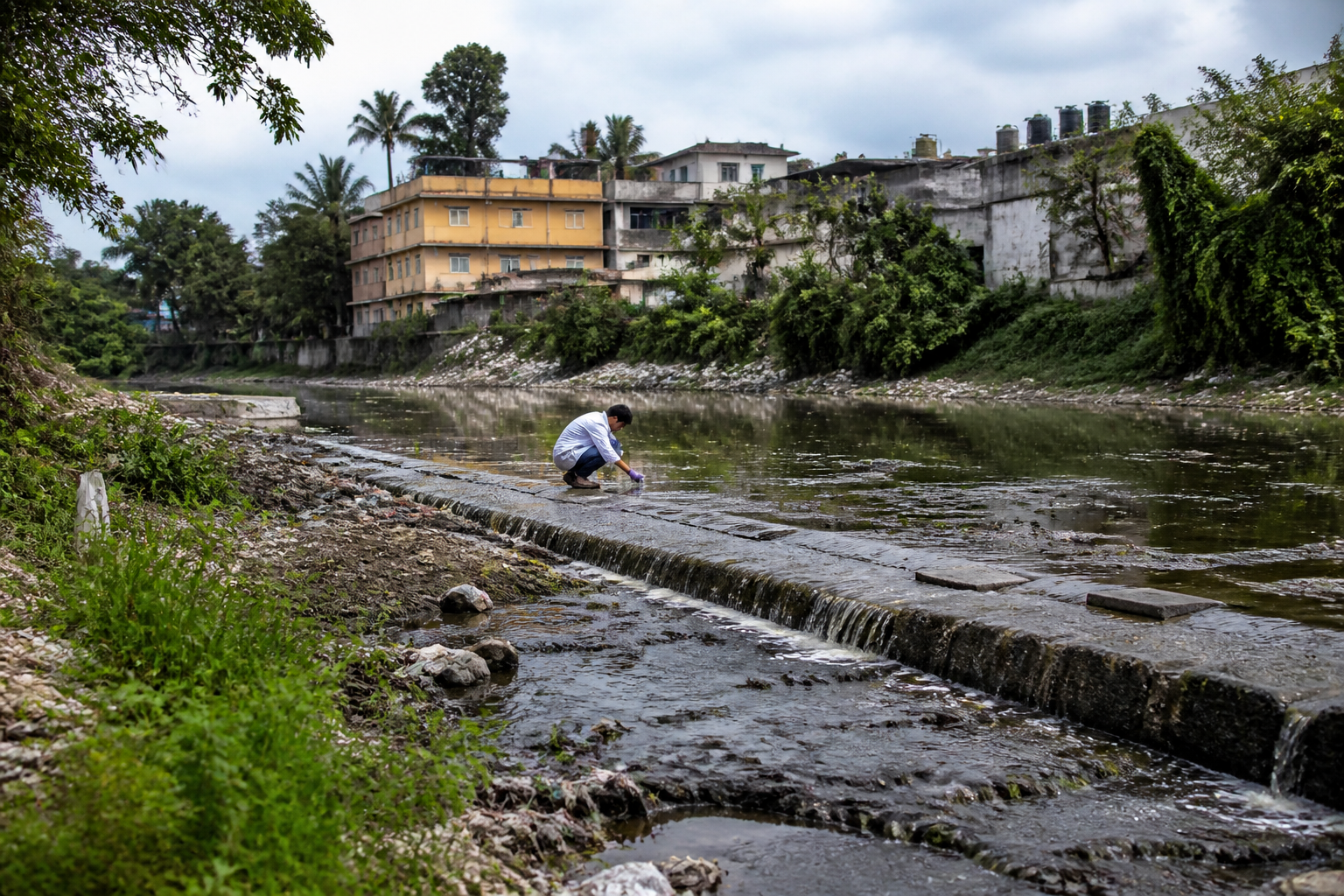
A study of a Cooum tributary in Tiruvallur district has identified check dams as both pollution traps and potential control points, revealing how sewage-linked contaminants accumulate before polluted water reaches the main river. The finding shifts attention from the visible condition of the Cooum to the less visible feeder network that carries organic matter, nutrients, salts and plastics into it.
Researchers from the National Taiwan Ocean University and the University of Madras examined 12 sites along an upper-midreach tributary passing through Kannapalayam, Avadi, Paruthipattu and Thiruverkadu. The study, published in Environmental Monitoring and Assessment, compared water and sediment conditions across rural, intermediate and urban stretches before the tributary joins the Cooum.
Its central evidence is a sharp deterioration between the upstream section and an urban check dam. Conductivity rose from 748 microsiemens per centimetre upstream to 1,766 microsiemens per centimetre at the urban structure. Total dissolved solids increased from 524 milligrams per litre to 1,236 milligrams per litre, while chloride levels rose from 104 milligrams per litre to 200 milligrams per litre.
Those measurements do not merely describe a polluted water channel. They show how a river system can change over a relatively short distance as it enters a more urbanised environment. The check dam slows the movement of water, allowing material carried by the stream to settle into sediment. That makes the structure easier to monitor, but it also means that the pollution is being stored within the basin rather than removed from it.
The study used diatoms, a group of algae, as biological indicators of water quality. Upstream, the researchers found diatom types associated with comparatively cleaner water. As pollution increased, pollution-tolerant types became more common. A partial recovery in diatom diversity appeared in a free-flowing middle stretch where water movement improved, before pollution-tolerant forms increased again downstream.
This pattern is important because it links water quality to the physical behaviour of the channel. The evidence in the study suggests that pollution is not only a question of what enters the tributary, but also of how long contaminants remain in slow-moving sections. A free-flowing stretch showed signs of biological improvement, while the urban check dam became a point where pollutants and plastics accumulated.
The sediment findings deepen that concern. Researchers examined two sediment cores, one up to 35 centimetres deep and another up to 20 centimetres. Both contained organic matter, phosphorus and chloride, while plastic material appeared in several layers. The urban core contained more microplastics than the rural site, which the researchers linked to sewage entering the river and slower water at the check dam allowing the particles to settle. Plastic deposition was also found at one level in the rural core.
Prof Nagaraj Subramani, the study’s corresponding author, said diatoms are useful pollution indicators because different types survive under different water conditions. He said the findings showed that check dams were retaining pollutants in sediment and that these pollutants could affect groundwater in surrounding localities. He also described the structures as possible intervention points because they are located before the tributary joins the main Cooum.
That proposal gives the check dam a dual institutional significance. It is a physical structure within the drainage network, but it can also function as a recurring observation point. Water samples, sediment layers and biological indicators collected there could help authorities identify whether pollution is rising upstream, being retained at the structure or moving into the main river. The study itself does not establish a complete monitoring programme, but it identifies where such monitoring could be concentrated.
The finding also exposes the limits of treating river restoration as a single-channel exercise. The Cooum is often approached as a citywide environmental and beautification challenge, but its condition is shaped by smaller feeder streams and localised inflows. Pollution entering a tributary in the upper or midreach can travel towards the main river, while check dams can hold part of that load in sediments. Cleaning only the main channel would therefore leave a significant part of the pollution pathway outside the intervention area.
Environmental activist G Sundarrajan said pollution must be stopped at source. He referred to a march along the Cooum around 10 years ago that identified about 880 sewage inflow points. He argued that preventing sewage from entering the river should be the first priority and said expenditure on projects had not produced results on the ground. His comments point to the gap between visible river works and the less visible administrative task of identifying, intercepting and maintaining every inflow.
That gap is central to the governance problem revealed by the study. A check dam can indicate where pollution is accumulating, but it cannot by itself prevent sewage from entering the drainage system. Source control would require authorities to trace inflows, distinguish domestic sewage from other wastewater, maintain interception infrastructure and ensure that pollution does not bypass treatment or re-enter the stream. The supplied study does not assess the performance of those systems, so their effectiveness cannot be established from its findings.
The numbers also caution against relying on a single measure of river health. Conductivity, dissolved solids and chloride show changes in the chemical character of the water. Diatoms show a corresponding biological response. Sediment cores reveal that pollutants and microplastics can remain in the system over time. Taken together, these indicators present a more complete picture than a one-time visual inspection of the river surface.
For Chennai’s urban water system, the larger question is whether restoration can be organised around the full movement of pollution rather than around the most visible stretch of the Cooum. The study suggests that feeder streams, check dams, sediment and groundwater connections belong within the same monitoring framework. It also shows that conditions can improve temporarily where water movement is better, before deteriorating again downstream.
The evidence confirms that the Cooum’s pollution problem is distributed across its basin and that an urban check dam can become a measurable concentration point for chemical pollutants, sediment-bound material and microplastics. It does not establish the exact sources of every contaminant, the extent of groundwater impact or the effectiveness of any proposed intervention. Those questions will require further sampling and administrative follow-through. For now, the study makes one operational point clear: a cleaner Cooum depends on controlling pollution in its feeder streams before it reaches the main river.
