


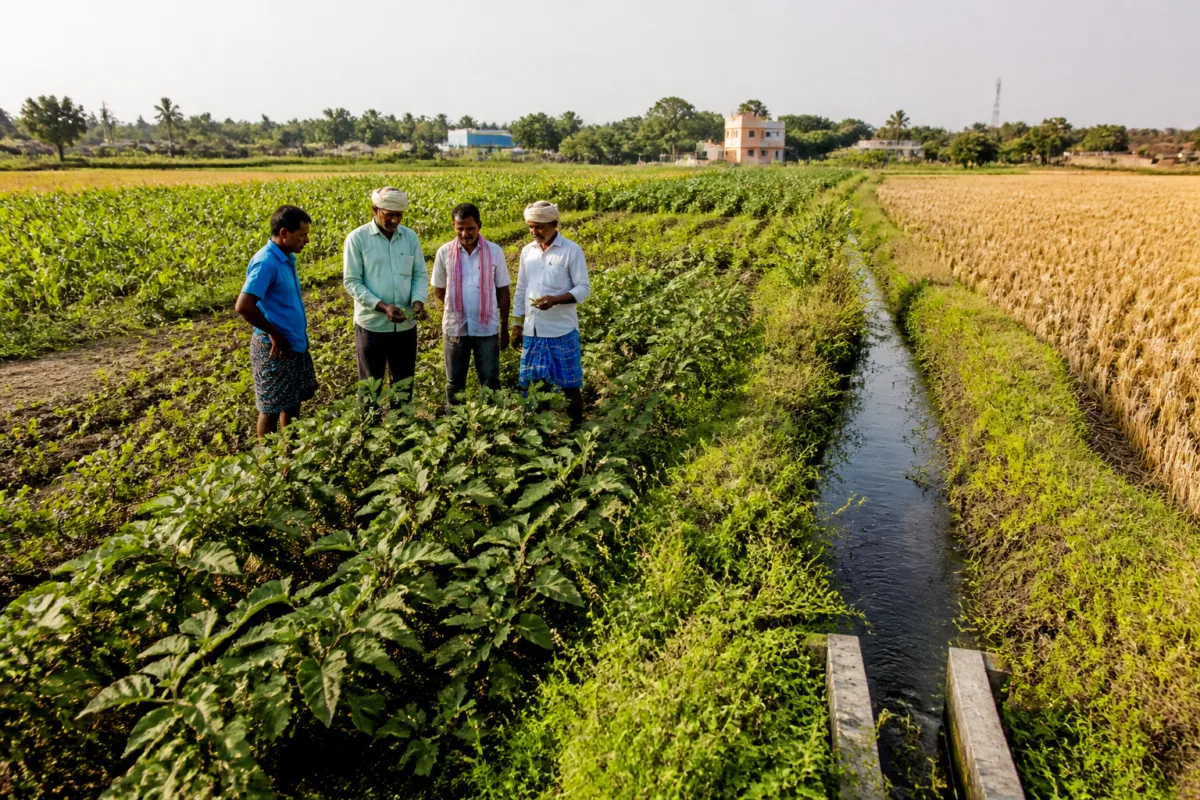
The demand to extend Telangana’s Rs 500-per-quintal fine rice bonus to pulses, vegetables and fodder exposes a central weakness in the state’s attempt to change cropping patterns: farmers are being asked to move away from water-intensive paddy without an equivalent financial signal for the alternatives. The issue is not only agricultural. It is also about how water, electricity, public money and food supply are managed across Telangana’s rural and urban systems.
The Congress government has urged farmers to avoid paddy cultivation during the Yasangi season because of water and power shortages. It is instead encouraging less water-intensive crops, particularly fodder. Farmers’ organisations, however, argue that appeals alone cannot compensate for the market and income risks involved in changing crops. Their proposal is to redirect some of the money currently associated with the fine rice bonus towards farmers who grow pulses, vegetables, fodder and other alternatives.
That argument places the state’s bonus scheme at the centre of a larger policy transition. A crop incentive is not merely a payment to an individual cultivator. It influences what is planted, which crops enter procurement channels, how much water is drawn for cultivation and what food is available to consumers in towns and cities. If the government wants a different crop pattern, farmers’ organisations are saying that public policy must make that pattern economically viable.
The existing incentive provides Rs 500 per quintal for fine rice varieties. The report says the bonus was restricted to seven fine rice varieties last season, unlike the previous year. The government claimed that it had disbursed Rs 1,199 crore to 4.41 lakh farmers in the earlier cycle. Telangana’s 2026-27 annual budget allocated Rs 3,500 crore for the paddy bonus scheme, although expenditure is expected to decline during the Vanakalam season because of the restriction on eligible varieties.
The scale of these figures matters because it shows that the state already has a substantial financial mechanism for influencing cultivation. The question raised by farmers’ organisations is whether part of this fiscal capacity can be used to support crops that the government itself is promoting. Their demand is not simply for a larger subsidy. It is for a redesign of the incentive architecture so that the state’s advice on water use is matched by a predictable economic alternative.
### The gap between official advice and farm economics
Crop diversification is difficult when the recommended alternative does not offer comparable certainty. Paddy has an established procurement and bonus framework, while the report does not identify a similar state-backed incentive structure for pulses, vegetables or fodder. This difference can make the government’s crop advice less persuasive even when the water rationale is clear.
Rythu Swarajya Vedika convenor B Kondal Reddy said farmers would not shift merely because they were asked to do so. He called for higher incentives for pulses, vegetables and other less water-intensive crops, and argued that the fine rice bonus should be diverted to alternative cultivation if the government genuinely wanted farmers to change their choices.
The demand also reflects the diversity of Telangana’s existing agricultural geography. According to Reddy, red gram is widely cultivated in Vikarabad, cotton in Adilabad, chilli in the erstwhile Khammam and Warangal districts, and groundnut in the erstwhile Mahabubnagar district. These patterns suggest that diversification would not necessarily require introducing unfamiliar crops everywhere. In several areas, the issue may be whether established alternatives can receive sufficient policy support.
However, the supplied material does not establish the relative profitability, water consumption, procurement access or price volatility of these crops. Those gaps are important. A bonus designed without information on production costs, market access and post-harvest infrastructure could shift risk from the state to farmers rather than solve the underlying problem.
### Why vegetable supply makes this an urban issue
The strongest connection to cities lies in Telangana’s vegetable supply. The report cites estimates that the state requires 34.67 million metric tonnes of vegetables annually but produces only 11.17 million metric tonnes. The remaining requirement is met through supplies from neighbouring states. Farmers’ organisations argue that a cultivation bonus could encourage more producers to take up horticulture and reduce this dependence.
This supply gap connects a seasonal farm-policy debate to everyday urban consumption. Cities depend on regular inflows of vegetables, and disruptions or dependence on distant producing regions can affect availability, transport requirements and prices. The report does not provide data on retail prices, urban consumption patterns or the logistics costs associated with outside-state supplies, so the precise effect on consumers cannot be established from the available evidence. But the dependence itself points to a food-supply system that extends well beyond municipal boundaries.
A shift towards vegetables would also require more than a payment at the farm gate. Vegetables are perishable and need reliable aggregation, cold storage, transport and wholesale distribution. The report does not say whether Telangana currently has sufficient infrastructure for these functions. That omission is significant because production incentives can increase output without guaranteeing that the additional produce reaches consumers efficiently.
The same institutional question applies to fodder. The government is encouraging fodder cultivation to respond to water constraints, while farmers are citing Maharashtra’s special incentives for fodder as a model. Yet no details are provided in the report about the proposed design, eligibility conditions or funding source for a Telangana programme. Until those mechanisms are specified, the policy remains an appeal rather than an operational alternative.
### The limits of reallocating the bonus
The proposed diversion of paddy bonus funds appears administratively attractive because the budget already contains a large allocation and expenditure may fall after the restriction to seven fine rice varieties. But the available information does not establish how much money would actually be available for redistribution, or whether the reduced paddy expenditure would be sufficient to support all the alternative crops being proposed.
There is also a difference between a procurement-linked rice bonus and an incentive for diverse crops. Fine rice can be identified through specified varieties and paid for through a defined system. Pulses, vegetables and fodder have different production cycles, market structures and quality requirements. A common incentive may therefore need different rules for each crop, even if the broad objective is the same.
The state’s role is consequently larger than announcing a crop shift. It must decide which crops qualify, how payments are verified, whether the incentive is linked to area or output, and how farmers are protected from market volatility. The supplied report confirms the demand for such support but does not indicate that the government has announced a detailed framework.
### The wider governance question
Telangana’s debate illustrates a recurring problem in resource governance: policy goals are often communicated through restrictions or appeals, while the economic incentives that shape behaviour remain unchanged. Farmers are being asked to reduce paddy cultivation because water and power are scarce, but the demand for alternative incentives suggests that the current support system still makes the preferred crop more secure.
For urban residents, the consequences appear through several connected systems. Water and electricity used for cultivation are part of the state’s wider resource balance. Food produced or not produced in Telangana affects the supply chains serving its cities. Public spending on crop support determines which production patterns the government reinforces. These are not separate rural and urban questions; they are different parts of the same regional system.
The evidence supplied in the report confirms the policy tension, the size of the existing paddy bonus framework and the state’s reported vegetable production shortfall. It does not establish whether extending the incentive would successfully change farmer behaviour, reduce water use or improve urban food availability. Those outcomes would depend on the eventual design of the programme, market infrastructure and implementation across districts.
The next development to watch is whether the Telangana government responds with a defined incentive for pulses, vegetables and fodder, and whether any such scheme is linked to the budgetary savings expected from restricting the fine rice bonus. Until then, the state’s crop-diversification strategy remains caught between an urgent resource message and an incomplete economic proposition.

