


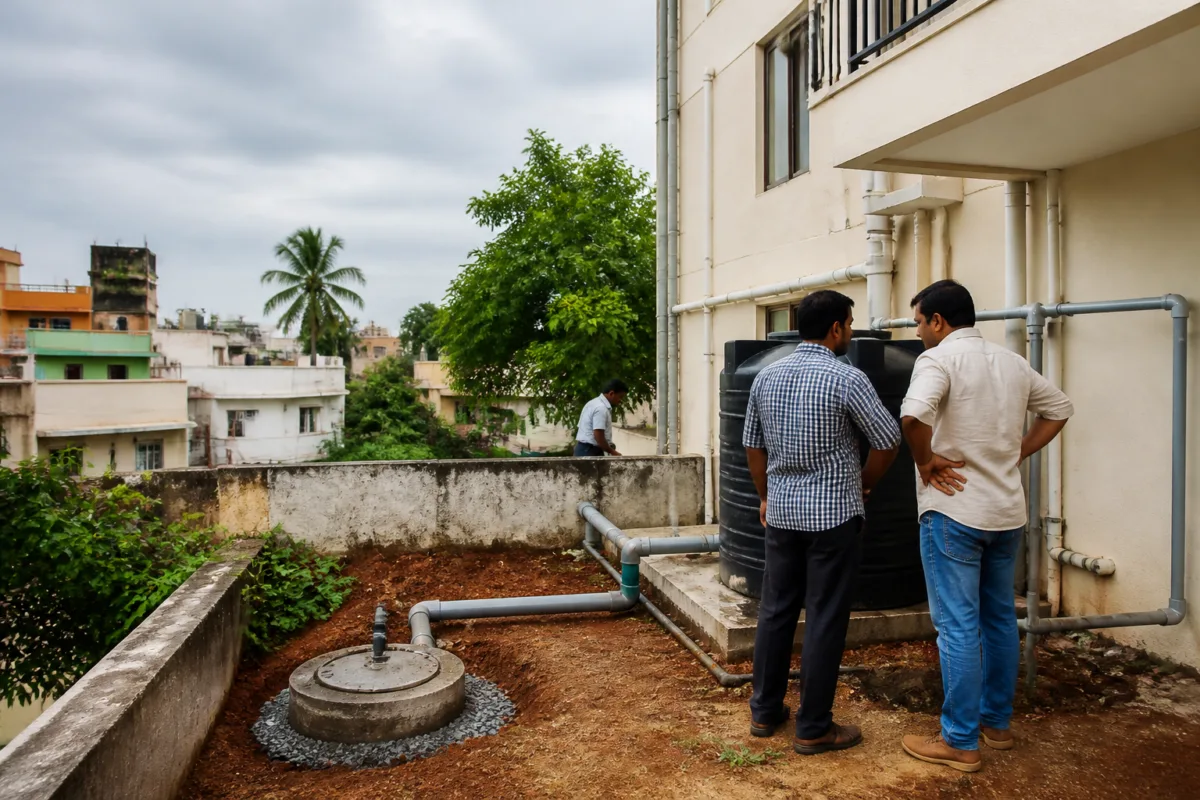
Tamil Nadu has ordered a statewide rainwater harvesting campaign that will require local authorities to enforce building rules, restore damaged systems and expand groundwater-recharge works across urban and rural areas.
The order issued by the municipal administration and water supply department seeks to make rainwater harvesting a mass water-conservation effort. It directs authorities to promote rooftop rainwater harvesting in houses, apartment complexes, institutions, commercial establishments and industries, including existing buildings that do not currently have such facilities.
Officials will inspect rainwater harvesting structures in buildings and ensure that systems that are damaged or non-functional are repaired and restored. Existing installations may also be rejuvenated or retrofitted wherever technically possible. The direction places responsibility on local bodies to move beyond the installation of systems and track whether they continue to function.
The campaign will include measures outside individual buildings. Authorities have been asked to construct check dams near water-tapping points and soak pits at open water-drawing sites to improve the percolation of rainwater into the ground. Rainwater harvesting is also to be included in new urban and rural water-supply schemes wherever technically feasible.
Tamil Nadu introduced rainwater harvesting as a state policy in 2002, when all buildings were mandated to have harvesting structures. Over time, however, many of those systems became dysfunctional. The latest order focuses on identifying existing structures, repairing them and creating new facilities where required.
Local bodies have been directed to maintain records of existing, repaired and newly created water-conservation structures. These records are expected to be supported by photographs, geo-tagging and digital reporting. District administrations will periodically review the performance of local bodies and monitor changes in groundwater levels.
The order gives special attention to over-exploited and critical groundwater blocks, as well as areas facing salinity. According to the official cited in the report, groundwater levels in 476 of Tamil Nadu’s 1,202 firkas, or revenue subdivisions, were found to be comfortable. The government has directed officials to track groundwater conditions as the campaign progresses.
The initiative also links rainwater harvesting with the restoration of water bodies. The rural development department has recently issued guidelines for restoring water bodies through private participation. The municipal administration department is expected to issue separate guidelines for urban areas, the official said.
The campaign will involve district administrations, local bodies, non-governmental organisations, institutions and residents’ welfare associations. The government plans to recognise the best-performing districts, local bodies, NGOs, institutions and resident groups through awards.
The order comes as Tamil Nadu seeks to strengthen groundwater recharge in a state described in the report as water-deficit and lacking perennial rivers. Its implementation will depend on the inspection of existing systems, the quality of repairs, accurate digital records and periodic monitoring by district administrations.

