


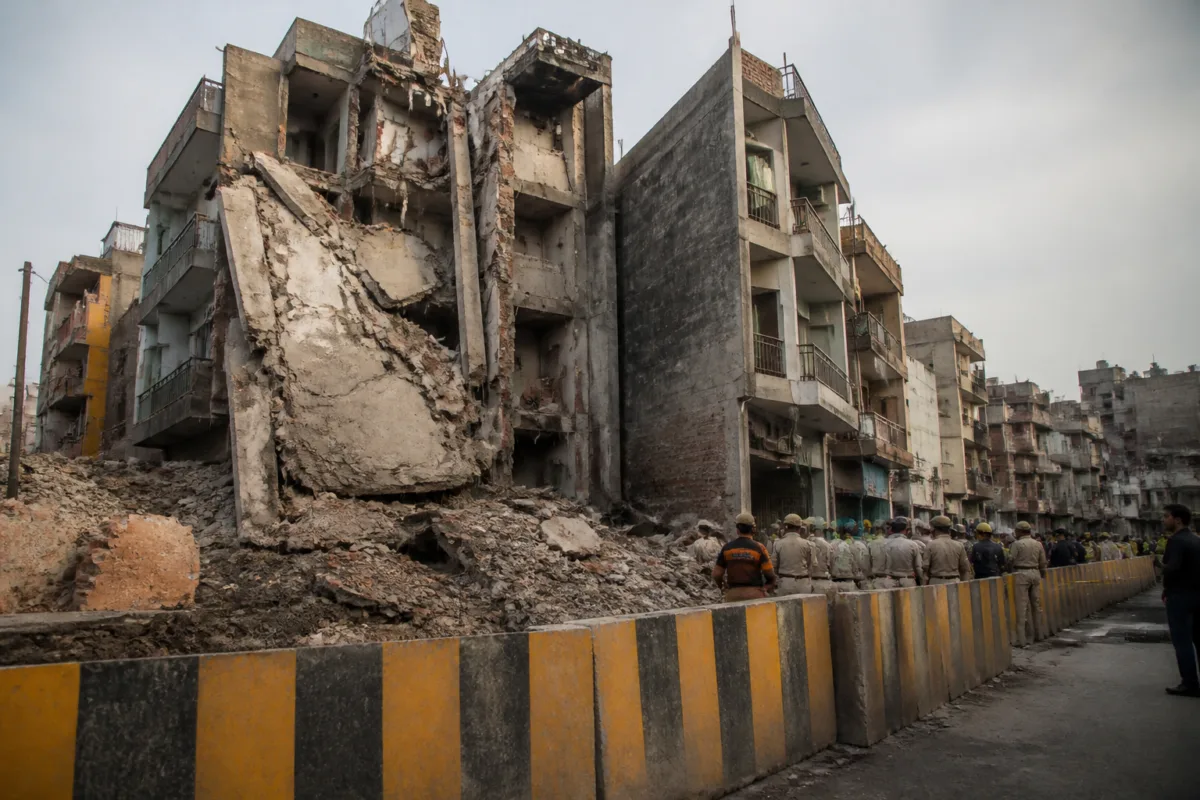
The Seemapuri building collapse, which killed four people on October 7, has moved from a rescue and evacuation response to an examination of how unauthorised construction, demolition activity and civic enforcement interact in Delhi’s dense neighbourhoods. The Delhi government’s decision to order a magisterial inquiry is significant not only because it seeks to establish the immediate cause of the collapse, but also because it has been tasked with examining whether building-rule violations, safety failures or administrative lapses contributed to the tragedy.
The four-to-five-storey residential building at house number E-402 in New Seemapuri collapsed at around 3 pm. According to an official statement cited by Millennium Post, it stood on a plot measuring approximately 20-25 square yards. The preliminary inquiry indicated that demolition work using heavy machinery at an adjacent unauthorised construction site may have triggered the collapse through vibrations. Three adjoining structures suffered major damage, were declared unsafe by the Municipal Corporation of Delhi and were subsequently evacuated.
The inquiry ordered by Delhi Home Minister Ashish Sood will be conducted by the district magistrate of North-East Delhi. Its mandate includes determining the circumstances and exact cause of the collapse, identifying responsibility for violations or negligence, and examining possible lapses by government departments and civic agencies. It will also look at the conduct of property owners, tenants and private individuals in relation to building rules and safety norms.
That combination of questions matters because the incident cannot be understood only as a failure of one structure. The preliminary account places the building within a chain of activity: a residential property on a very small plot, construction or alteration in a densely built area, demolition using heavy machinery next door, and neighbouring structures that became unsafe after the collapse. The inquiry’s terms of reference recognise that urban building safety can involve several actors at once, rather than a single point of failure.
## Seemapuri building collapse and the problem of neighbouring risk
A building can be affected by work taking place outside its own plot. Demolition, excavation and heavy machinery can alter the physical conditions around adjacent structures, particularly where buildings are closely packed. The official statement does not establish that vibrations definitively caused the Seemapuri collapse; it says the preliminary inquiry indicated that demolition work at an adjacent unauthorised site may have triggered it. Establishing that connection is one of the central tasks before the district magistrate.
The distinction between a preliminary indication and a confirmed finding is important. A final determination would need to establish what work was taking place, whether it had been authorised, what equipment was used, whether safety precautions were followed, and how the neighbouring building responded. The inquiry has also been asked to examine possible violations by private parties as well as lapses by government departments and civic agencies. That broader scope suggests that the investigation will not be limited to the mechanics of the collapse.
The damage to three nearby structures adds another layer. Their evacuation shows that the immediate public-safety impact extended beyond the building where the deaths occurred. Once adjoining buildings were declared unsafe, residents faced displacement and uncertainty over whether they could return. The supplied report does not provide details of the number of affected households, the duration of evacuation, or arrangements for temporary accommodation. Those details will be important in assessing the wider human cost of the incident.
## The enforcement chain under examination
The inquiry’s reference to building rules and safety norms brings enforcement into focus. In a dense urban area, compliance is not limited to whether a building was originally constructed according to an approved plan. Safety can also depend on later additions, structural alterations, demolition on neighbouring plots and the ability of civic authorities to identify dangerous work before it causes damage.
The official terms of reference cover property owners, tenants and private individuals, while also examining possible lapses by government departments and civic agencies. This indicates that responsibility may be distributed across the private and public sides of the built environment. Owners and occupiers may be responsible for unauthorised construction or unsafe alterations. Contractors and private operators may be responsible for the way demolition is conducted. Civic agencies may face questions about approvals, inspections, enforcement and timely action if violations were visible or reported.
The available report does not establish whether complaints had previously been made, whether notices had been issued, or whether any agency had inspected the site before the collapse. It also does not state whether the adjacent demolition work had received permission or identify the private parties involved. These are not minor omissions. They are among the facts that would determine whether the incident resulted from an isolated act, a failure to follow known procedures, or a more persistent weakness in neighbourhood-level oversight.
A magisterial inquiry can bring these separate strands together by examining records and statements across departments and individuals. Its value will depend on whether the final report reconstructs the sequence of events clearly: what existed at E-402, what work was under way next door, when warnings or damage became visible, which authorities had jurisdiction, and what action was taken before and after the collapse.
## What the available evidence confirms
The confirmed facts in the supplied account are limited but serious. Four people died when the residential building collapsed on October 7. The structure had four to five storeys and occupied a plot of about 20-25 square yards. Demolition involving heavy machinery was taking place at an adjacent unauthorised construction site. Three adjoining structures were badly damaged and later evacuated after being declared unsafe by the Municipal Corporation of Delhi.
The report does not provide the identities or ages of those who died, the number of people inside the building at the time, or the precise condition of the structure before the collapse. It also does not provide engineering findings, photographs, inspection reports or details of the demolition operator. As a result, the available evidence supports a clear account of the incident and the government response, but not a final conclusion about causation or liability.
This is why the inquiry’s wording is consequential. It is not restricted to asking whether the collapse was triggered by adjacent demolition. It also includes building-rule violations, safety norms, and potential negligence by individuals or officials. That framework allows the investigation to consider both the immediate physical trigger and the conditions that made the surrounding area vulnerable.
The involvement of the district magistrate and the reference to MCD action also illustrate the multi-agency character of urban safety. The district administration is conducting the inquiry, while the civic body declared the adjoining structures unsafe. The supplied report does not identify the roles of other departments or agencies. The final investigation may therefore clarify how responsibilities were divided and whether information moved effectively between authorities.
## The larger urban governance question
The Seemapuri incident raises a basic question for cities with dense, incrementally built neighbourhoods: how should authorities manage risk when buildings, plots and construction activity are physically interdependent? A narrow property-by-property approach may miss dangers created by work on the next plot. Conversely, an intervention after visible damage may come too late for residents in adjoining structures.
The case also shows why unauthorised construction is not merely a planning or property issue. It can become a public-safety issue when building activity affects structural stability, access, evacuation and neighbouring homes. The official statement’s inclusion of both private actors and government agencies reflects this overlap. Construction control, demolition safety, structural assessment and emergency evacuation are connected parts of the same urban system.
At the same time, the supplied evidence does not establish how widespread similar risks are in Seemapuri or elsewhere in Delhi. It provides no citywide data on unsafe buildings, unauthorised construction, demolition-related incidents or enforcement capacity. Those questions require separate evidence and should not be inferred from one collapse. What can be said is that this incident has exposed a specific failure-risk chain that the inquiry is now required to examine.
The next important document will be the district magistrate’s findings. It should clarify the exact cause of the collapse, identify any violations, establish whether demolition activity contributed to the failure, and determine whether government or civic agencies neglected duties. It should also explain the status of the three evacuated structures and the steps required before residents can safely return, if return is possible.
For now, the evidence confirms a deadly collapse, serious damage to neighbouring buildings and a formal investigation into both private conduct and official oversight. The central issue is no longer only what brought down E-402, but whether Delhi’s systems can detect and control the chain of risks created when construction and demolition proceed in tightly packed urban neighbourhoods.

