


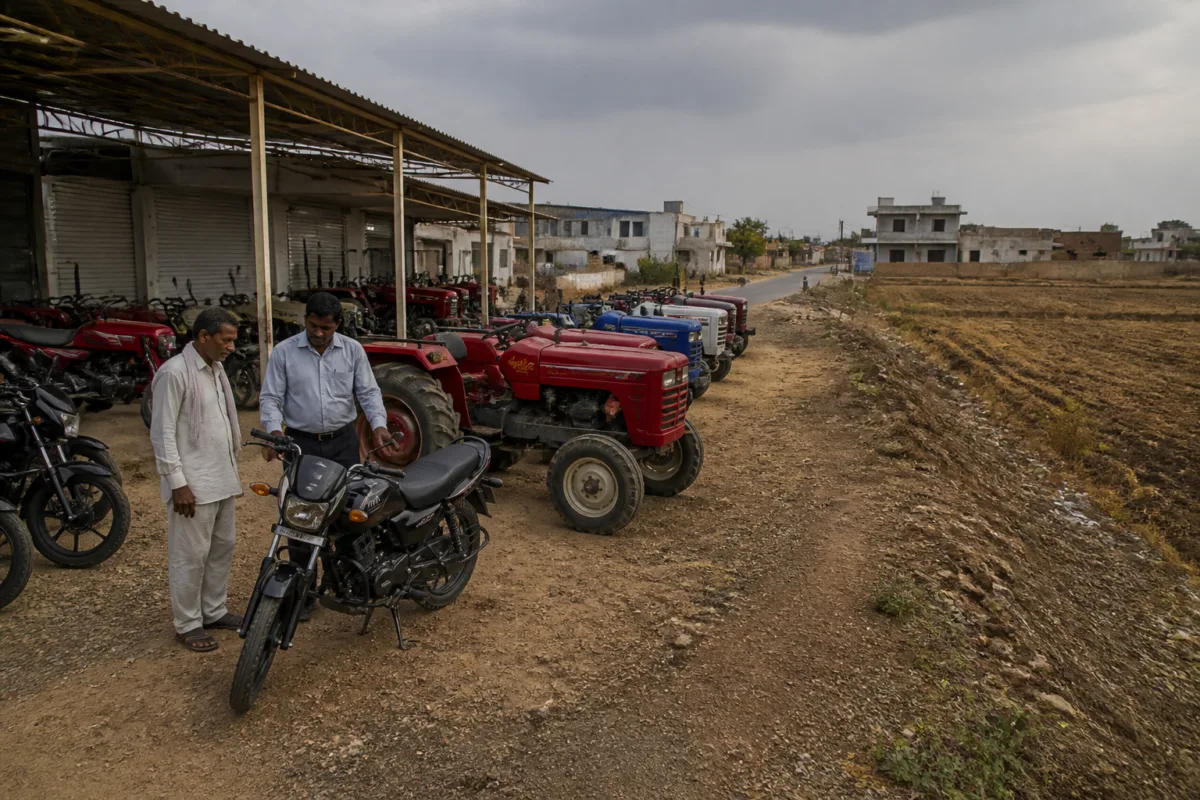
Rural vehicle demand is weakening as deficient monsoon rainfall and drought in key agricultural states put pressure on farm incomes, revealing how closely India’s mobility markets remain tied to the water cycle. Tractor sales are projected to fall by up to 10% year-on-year this fiscal, while dealers are reporting sharper declines in entry-level cars and two-wheelers in some rural markets, according to a report by The Economic Times.
The immediate story is about vehicle sales. The larger one is about the economic geography that connects farms, small towns, dealerships, lenders and transport access. Tractors are a bellwether for the rural economy because purchases depend not only on farm demand, but also on expectations about crop earnings, water availability and the ability to repay loans. Entry-level motorcycles and cars perform a similar signalling function for household consumption. When these purchases are postponed, the pressure is visible beyond showrooms, affecting the wider network of dealers, financiers and local businesses that support rural mobility.
The reported slowdown comes after an unusually strong comparison period. Tractor dispatches had increased 23% to more than one million units in FY26, while tractor sales rose 8% to 610,000 units in the first half of the current year from the year-ago period, according to the Tractor and Mechanisation Association. The current weakness therefore reflects both a rainfall-related shock and a high base created by stronger sales earlier.
That distinction is important. A year-on-year fall after a record or near-record period does not by itself establish a collapse in long-term demand. But the evidence cited by dealers and industry representatives suggests that the pressure is not confined to tractors. Entry-level car sales in the markets covered by a Kolhapur-based dealer were reported to be down 20-25%, while entry-level two-wheeler sales fell 25-27%. Overall motorcycle sales in those markets declined 18-19%, the dealer said.
These figures are market-specific rather than a national estimate, but they show how farm uncertainty can move through household and business decisions. Motorcycles are often closely connected to everyday access to work, markets, education and services in areas where public transport networks are less extensive. Cars and tractors represent larger purchases, making them more sensitive to income expectations and financing conditions. When households delay them, the decision can reflect caution about future cash flows rather than a simple lack of immediate need.
Rainfall is the central trigger in the current account. The report cites rainfall at 13% below the long-period average nationally and drought conditions in Maharashtra, Karnataka and Andhra Pradesh. The India Meteorological Department recorded a 19% overall rainfall deficit in Maharashtra during the June-September monsoon season. Industry representatives said inconsistent and untimely rainfall had weakened rural sentiment, while declining reservoir levels and water availability could intensify the impact in peninsular India over the next two to three quarters.
The mechanism is straightforward but institutionally important. Farm income depends on the quantity and timing of water, while vehicle purchases often depend on a household’s confidence that income will remain stable after the harvest. A deficient or irregular monsoon can therefore affect demand even before the full effect on annual earnings is known. The report says rural customers are postponing purchases amid uncertainty over farm earnings and waiting for government assistance. Lenders, meanwhile, are flagging the risk of weaker rural cash flows and becoming more cautious.
This creates a feedback loop between agriculture, mobility and credit. Lower confidence delays purchases. Delayed purchases reduce dealer turnover and may make lenders more conservative. Tighter or more cautious lending can then make it harder for households and small businesses to finance vehicles, even where the underlying need for transport remains. The supplied evidence does not establish the scale of this credit contraction, but it identifies lender caution as part of the emerging pressure on the market.
For agricultural mechanisation, the timing matters. Tractor demand is not only a consumer indicator; it also reflects the ability of farms and rural enterprises to invest in productive equipment. A decline in sales may mean that buyers are postponing replacement or expansion decisions. It does not necessarily mean that mechanisation needs have disappeared. However, if water stress persists, the purchase decision can be deferred because expected farm utilisation and returns become less certain.
The impact is also uneven across geography. The report points specifically to drought in Maharashtra, Karnataka and Andhra Pradesh and to a potentially stronger effect in peninsular India as reservoirs fall. A national sales number can therefore conceal substantial differences between regions. In one market, a dealer may face a sharp fall in entry-level vehicles; elsewhere, demand may hold up better because rainfall, crops, irrigation access or local incomes differ. The source material does not provide a state-by-state sales comparison, but it makes clear that the distress is concentrated in markets exposed to rainfall and farm-income uncertainty.
The policy landscape described in the report is consequently less about a single vehicle-sector intervention and more about how rural risk is managed. Customers are waiting for government assistance, but the report does not specify the form, timing or coverage of that support. That absence matters because purchasing decisions depend not only on whether assistance is announced, but also on when households receive clarity about their earnings and repayment capacity.
The institutional chain is spread across several actors. The IMD provides the rainfall assessment. Reservoir conditions and water availability shape the outlook for farm operations. Vehicle manufacturers and dealers observe order and retail trends. FADA represents dealer concerns, while lenders assess repayment risk. Government support can influence household confidence, but the report does not identify a specific assistance programme or quantify its likely effect. No single institution therefore controls the full rural demand cycle.
The data points in the report show a market moving from expansion to caution. Tractor dispatches had risen 23% to more than one million units in FY26, yet an industry estimate cited in the report puts the possible decline in FY27 sales at 8-10%. CNH India expects a flat to single-digit decline for the financial year and a 10-15% fall in sales in the October-December quarter. The first-half tractor sales figure of 610,000 units, up 8% year-on-year, indicates that the slowdown may not be uniform across the fiscal year.
The timing of the festive season is another factor in how the market will be read. A Maharashtra dealer told The Economic Times that the full picture would emerge after the festive period. That is a statement about measurement as much as demand: seasonal buying can temporarily lift sales, but it may not resolve the underlying uncertainty over farm earnings, water and credit. The source does not establish whether a festive-season recovery occurred or whether it would be sustained.
The rural vehicle market therefore functions as an early indicator of stress in the wider rural-urban system. Dealerships are often located in small towns that serve surrounding villages. Their sales connect agricultural income to local employment, finance, repair services and the movement of people and goods. A slowdown in vehicle purchases does not automatically translate into a broad economic contraction, but it does provide a visible measure of how households and businesses are responding to uncertainty.
The bigger urban question is how India plans for economic vulnerability that begins outside major cities but affects the entire settlement network. Small towns are service and distribution hubs for rural regions, while urban manufacturers, lenders and logistics systems depend on demand beyond metropolitan markets. The reported sales pressure shows that climate variability is not only an agricultural issue. It can influence mobility choices, capital expenditure, credit risk and the viability of local commercial networks.
What the available evidence confirms is a linked pattern: deficient and untimely rainfall has weakened rural sentiment; dealers are reporting falls in entry-level vehicle sales; manufacturers expect pressure in the coming quarters; and lenders are becoming more cautious about rural cash flows. What remains uncertain is the national scale and duration of the slowdown, because several figures are company forecasts or dealer-level observations and the source does not provide a complete state-wise dataset. The next milestones to watch are the October-December sales performance, post-festive demand, reservoir conditions, government assistance and whether rural credit conditions ease or tighten further.

