


India’s gaming market has reached a scale that should make it commercially formidable. Yet the Game Developer Association of India’s Game Dev Outlook 2026 report shows a sharp gap between audience size and economic value: 511 million players are associated with estimated gaming revenue of $1.04 billion in 2025, producing annual revenue of only $2.04 per user. That gap is not simply a problem for game studios. It is a signal about how India’s digital economy converts participation into sustainable businesses, creative employment and locally owned intellectual property.
The report, released at the India Game Developer Conference in Chennai, records 14.8% year-on-year growth in gaming revenue. On the surface, that growth suggests a sector expanding rapidly. The lower revenue-per-user figure, however, indicates that scale alone is not translating into equivalent commercial strength. India can produce one of the world’s largest gaming audiences while remaining a difficult market in which to finance, launch and monetise games.
That distinction matters because audience growth and industry development are not the same thing. A large player base creates reach, data and cultural visibility. It does not automatically provide studios with the cash flow required for production, marketing, distribution, staffing or the development of original intellectual property. The GDAI report’s findings suggest that the Indian market is strong at generating users but weaker at converting those users into paying customers.
The report identifies low willingness to pay as the second-biggest barrier to market growth, behind capital and publishing investment. It does not provide, in the supplied findings, a detailed breakdown of why users are unwilling to pay or how willingness varies across game types, regions or income groups. That limitation is important. The $2.04 figure describes the commercial outcome, but does not by itself establish whether the main constraint is pricing, payment access, game design, household spending priorities, platform economics or the availability of products that users consider worth paying for.
What the findings do establish is that studios are operating within a market where domestic demand is large but domestic monetisation remains limited. The report says 74% of survey responses indicate that less than 10% of studio revenue comes from India. For a sector with a large domestic audience, that is a significant dependence on overseas markets. It means international players, publishers, investors and clients are not peripheral sources of growth for many studios; they are central to commercial viability.
This dependence changes the role of a game studio. It is not enough to create a technically competent product and release it to Indian consumers. Studios also need access to publishing expertise, market knowledge, financing and distribution networks that can connect a game to audiences beyond India. The GDAI report identifies all four as critical enablers for developers attempting to turn creative ideas into commercially viable games.
The institutional question is therefore larger than whether Indian consumers spend enough on games. It is whether the ecosystem gives studios the capabilities required to reach paying markets, domestically and internationally. The report specifically calls for stronger go-to-market capability and easier, more structured access to publishers and investors. This points to an ecosystem gap between production and commercialisation. Developers may be able to build games, but the surrounding systems that help them package, finance, distribute and scale those products remain insufficient for a large share of the industry.
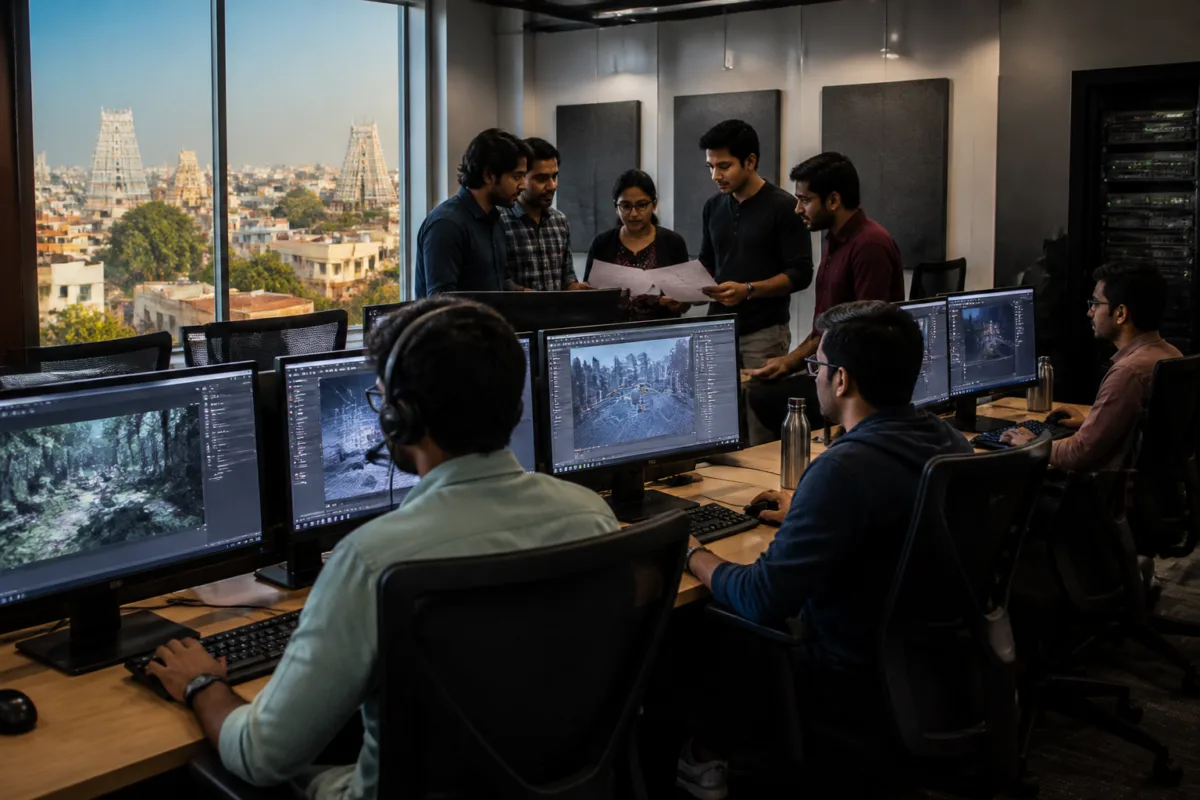
That gap has an urban dimension. Digital industries are often discussed as though they are independent of place, but studios still depend on concentrated networks of talent, finance, professional services, technology infrastructure, events and institutional support. The India Game Developer Conference in Chennai itself illustrates the importance of physical industry platforms where developers, publishers, investors and other stakeholders can meet. The supplied report does not compare cities or identify a specific urban policy model, so it cannot establish which locations are best positioned to support gaming. It does, however, show why the organisation of the ecosystem matters.
The report’s emphasis on international partnerships also complicates the usual reading of India’s digital growth story. A large user base is often treated as an advantage that will naturally lead to domestic value creation. In gaming, the evidence presented here suggests that value creation depends on more than access to users. It requires ownership of original intellectual property, the ability to sell that IP across markets and access to the capital and publishing relationships needed to sustain development.
The findings on intellectual property reinforce this point. The report says 82.7% of surveyed studios identify the launch of new game IP as a top priority. That priority indicates that developers are looking beyond short-term production work and seeking to build assets that can travel across markets. Original IP can potentially give studios greater control over their products and commercial identity, but the report does not establish how many such projects are currently being financed, launched or generating revenue. The priority is clear; the conversion of that priority into durable businesses remains an open question.
The sector is also changing in ways that make a single measure of the Indian player inadequate. The report notes that female participation is approaching half of the player base and that non-battle-royale titles are gaining share in mobile revenue. These findings suggest a market with a broader audience and a changing product mix. They also challenge the assumption that India’s gaming opportunity can be understood through one dominant genre or one typical player profile. The supplied material does not provide the precise gender participation figure, the revenue share of non-battle-royale games or the time period over which that shift occurred, so the scale of the change cannot be quantified here.
For policymakers and urban institutions, the report raises a question about what kind of support digital creative sectors require. The priorities identified by GDAI are not limited to faster connectivity or a larger consumer base. They include capital, publishing expertise, production capability, market access and structured links to investors and international partners. These are ecosystem functions. They involve finance, skills, professional networks and routes to market, rather than only physical infrastructure.
The distinction is relevant to India’s wider urban economy. Cities increasingly compete to attract technology and creative enterprises, but attracting studios is only one part of building a sector. The more difficult task is enabling firms to grow beyond early production, retain value from their intellectual property and connect with customers and capital at scale. The GDAI findings suggest that India’s gaming challenge is not a shortage of users. It is the incomplete institutional and commercial bridge between users, developers and paying markets.
There are also limits to what the report can demonstrate. It is based on a survey of studios and presents industry estimates, but the supplied article does not state the survey sample size, methodology, geographic distribution or definition of revenue per user. It also does not provide a comparison with other countries or sectors. The findings should therefore be read as a diagnosis of industry concerns and reported market conditions, not as a complete measurement of every part of India’s gaming economy.
Even with those limitations, the direction of the evidence is consistent. India has audience scale, growing gaming revenue and a developer community that wants to create original IP. At the same time, low annual revenue per user, limited domestic revenue exposure and continuing dependence on international partnerships reveal a commercial system that has not yet converted scale into proportionate value for studios.
The next stage of the industry’s development will depend on whether the priorities identified in the report become functioning capabilities: access to capital, stronger publishing and go-to-market support, production capacity, and structured links to overseas markets. The report confirms the size of the opportunity. It also makes clear that audience growth, by itself, has not solved the harder urban-economy question of how creative enterprises become sustainable businesses.

