


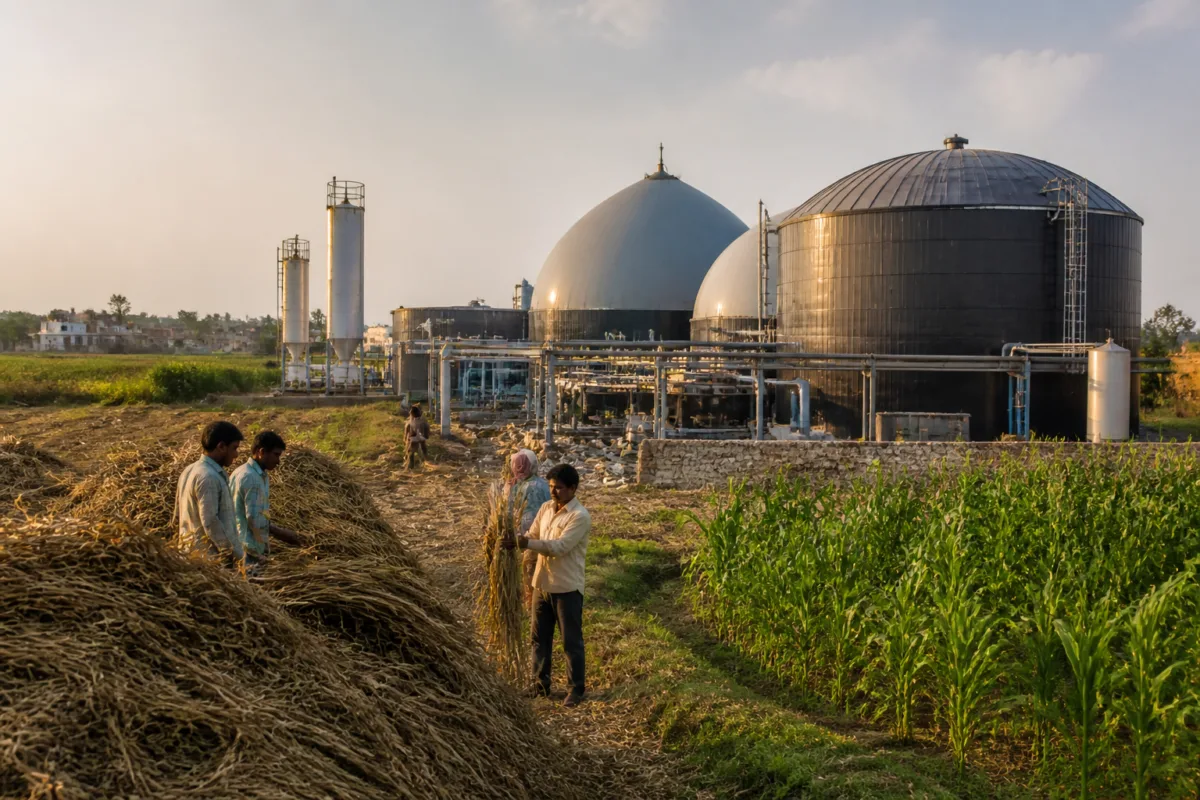
Reliance Industries plans to invest about ₹15,000 crore ($1.6 billion) to build around 100 compressed biogas plants by 2030, expanding an agricultural-residue-based energy network that the company expects to produce about 5 million cubic metres of gas a day.
Vikas Rathi, chief financial officer of Reliance’s Bio Energy Business, disclosed the plan at an industry event, according to a report by Business Standard. Rathi said the company currently operates 45 biogas plants across 10 states, producing about 350 metric tonnes of biogas a day, although the plants are operating below capacity.
The company plans to add 10 more plants by the end of March 2027. Reliance expects that expansion to raise overall output to 1,100 metric tonnes per day, equivalent to approximately 1.5 million to 2 million cubic metres of gas daily, Rathi said.
Reliance’s plants use agricultural residue as feedstock. The company sells the biogas to distribution companies that supply gas to households and small industries. Rathi said the company would locate additional facilities in areas where sufficient agro-residue is available, indicating that feedstock access will shape the geography of the planned network.
Compressed biogas plants convert organic material, including agricultural residue, into a methane-rich fuel that can be supplied through existing gas distribution systems. In the Reliance plan, this creates a link between farm waste, decentralised production and urban and industrial gas demand. The company did not provide a state-wise breakdown of the proposed 100 plants or a detailed construction schedule in the information released.
The expansion comes as India seeks to increase the share of gas in its energy mix to 15 per cent by 2030 from about 6.2 per cent currently. The reported targets place Reliance’s project within a broader effort to expand gas availability while using locally generated feedstock. However, the company has not disclosed the expected capacity, investment schedule or commissioning dates for each proposed facility.
For cities and smaller industrial centres, the plan could add a new layer to gas infrastructure: production would take place near areas with agricultural residue, while distribution companies would connect the fuel to households and small businesses. That model also makes the reliability of residue collection, plant utilisation and local transport networks central to the expansion.
Reliance’s immediate milestone is the addition of 10 plants by the end of March 2027. The longer-term target is about 100 plants and daily production of approximately 5 million cubic metres by 2030.

