


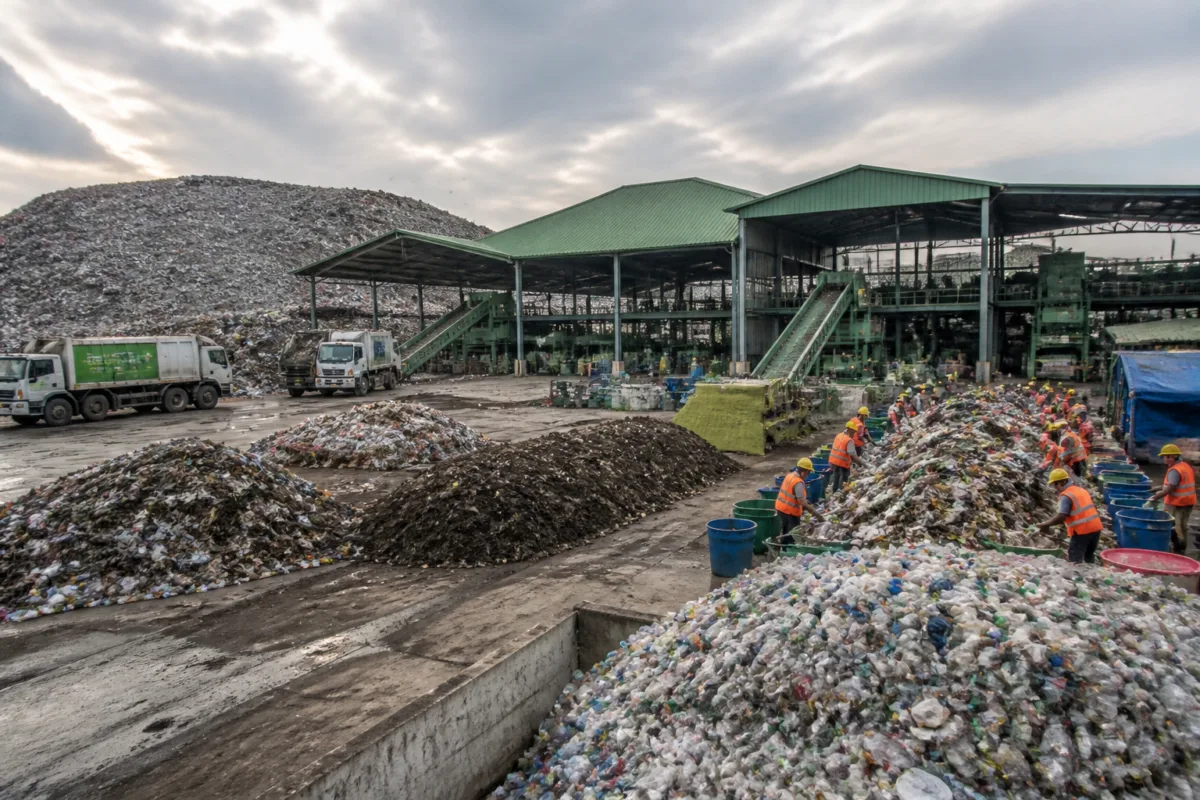
Nagpur’s Bhandewadi waste plants are operating at only about 65% of their combined stated capacity, according to data furnished by the Nagpur Municipal Corporation (NMC). The four major facilities can process 5,050 tonnes per day on paper but are currently handling 3,260 tonnes, leaving a gap of 1,790 tonnes a day in a system meant to move the city towards its garbage-free objective.
The figures, provided by NMC’s public health engineering department in response to a query from standing committee member Abhijit Jha, reveal that the challenge at Bhandewadi is not simply the availability of treatment infrastructure. It is also about whether contracted facilities are operating at their promised scale, whether the capacity figures are consistently defined, how public money is being spent and what value the municipal corporation receives from the materials produced.
Bhandewadi is handling several different waste streams through separate contracts. The facilities cover fresh municipal waste, biomining and remediation of legacy waste, construction and demolition debris, and a plant designed to produce compressed biogas. Their outputs include compost, refuse-derived fuel, recyclables, bio-CNG and construction aggregates. Yet none of the four projects has reported direct revenue so far, while three rely on arrangements in which contractors retain rights to sell processed products.
The largest gap is at the SusBDe LOC Nagpur Pvt Ltd facility. The plant is designed to process 1,200 tonnes of waste daily using dry fermentation and to produce compressed biogas, compost, refuse-derived fuel and recovered materials. It is currently processing only 300 tonnes a day, or 25% of its stated capacity. NMC expects the facility to reach full capacity by December 2026.
The project operates under a public-private partnership model without tipping fees or processing and maintenance payments from NMC. Instead, the contractor is expected to generate revenue from its products. Once the plant achieves full capacity, it is required to pay NMC an annual royalty of Rs15 lakh. The arrangement therefore shifts part of the project’s commercial risk to the operator, but the current low utilisation means the municipal corporation has not yet received the expected operational or revenue benefits.
NMC has also recovered a penalty of Rs30.64 lakh from SusBDe for failing to dispose of refuse-derived fuel within the stipulated period. The penalty indicates that processing waste is only one part of the system. The city must also find reliable outlets for the material generated by these plants. If RDF, compost or recovered products remain undisposed, the treatment chain can become congested even when the processing equipment is available.
Bhumigreen Energy Enviro Care LLP’s facility is processing 550 tonnes a day against a stated capacity of 700 tonnes. It uses windrow composting, material recovery and RDF production to handle fresh municipal waste. However, NMC’s disclosures contain a capacity discrepancy: the facility is described in one place as a 700-tonne-per-day project, while its project description mentions a 500-tonne-per-day facility. That difference matters because capacity is the basis for measuring performance, calculating payments and assessing whether a contractor is meeting its obligations.
NMC pays Bhumigreen a tipping fee of Rs772 per tonne. The corporation’s reported expenditure on the project is about Rs7.47 crore, with another project summary putting the figure at Rs7.48 crore. The variation is small, but the conflicting numbers and capacity descriptions reinforce the need for consistent public reporting across municipal contracts.
The Zigma Global Environ Solutions project is focused on biomining and remediation of legacy waste rather than only the treatment of newly generated garbage. It is processing 2,300 tonnes daily against a stated capacity of 3,000 tonnes. Its contract covers remediation of 10.5 lakh metric tonnes of legacy waste and was later extended by another 4.8 lakh metric tonnes. The project was awarded for Rs119.34 crore, while NMC’s reported expenditure has reached about Rs141.43 crore or Rs141.44 crore in the project summary.
The difference between the original contract value and reported expenditure is not explained in the supplied disclosure. That makes it difficult to determine whether the higher expenditure reflects approved additions, extensions, revised quantities or another contractual provision. Zigma attracts a tipping and processing charge of Rs780 per tonne, and NMC has imposed a penalty of Rs8.80 lakh for delays in disposing of processed waste.
Legacy-waste remediation is operationally different from processing fresh municipal waste. Biomining involves handling accumulated waste, recovering usable material and reclaiming landfill space. Its performance should therefore be assessed not only by daily tonnage but also by the quantity of legacy waste remediated, the quality and disposal of recovered material, and the land made available after reclamation. The supplied NMC data confirms the project’s processing rate and contract quantities but does not provide a completed-land or material-recovery outcome.
The fourth facility, operated by Hyderabad C&D Waste Pvt Ltd, processes construction and demolition debris. It handles 110 tonnes daily against a capacity of 150 tonnes. The plant began processing in June 2024 and has a contract period running from 2022 to 2042. The project attracts charges of Rs234 per tonne for collection and transportation and Rs180 per tonne for processing and disposal, described in the project summary as a combined tipping fee of Rs414 per tonne.
NMC’s expenditure on the C&D facility is reported at Rs3.16 crore, while the agency’s investment is listed at Rs11.88 crore. Unlike household or mixed municipal waste, construction debris can be channelled into aggregates and other products when it is collected separately and processed consistently. The current shortfall of 40 tonnes a day against stated capacity shows that the availability of a plant does not by itself guarantee that the city’s construction waste will enter the formal processing stream.
Taken together, the four facilities operate below their stated capacity, but the scale of the shortfall varies sharply. Bhumigreen is operating at approximately 79% of its reported 700-tonne capacity, Zigma at about 77%, Hyderabad C&D Waste at approximately 73%, and SusBDe at only 25%. The combined figure of roughly 65% is therefore driven disproportionately by the biogas plant’s low utilisation.
The financial structure is equally important. NMC pays contractors for some waste-processing services while receiving little or no direct revenue from the resulting products. Bhumigreen and Zigma receive per-tonne payments, and the C&D facility has separate collection, transportation, processing and disposal charges. SusBDe does not receive tipping fees or processing and maintenance charges, but its royalty obligation begins only after it achieves full capacity.
NMC’s disclosures also state that contractors retain rights to sell processed products, including compost, RDF and recyclable material, in three of the four projects. There is no reported revenue-sharing arrangement in those projects. This means the public value of the contracts is currently measured primarily through waste handled and services delivered, rather than through a demonstrated municipal return from the sale of recovered products.
Land is another public asset embedded in the system. NMC has provided land at Bhandewadi to all four operators under different arrangements, including free temporary use, annual rent and partial lease payments. The supplied information does not quantify the land value or compare the terms across projects. Without that information, the financial picture remains incomplete: the visible expenditure is recorded, but the opportunity cost and contractual value of municipal land are less clear.
The data also shows why a city’s waste strategy cannot be judged solely by installed capacity. A plant may have modern technology and a large design capacity, but its actual contribution depends on regular waste supply, equipment performance, labour, segregation, market demand for recovered products and timely disposal of outputs. The penalties imposed on SusBDe and Zigma point to bottlenecks after processing, while the capacity discrepancy in the Bhumigreen records points to a measurement problem before performance can even be assessed.
For Nagpur, the immediate administrative task is to reconcile the published capacity, expenditure and contract figures and establish a common performance dashboard for Bhandewadi. That dashboard would need to distinguish fresh waste processing from legacy-waste remediation and C&D waste treatment, while reporting daily intake, actual output, rejected material, product disposal, payments, penalties and revenue received by NMC. The supplied material does not state whether such a consolidated dashboard exists.
The central urban question is therefore not whether Nagpur has waste plants. It does. The question is whether those plants are functioning as an integrated municipal system, with transparent capacity definitions, enforceable output obligations and a clear public return on the land and money committed to them.
NMC expects SusBDe to reach full capacity by December 2026. That milestone will be the clearest near-term test of whether the city can close its largest operational gap. Until then, the available figures show a waste-management network with substantial infrastructure in place, but uneven utilisation, unresolved reporting inconsistencies, continuing expenditure and limited demonstrated revenue for the municipal corporation.

