


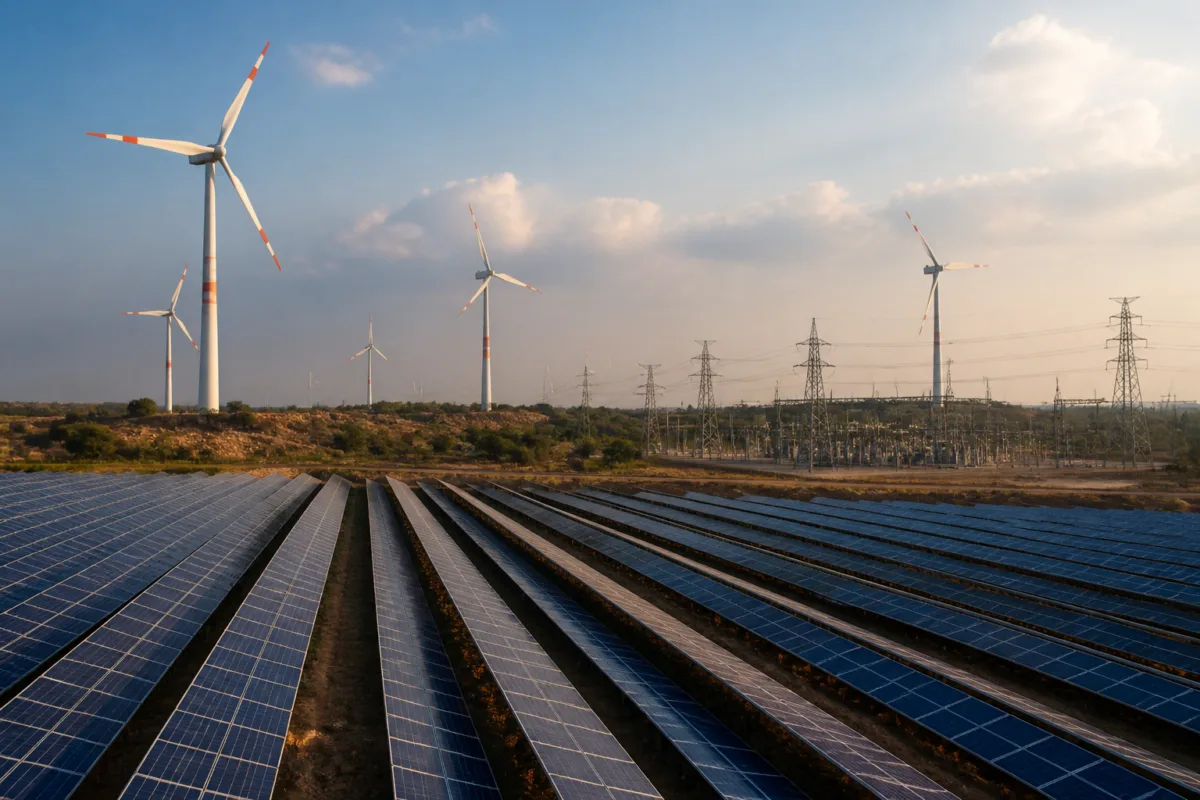
Amazon’s plan to invest $7 billion in renewable energy projects in India by 2030 is more than a corporate climate announcement. It shows how large technology and e-commerce companies are becoming significant participants in the country’s electricity system, contracting utility-scale wind and solar capacity to support operations that depend on reliable power.
The commitment, announced on Tuesday, will be in addition to $4 billion already contracted by Amazon for renewable energy investments in India, according to the company. Amazon also announced four new wind and solar projects with a combined capacity of 934 megawatts (MW). Once operational, its contracted projects in India will have a combined capacity of more than 2 gigawatts (GW), the company said.
That scale places the announcement within a wider transition in how large businesses secure electricity. Instead of treating renewable power only as an emissions-reduction instrument, Amazon’s statement connects it to energy security, long-term investment and the expansion of its operating footprint. The projects also show how corporate demand can influence where new generation capacity is built and how it is tied to commercial consumption.
The geography of the announced projects is significant. Amazon has contracted a 234 MW wind farm in Karnataka, described by the company as its largest wind project contracted in Asia. It is also backing a 200 MW combined solar and wind project in Karnataka, a 300 MW solar project in Madhya Pradesh and a 200 MW solar project in Rajasthan.
Together, the four projects total 934 MW. Their distribution across three states illustrates the land, resource and grid considerations that shape utility-scale renewable energy. Karnataka features in both wind and hybrid generation, while Madhya Pradesh and Rajasthan account for solar capacity. The announcement does not provide project-level commissioning dates, construction milestones, locations within the states or details of the transmission arrangements. Those omissions matter because a contracted project is not the same as an operational power asset.
The projects have been secured through power purchase agreements, or PPAs. These contracts are central to the renewable energy model because they provide a framework for purchasing electricity generated by a project over an agreed period. For a large electricity consumer, PPAs can support the addition of new capacity while helping align its power consumption with a stated climate target. For project developers and financiers, they can provide an identifiable corporate buyer.
Amazon quoted Union Minister for New and Renewable Energy Pralhad Joshi as saying that such investments would support India’s clean-energy ambitions, strengthen energy security and contribute to sustainable economic growth. He also said the investments demonstrate the confidence of global companies in India’s renewable energy sector and its potential to attract long-term investment, create economic opportunities and accelerate the country’s energy transition.
The minister’s comments place the announcement within the government’s broader energy narrative. Renewable investment is being presented not only as a response to carbon emissions but also as part of national energy security and economic development. That framing is important for India’s cities and industries, where electricity demand is closely connected to construction, digital infrastructure, logistics, offices, warehouses and household services.
Amazon’s own operating model gives the announcement a strong built-environment dimension. The company has an extensive network of facilities and said its renewable portfolio in India includes 14 utility-scale wind and solar projects and 43 on-site solar installations across its facilities. The utility-scale projects relate to regional generation, while on-site installations connect renewable power more directly to individual buildings and operational sites.
This distinction reveals two different layers of corporate energy transition. On-site solar can reduce the electricity drawn from the grid at a particular facility, subject to the site’s physical and operational conditions. Utility-scale projects, by contrast, add generation capacity at a much larger scale but require contractual, transmission and grid arrangements to connect production with consumption. Amazon’s portfolio combines both approaches rather than relying on a single form of decarbonisation.
The company said its Indian renewable energy portfolio will contribute to a new global goal of reducing the carbon intensity of the electricity powering its operations by 65 per cent by 2030, against a 2019 baseline. Amazon also said it is implementing a climate pledge to achieve net-zero carbon emissions by 2040.
The 65 per cent target changes the way the investment should be read. The immediate announcement is about projects, capacity and capital, but the stated measure is carbon intensity: the emissions associated with each unit of electricity consumed. More renewable generation can support that goal, but the supplied announcement does not establish how much of Amazon’s Indian electricity demand the projects will cover, how the company will account for power delivered across different locations or how the target will be measured at individual facilities.
That information will be important as the investment moves from announcement to implementation. The headline figure of $7 billion communicates the scale of the commitment, while the PPAs and capacity figures provide a more operational description. Yet the impact on actual electricity use will depend on when the projects become operational, how much power they generate, how their output is contracted and how Amazon’s demand changes through 2030.
Amazon’s announcement also needs to be placed within its wider investment programme in India. The company said its total commitment to the country through 2030 will reach $55 billion, including a $13 billion announcement in June for artificial intelligence and cloud infrastructure. It had announced a $35 billion investment across all its businesses in 2025. The company also said its cumulative investment in India from 2010 to 2030 was $88 billion.
These figures connect renewable energy with the expansion of digital and physical infrastructure. Artificial intelligence and cloud services require data infrastructure, while e-commerce requires fulfilment facilities, warehouses, delivery systems and associated electricity consumption. The announcement does not provide a breakdown of the $55 billion commitment, so it is not possible from the supplied information to determine how the renewable investment will be distributed across generation assets, facilities or other energy-related requirements.
The stated scale of Amazon’s global portfolio adds another layer. The company said it is among the largest corporate purchasers of carbon-free energy, with 700 wind and solar projects representing more than 40 GW of combined capacity. India’s more than 2 GW of contracted capacity would therefore form one national component of a much larger corporate procurement strategy.
For India’s energy system, the significance is not simply that a multinational company is buying renewable power. It is that corporate procurement can become a source of demand for new generation capacity at a time when commercial and digital infrastructure are expanding. The arrangement brings together private capital, project developers, state-level land and power systems, central renewable-energy policy and corporate climate commitments.
That institutional chain also creates questions that the announcement leaves open. The source does not identify the developers of the four projects, disclose their total project costs, specify the PPA tenures or state how the electricity will be wheeled to Amazon’s facilities. It also does not state whether the projects will supply particular facilities or whether their output will be accounted for through a broader corporate procurement mechanism.
Those details will determine how the investment is experienced beyond the corporate balance sheet. Utility-scale renewable projects require land, transmission connectivity and approvals, while their benefits and operational impacts are distributed across the regions where they are built. The announcement establishes the contracted capacity and the states involved, but not the local construction schedules, employment numbers, land arrangements or grid upgrades associated with each project.
The confirmed evidence therefore supports two conclusions. First, Amazon is committing substantial capital to renewable energy in India, with four newly announced projects adding 934 MW to a contracted portfolio expected to exceed 2 GW once operational. Second, the investment links the growth of technology and e-commerce infrastructure to the country’s renewable energy build-out and to a corporate target for lower electricity-related carbon intensity.
What remains to be established is how quickly the projects will move from PPAs to generation, how their electricity will reach Amazon’s operations and how the company will report progress against its 2030 target. The next meaningful markers will be project-level disclosures, construction and commissioning updates, and evidence of how the new capacity is integrated with Amazon’s Indian facilities and wider power procurement system.

