


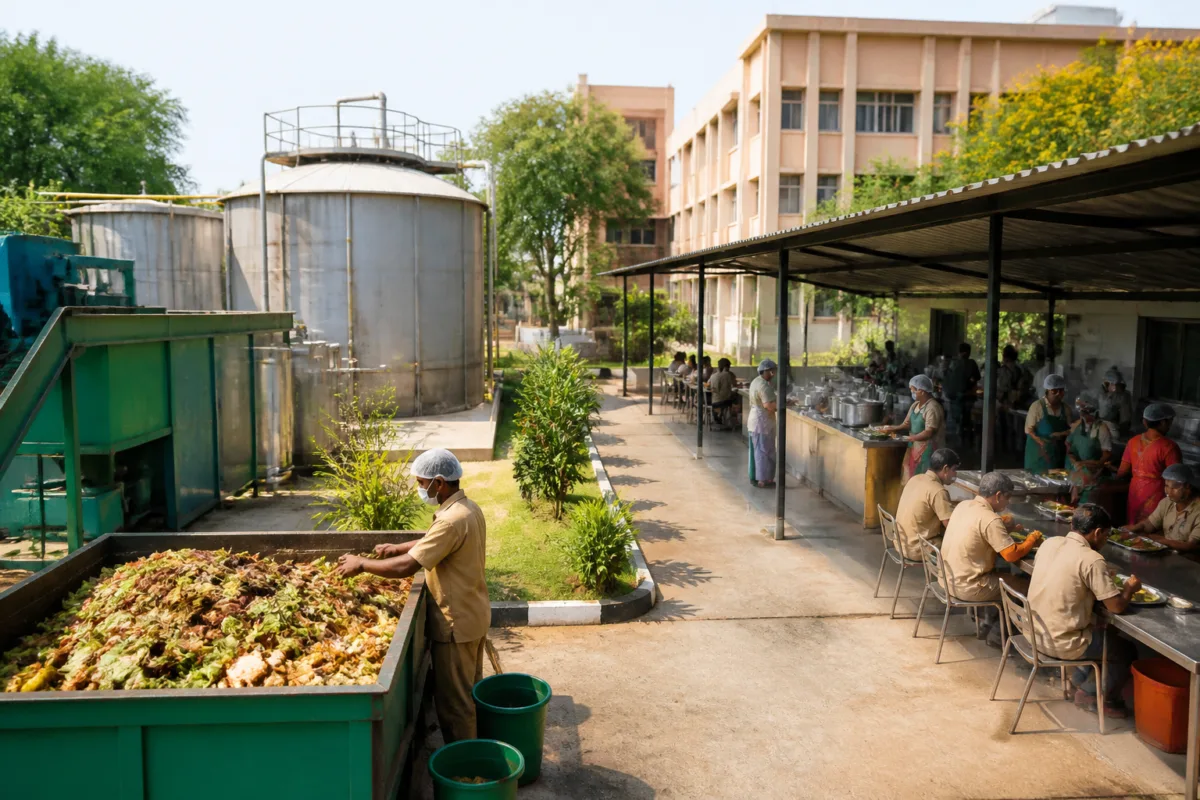
A new biogas plant at the Malkajgiri Municipal Corporation headquarters in Hyderabad is converting food waste from nearby hotels into cooking gas for the Indiramma canteen, while producing liquid fertiliser for municipal landscaping.
The facility can process 125 kg of food waste every day. The gas generated is being supplied to the canteen, which is operated by women’s self-help groups on the corporation premises. The project gives discarded food a productive use within the municipal system instead of sending it for conventional disposal.
According to the details released by the corporation, the plant can generate biogas equivalent to six commercial LPG cylinders a month. It also produces three kilolitres of liquid organic fertiliser, which is being used for landscaping and horticulture activities at the municipal premises.
The facility is expected to reduce carbon emissions by around 4.5 tonnes every month. The corporation has positioned the project as a local example of converting organic waste into energy and usable by-products, linking waste processing with municipal operations and public food services.
Malkajgiri Municipal Corporation Commissioner T. Vinay Krishna Reddy and CSIR-IICT director Srinivas Reddy inaugurated the facility on Thursday. The plant was established in collaboration with KHAR Energy Optimizers and uses AGR technology developed and patented by the Council of Scientific and Industrial Research–Indian Institute of Chemical Technology.
The project also connects waste management with the functioning of the Indiramma canteen. By supplying cooking gas to the canteen, the facility creates a direct municipal use for the energy produced from food waste collected from bulk generators in the surrounding area.
The corporation expects the model to be adopted by other bulk waste generators, including hotels, hospitals, educational institutions and residential welfare associations. These establishments produce significant quantities of organic waste and are among the potential users of decentralised systems that process food waste close to where it is generated.
The facility’s stated capacity and output will make its operation a test of how effectively municipal bodies can integrate source-level food-waste processing, renewable fuel generation and organic fertiliser use. For now, the Malkajgiri installation is supplying gas to the canteen and fertiliser for landscaping, with the corporation presenting its expansion to other bulk waste generators as the next step.

