


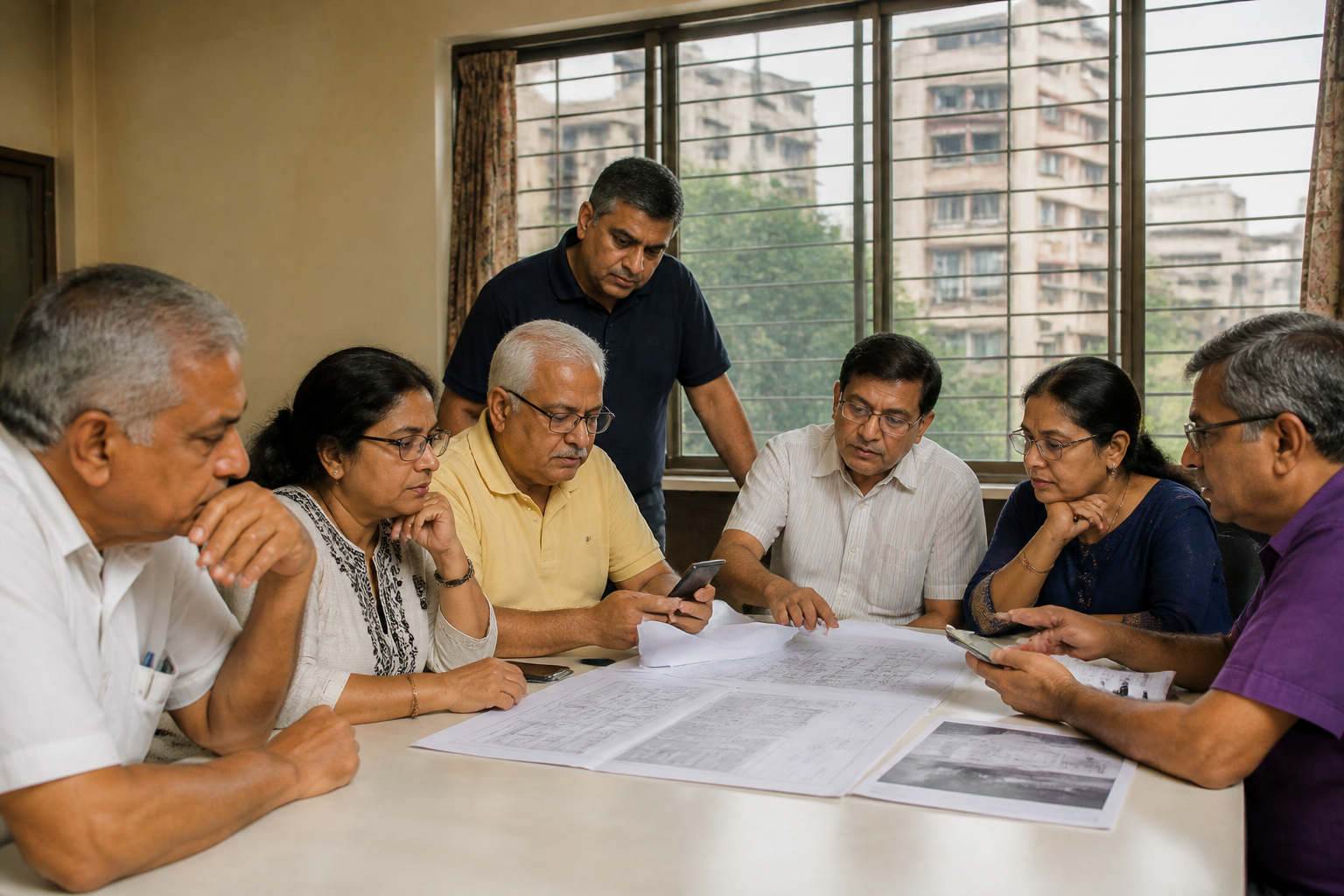
A new WhatsApp-based artificial intelligence service in Pune is attempting to address one of the most persistent problems in housing-society redevelopment: residents often have to make complex legal, financial, architectural and regulatory decisions without easy access to understandable information.
Called ‘RedevelopmentGuru’, the service has been launched through Dreams Redeveloped, a redevelopment consultancy started by entrepreneur S. Lakshminarayan. According to a report by Loksatta – Pune, residents can send questions through WhatsApp and receive answers on issues including the size of the home they may receive and when possession could be delivered.
The launch is significant less because it introduces another digital service than because it identifies a structural weakness in the redevelopment process. For a housing society, redevelopment can be a one-time decision involving a substantial share of members’ accumulated wealth. Developers, by contrast, deal with such projects repeatedly. That difference in experience creates an information imbalance before negotiations even begin.
The service is presented as an attempt to narrow that gap. Lakshminarayan told Loksatta – Pune that society members need clear information before taking decisions and that the platform aims to deliver reliable, verifiable material through a simple and accessible channel. The service has been designed, the report said, with senior citizens and residents who have invested much of their lifetime property wealth in their homes in mind.
That focus matters because redevelopment is not merely a construction transaction. It affects the ownership and use of an existing building, the terms offered to residents, the timing of relocation and return, and the way members assess a developer’s proposal. Questions that appear straightforward—such as the size of a replacement flat or the date on which possession will be given—can sit within a larger set of contractual, regulatory and financial conditions.
The information available about RedevelopmentGuru suggests that its operating model is based on a question-and-answer interface. Residents can ask questions directly on WhatsApp after sending the word “Guru” to the number 9699653592. The report says that the answers are connected to sources including MahaRERA records, the ownership history available through the Registration and Stamps Department, and relevant rules.
The reported use of these sources is an important part of the service’s stated proposition. Redevelopment decisions depend not only on what a developer or consultant says, but also on documents and records that can be checked. A digital tool that directs members towards such material could make the initial stage of information gathering less intimidating, particularly for residents who may not know which public record or regulatory provision is relevant to a question.
However, the source material does not establish how the service verifies its answers, how frequently its database is updated, or what happens when a question involves conflicting documents or a disputed interpretation of a rule. It also does not provide an independent assessment of the tool’s accuracy. These are not minor technical details. In redevelopment, an answer can influence how members evaluate a proposal, frame questions to a developer or decide whether professional legal and financial advice is required.
This is where the distinction between information access and professional advice becomes important. A WhatsApp answer may help a resident identify an issue, locate a record or prepare for a meeting. It cannot, on the evidence available in the report, be treated as proof that a particular redevelopment proposal is legally sound or financially beneficial. The service’s public value will therefore depend not only on how quickly it responds, but also on how clearly it identifies the limits of its answers.
The report says residents commonly ask about the area of the home they will receive and the date on which possession will be available. Those questions reveal the practical priorities of society members. They are also questions that can be difficult to assess in isolation. The promised area may need to be read alongside the definition of the area being offered, the configuration of the building, the treatment of common spaces and the terms of the agreement. Similarly, a possession date may be meaningful only when linked to contractual milestones and the consequences of delay.
The service is also intended to help members prepare for conversations with developers, housing societies, architects, lawyers and redevelopment specialists. That function could be as important as the automated answers themselves. A society that knows which questions to ask may be better placed to compare proposals and identify missing information. Yet the report does not state whether the platform reviews individual project documents, provides a formal comparison of bids or replaces direct consultation with qualified professionals. Those distinctions should remain clear to users.
Pune’s redevelopment activity forms the immediate setting for the service, but the underlying challenge is common to many urban housing societies. Existing residents are often organised collectively, while the technical and commercial aspects of redevelopment are handled by specialised professionals. The society must convert individual concerns into a common decision, while also assessing documents and commitments that may be unfamiliar to most members.
That makes communication a governance issue. A redevelopment decision is not simply a matter of whether a building should be rebuilt. It is also a test of whether all members can access the same information, understand the choices before them and participate in the decision-making process. A tool that works through a familiar messaging platform may reduce the first barrier—finding information—but it cannot by itself resolve disagreements within the society or settle questions that require formal interpretation.
The choice of WhatsApp is central to the service’s design. The report describes it as a direct channel through which residents can ask questions and receive immediate responses. This lowers the need for users to learn a new platform and could make the service more accessible to members who are less comfortable with specialised websites or formal databases. At the same time, ease of access can create a risk of overconfidence if users mistake a quick answer for a complete review of their project.
The most credible role for such a service, based on the information supplied, is therefore as an early-stage information and preparation tool. It can help residents formulate questions, locate relevant records and understand the vocabulary of redevelopment. Its effectiveness would need to be judged through evidence that is not included in the report: the accuracy of responses, the traceability of sources, the handling of sensitive documents, the process for correcting errors and the way users are directed to independent professional advice.
The involvement of public records also raises questions about source quality and document interpretation. MahaRERA records and ownership documents may provide important information, but a record’s existence does not automatically answer every question about a live redevelopment proposal. A digital service needs to show users what a source establishes, what it does not establish and whether the information reflects the latest available position. The source material does not provide details of the platform’s technical or editorial safeguards on these points.
For housing societies, the immediate benefit may lie in changing the balance of preparation before meetings and negotiations. Residents who previously relied on fragmented conversations could have a single channel for preliminary questions. But that benefit will remain limited if the service cannot distinguish between general guidance and project-specific advice, or if its answers are not supported by documents that members can independently inspect.
The launch also illustrates a broader pattern in urban housing: technology is increasingly being positioned as an intermediary between citizens and complex systems. In this case, the system is redevelopment, with its combination of property records, regulations, construction decisions and collective consent. The technology may simplify the interface, but it does not simplify the underlying responsibility. Members still need to examine agreements, question assumptions and make decisions through the society’s formal processes.
What the available evidence confirms is that RedevelopmentGuru has been launched in Pune by Dreams Redeveloped as a WhatsApp-based AI service for redevelopment-related questions. It is intended to address concerns about replacement-home area, possession timelines and the questions members should ask other stakeholders. What remains unestablished is the service’s independent accuracy, coverage, updating process and role in relation to qualified legal, financial and technical advice. Those are the issues that will determine whether the tool becomes a meaningful accountability aid or simply another layer in an already complex redevelopment process.
