


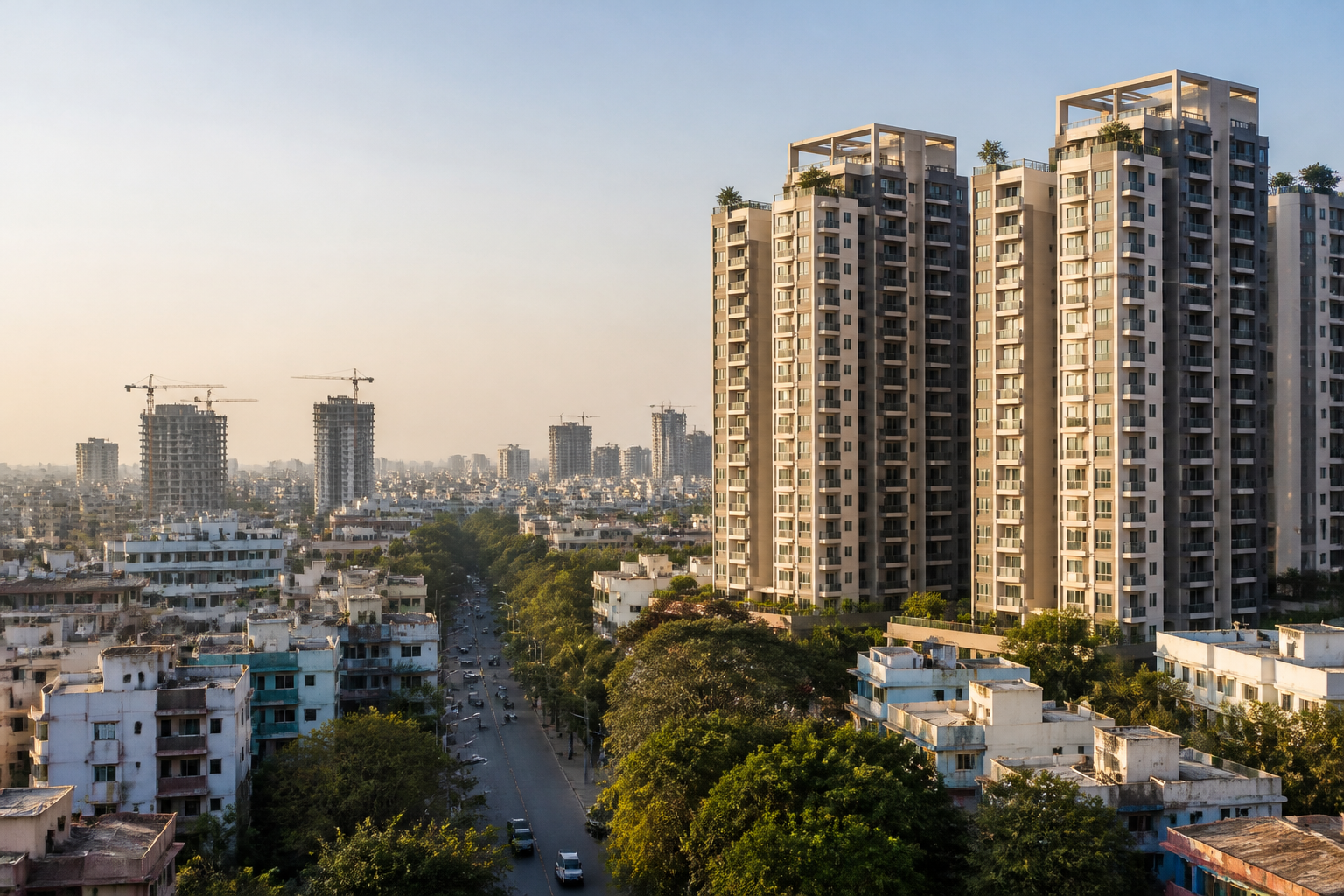
Pune’s real estate market is not experiencing a broad-based boom. It is undergoing a sharper change: total home sales have remained almost unchanged, while demand is moving decisively towards higher-priced housing and weakening in the lower-priced segment. The pattern reported by Knight Frank India’s latest assessment points to a residential market that is stable in volume but increasingly concentrated in homes that fewer households can afford.
Between January and September 2026, Pune recorded sales of 36,402 homes, compared with 36,447 during the same period a year earlier. The difference is only 45 units, indicating that the market’s headline volume has essentially remained flat. Yet that aggregate conceals a substantial shift in the composition of demand.
Sales of homes priced above ₹1 crore rose 32 per cent year on year to 13,372 units. Within that category, homes priced between ₹2 crore and ₹5 crore recorded an even stronger increase of 38 per cent, reaching 2,897 units. The share of higher-priced homes in Pune’s total sales increased from 28 per cent in 2025 to 37 per cent during the period covered by the report.
At the other end of the market, sales of homes priced below ₹50 lakh fell 22 per cent to 7,219 units. The ₹50 lakh to ₹1 crore segment remained the largest price band, with 15,811 homes sold. Taken together, these figures show that Pune’s residential demand is not simply rising or falling. It is being redistributed across price bands, with the strongest momentum at the upper end and the clearest contraction at the lower end.
That distinction matters because a stable sales total can make the housing market appear healthy without showing who is able to participate in it. If premium sales expand while lower-priced sales decline, the market may be sustaining transaction activity without improving access for households that are more sensitive to prices, borrowing costs and monthly repayment burdens. The supplied data does not establish the causes of the lower-priced decline, but it does establish that the two segments are moving in opposite directions.
## Pune real estate market shows a widening price split
The report records a controlled increase in Pune’s average residential prices. The average rate rose 4 per cent to ₹10,067 per square foot. Knight Frank India continues to describe Pune as one of the relatively affordable major housing markets in the country, but the price-band data introduces an important qualification: relative affordability at the city level does not mean that all segments of the market are equally accessible.
A city can remain more affordable than other major markets while still becoming less affordable for a large share of its own residents. The increase in premium sales and decline below ₹50 lakh suggest that affordability needs to be assessed not only through average prices, but also through the availability and absorption of homes at different price points.
The market’s supply figures add another layer. Developers and other market participants introduced 44,672 new homes in Pune during the nine-month period, considerably more than the 36,402 homes sold. At the level of reported units, this indicates that new supply exceeded sales during the period. The wider assessment covering eight major residential markets also recorded 279,899 new homes launched against 258,238 sales, with supply increasing 4 per cent year on year.
Knight Frank said the third quarter of the current financial year marked the 16th consecutive quarter in which new home additions exceeded sales across the eight major markets. This does not by itself demonstrate an oversupply in Pune, because the data supplied does not provide unsold inventory, project-level absorption or the location of the new homes. It does, however, show that developers are continuing to bring homes to market even as overall sales remain broadly stable.
The relationship between new supply and actual demand will therefore be more important than the supply number alone. New homes priced, located or designed for the households currently driving demand may continue to move through the market, while homes aimed at more price-sensitive buyers may face a different response. The report’s price-band results suggest that the composition of supply and demand deserves closer attention than citywide sales totals.
## What the premium housing surge does and does not show
The 32 per cent increase in sales above ₹1 crore is the most visible feature of the data. It indicates stronger purchasing activity in the premium segment, but it should not automatically be read as evidence that the entire city has become wealthier or that housing stress has eased. The data identifies a change in the homes being sold, not the income profile of buyers or the source of their purchasing capacity.
Knight Frank India’s Pune representative, Vilas Menon, attributed the market’s strength to the city’s robust office economy, controlled price growth and the sale of remaining homes in older projects. These are the explanations provided in the source report. They suggest that demand is being supported by both continuing economic activity and the absorption of previously available inventory, but the supplied material does not quantify the contribution of each factor.
The office economy is particularly relevant to the housing market because residential demand depends on the ability of households to sustain purchase prices over time. However, the report does not provide employment figures, household income data, mortgage information or buyer profiles. It is therefore not possible from the supplied evidence to determine whether the premium segment is being driven primarily by local salaried households, business owners, investors, non-resident buyers or a combination of groups.
The data does establish a clear market signal: high-value housing is not merely holding its share of sales; it is taking a larger share. At the same time, the largest individual segment remains the ₹50 lakh to ₹1 crore band, with 15,811 sales. This means Pune’s market has not become exclusively premium. Instead, it is becoming more polarised, with the middle band retaining substantial demand and the lower band losing ground.
That polarisation has consequences for the way housing supply should be read. A rise in total launches does not necessarily answer the needs of households unable to purchase below ₹50 lakh. Nor does the growth of premium sales establish that demand for lower-priced homes has disappeared. The decline could reflect changes in available stock, buyer preferences, financing conditions or the location of new projects, but these factors are not separately identified in the supplied report.
The institutional question behind the numbers
For Pune’s housing market, the central issue is not whether sales are rising or falling in isolation. It is whether the market is producing homes across a sufficiently broad range of prices and whether those homes are available in places connected to the city’s employment and transport systems. The supplied report does not provide neighbourhood-level data, so it cannot establish how the shift varies across Pune’s urban geography. It nevertheless raises the question because the lower-priced segment is contracting while premium demand is accelerating.
This is also why average price growth requires careful interpretation. A 4 per cent increase to ₹10,067 per square foot appears controlled in comparison with a sharper price escalation, and Knight Frank continues to classify Pune as relatively affordable among major markets. But an average is shaped by the mix of homes sold. If more transactions occur in expensive homes, the average can coexist with very different experiences across income groups and price bands.
The supply-demand gap reported for the nine-month period should similarly be understood as a market indicator rather than a complete affordability assessment. Pune saw 44,672 new homes introduced against 36,402 sales. Without data on unsold stock, completion status, tenure, location and price distribution, the figures cannot show whether the new supply is aligned with the households whose sales have weakened.
The report’s national comparison places Pune third among the eight major residential markets by sales, with a 14 per cent share of total sales. That position confirms the city’s importance in the broader housing market. It also means that the shift in Pune is not a marginal local development: it is part of the way a major urban housing market is responding to demand, pricing and supply conditions.
What remains clear is that Pune’s residential market is stable in total volume but changing in composition. Premium housing is expanding rapidly, the middle price band remains the largest, and homes below ₹50 lakh are losing sales. Prices have increased moderately, while new supply has outpaced sales during the period covered. The next evidence to watch is whether this pattern persists, how much of the new supply falls into each price category, and whether lower-priced sales recover or continue to decline. Those indicators will determine whether Pune’s apparent housing stability represents broad resilience or a market increasingly tilted towards households at the top end.
