


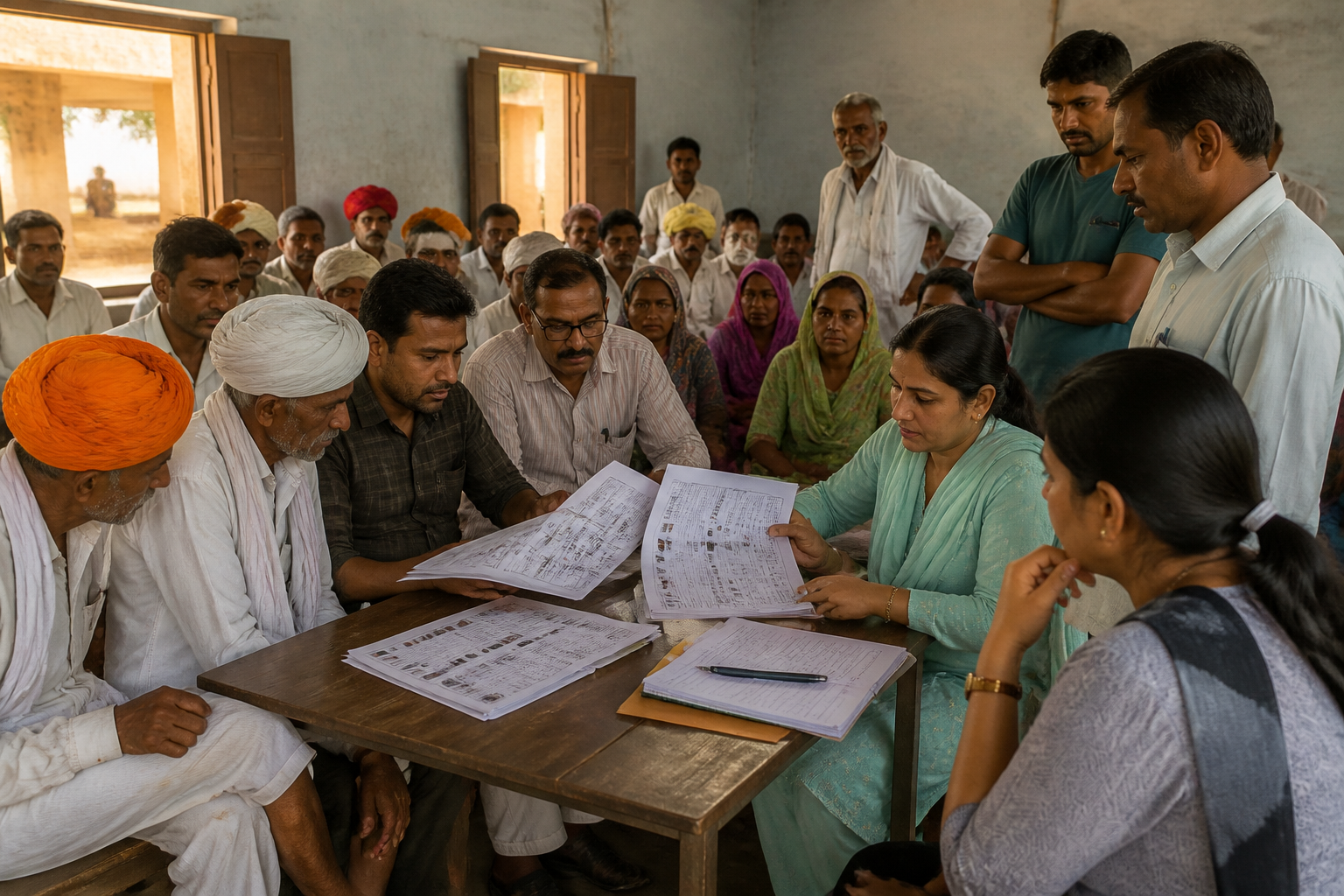
The dispute over Rajasthan’s 2026 voter-roll revision is not only about whether officials should read electoral rolls aloud in village and ward meetings. It is about which verification system citizens can actually see, challenge and correct. An RTI-based account of the state’s earlier revision shows that public participation led to around 16 lakh names being added after complaints about deleted genuine voters and retained ineligible names. Activists now say a similar public audit was refused during the latest Special Intensive Revision (SIR), raising questions about how errors can be detected after the final roll is published.
The issue has emerged after the Rajasthan chief electoral officer’s office declined a request for a public reading of revised rolls at a Gram Sabha in Delwara panchayat of Beawar district. The request was made on June 22, 2026, by activist and Mazdoor Kisan Shakti Sangathan founder Nikhil Dey and other civil society representatives. In a reply dated August 30, the election department said the March 2023 Manual on Electoral Rolls allows draft rolls to be read out during a special summary revision, but contains no instruction for reading final rolls at a Gram Sabha or Ward Sabha. The department also said the final rolls had been published on its website in February after the SIR.
Chief electoral officer Naveen Mahajan, responding to the activists’ charge, said the 2026 SIR was not a Rajasthan-specific exercise. “The Bihar template was adopted nationwide, so the ECI would be better placed to explain the rationale behind it,” he said, according to the report. That response points to an important institutional distinction: the state election office is implementing a process whose framework was designed at the national level, while citizens seeking additional local scrutiny are asking the state office to revive a practice used during an earlier revision.
The 2002-03 precedent is significant because it provides more than a general argument for participation. Documents obtained through the Right to Information Act show that complaints from civil society organisations and political parties prompted then Chief Election Commissioner James Lyngdoh to visit Rajasthan and meet groups in Jaipur. It was subsequently agreed that electoral rolls would be read out during door-to-door verification and displayed at Gram Sabha, Ward Sabha and Nukkad Sabha meetings so that omissions and errors could be identified.
Guidelines issued on August 6, 2003, followed that agreement. The resulting process, according to the RTI reply, added around 16 lakh names to the rolls. The number is important not simply because it is large, but because it demonstrates how a verification mechanism can change the official record when citizens are given a visible forum to contest omissions. A roll that appears complete in an office or on a website can look different when read out in the presence of neighbours, local representatives and affected households.
That difference goes to the heart of voter-roll administration. Electoral rolls are not static registers. They are continuously affected by migration, deaths, new adult voters, changes of address, household splits and errors in names or relationships. The supplied documents do not provide a complete assessment of the accuracy of the 2026 rolls. They do, however, show that the earlier process identified enough omissions to add around 16 lakh names, while the current process does not contain an equivalent instruction for public reading of final rolls at local assemblies.
The comparison also reveals that the two revisions were built around different reference systems. During the 2002-03 SIR, the existing electoral roll was used as the reference document for house-to-house verification, as stated in a July 2001 Election Commission of India letter. In the 2025-26 revision, voters were required to map their names, or the names of relatives, to the previous SIR roll. This changes the practical burden placed on electors. Instead of checking the current register against household information, the newer process requires people to establish a link with an earlier roll.
The source account identifies three further requirements introduced in the 2026 SIR: enumeration forms, mapping electors to the previous SIR roll and provisions concerning a “logical discrepancy”. Official documents relating to the 2002-03 revision, according to the RTI response, do not mention these requirements. Dey has demanded that all three be withdrawn. The report does not establish whether the demands will be accepted or how many voters have been affected by the new requirements.
The distinction matters because every additional administrative step creates a possible point of failure. A voter may be present in the current roll but unable to identify a matching name in an older register. Family names may have changed, records may contain spelling differences, and households may have moved between revisions. The supplied material does not quantify these problems, but it establishes that the 2026 process places greater emphasis on historical mapping and discrepancy checks than the 2002-03 process did.
It also describes a change in the role of citizenship-related documentation. The ECI’s special guidelines for the 2002-03 SIR stated that determining citizenship was not the responsibility of enumerators. In contrast, the current process examines citizenship documents when discrepancies arise. This does not by itself prove that eligible voters have been removed, but it changes the character of the interaction between the administration and the elector. A routine roll-verification exercise can become a document-based inquiry when a discrepancy is identified.
That is why the question of public audit cannot be separated from the question of administrative design. Public reading is not merely a symbolic consultation. It can create a local checking layer between the preparation of a roll and the citizen’s need to challenge an omission. Gram Sabhas, Ward Sabhas and neighbourhood meetings can bring together people who know whether a household exists, whether a listed voter has moved, or whether a name has been incorrectly excluded. They can also expose the limits of purely individual online verification, especially when citizens do not know that a record has changed.
The department’s reply draws a procedural boundary: the manual provides for reading draft rolls during special summary revision, but not final rolls at Gram Sabha or Ward Sabha meetings. This means the dispute is partly about timing. Reading a draft roll creates an opportunity to correct errors before final publication. Reading a final roll would provide a later audit of what was ultimately published. The election office’s position, as reported, is that the latter step is not provided for in the manual.
The institutional responsibility is consequently divided. The ECI sets the national framework and, according to the chief electoral officer, is the appropriate authority to explain the rationale behind the nationwide template. The state chief electoral office implements the revision in Rajasthan and responds to requests for local procedures. District and local institutions are the places where citizens would encounter the roll in practice. The effectiveness of the system depends on how these levels communicate, and on whether the formal rules create accessible channels for correction.
The Rajasthan case also shows why electoral administration is an urban and rural governance issue rather than a narrow election-season matter. Voter rolls are a basic civic database. They determine who can participate in elections, but the report also records Dey’s concern that changes in electoral rolls could have broader implications for access to government services. The supplied material does not establish a direct legal link between voter-roll status and entitlement to a particular service. It does establish that activists see the roll as part of a wider relationship between citizens and the state.
For cities and expanding settlements, the same structural problem appears in a different form. Frequent migration, informal housing, changing addresses and uneven documentation can make historical records difficult to match. The report focuses on Delwara panchayat and Rajasthan’s statewide process, so it does not provide city-level data on exclusions or discrepancies. But its evidence highlights a general administrative question: whether a digital publication of final rolls is sufficient when the people most likely to need correction may not have easy access to historical records, online systems or formal procedures.
The available numbers underline both the scale and the limits of the evidence. Around 16 lakh names were added after the 2002-03 public verification process. The report does not provide a corresponding figure for additions, deletions, objections or unresolved discrepancies in the 2026 SIR. Nor does it establish how many people sought a public reading of the final rolls beyond the request made for Delwara panchayat. Those gaps are important because they prevent a definitive conclusion about the accuracy of the latest revision.
What can be established is narrower but consequential. Rajasthan has a documented precedent in which public reading and local display followed complaints about voter deletions and resulted in a substantial number of additions. The 2026 process uses different requirements, including historical mapping and logical-discrepancy provisions. The state election office has said that the existing manual does not provide for reading final rolls at Gram Sabha or Ward Sabha meetings. Civil society groups argue that local participation remains necessary to detect errors and omissions.
The larger question is how electoral institutions should balance standardised national procedures with locally visible verification. Uniformity can make administration easier to coordinate, but a common template may not resolve the practical problems created by different settlement patterns, historical records and documentation conditions. Local public scrutiny can improve visibility, yet it also requires clear rules, responsible officials and a defined process for acting on objections.
The evidence currently confirms a procedural change and a dispute over the safeguards attached to it. It does not confirm widespread disenfranchisement or establish that the 2026 rolls are inaccurate. The developments that warrant monitoring are the Election Commission’s explanation of the nationwide template, the treatment of objections under the revised process, and whether any additional public verification is permitted or organised in Rajasthan. Those steps will determine whether the difference between the 2002-03 and 2025-26 revisions remains an administrative distinction or becomes a measurable difference in citizens’ ability to correct the electoral record.
