


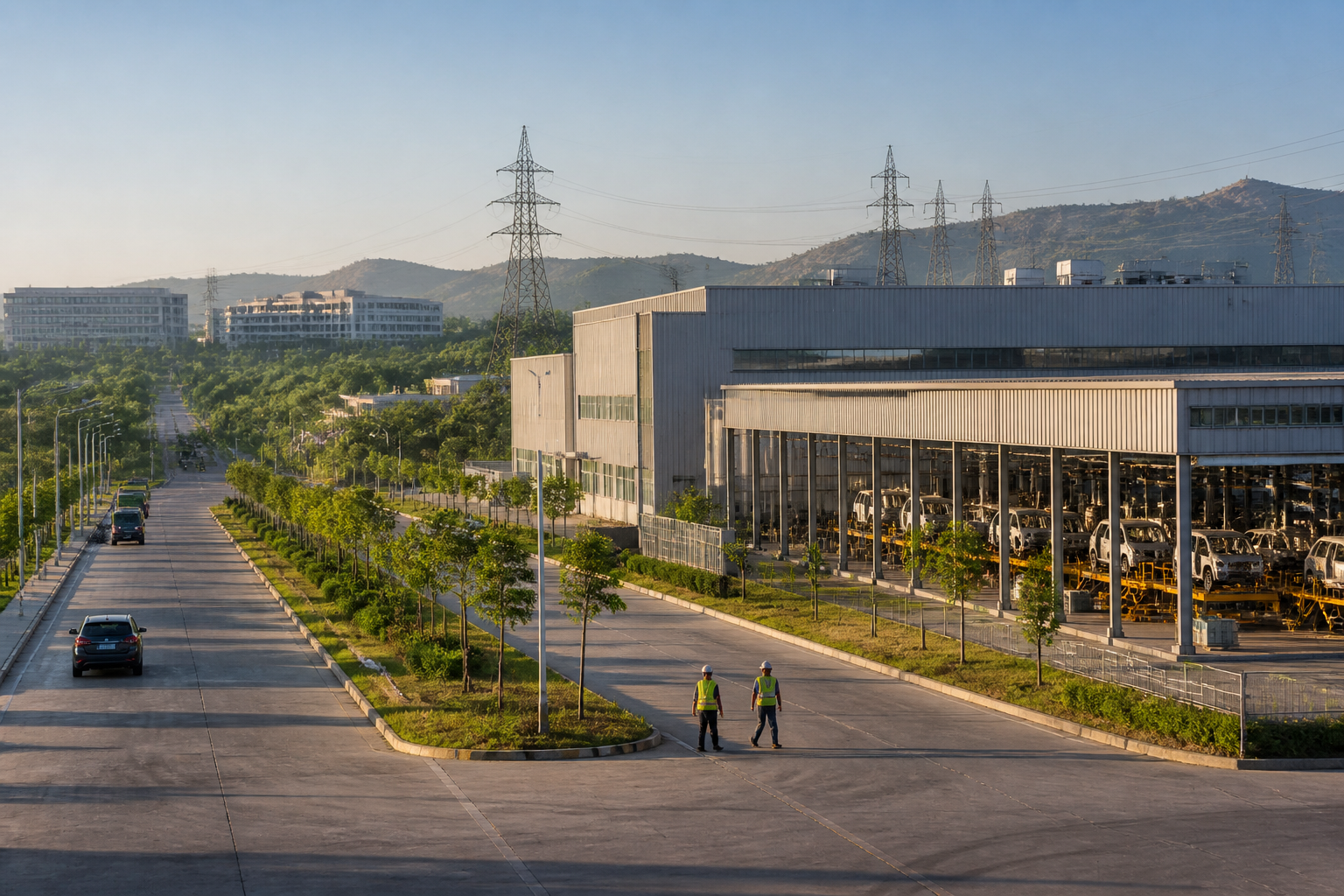
The Pune Growth Hub economic plan sets out an ambitious attempt to move the Pune economic region beyond its established identities as an automobile and information technology centre. Prepared under the initiative of the Maharashtra government and NITI Aayog, the plan aims to take the region’s economy to between $200 billion and $220 billion by 2036, supported by 58 priority projects, investments of ₹9 lakh crore to ₹10 lakh crore and an estimated 15 lakh to 20 lakh additional jobs.
The scale of the targets is significant, but the more important feature of the plan is its choice of growth sectors. It focuses on manufacturing, automobiles and electric vehicles, engineering goods, defence-robotics-drones, electronics and semiconductors, and biotechnology. Together, these sectors reveal an effort to deepen Pune’s existing industrial base rather than replace it with an entirely new economic model.
That distinction matters for a metropolitan region whose employment and infrastructure systems already extend well beyond the core city. The industrial belt covering Pimpri-Chinchwad, Bhosari, Chakan, Talegaon, Ranjangaon and Khed is identified in the report as a base for national and international companies. The plan’s success will therefore depend not only on attracting fresh investment, but also on how effectively these industrial locations are connected to skills, research institutions, suppliers, housing and transport.
The Pune Growth Hub plan is best understood as an attempt to convert an existing industrial ecosystem into a higher-value production network. The report identifies supply chains, skilled engineers, higher education institutions and operating industries as strengths that already support Pune’s manufacturing position. This gives the region a starting advantage, but it also creates an urban planning challenge: advanced production requires reliable infrastructure and coordinated institutions across multiple jurisdictions.
Pune’s automobile base is central to this transition. Tata Motors and Bajaj Auto already have a presence in the region, while Mercedes-Benz operates its only production plant in India in Pune, according to the report. The next stage is expected to involve electric vehicles and related technologies. The existing automobile ecosystem could help this shift by providing suppliers, engineering expertise and manufacturing capabilities that are difficult to build from scratch.
The reported announcement of an advanced battery research and development centre by COEP Technological University and JSW is an example of how the plan links industry with higher education. The centre is expected to involve an investment of ₹800 crore. Its significance lies not only in the amount proposed, but also in the institutional relationship it represents: a technology university and an industrial company working around a capability that is becoming increasingly important to electric mobility.
However, the available material does not establish the centre’s construction timeline, land requirements, operating structure or expected employment. Those details will be important in determining whether such projects become functioning parts of the regional economy or remain isolated announcements. The same applies to the plan’s 58 priority projects, for which the supplied report does not provide a project-wise list, funding schedule or implementation authority.
The engineering goods sector provides another bridge between Pune’s industrial past and its proposed technological future. The Bhosari, Pimpri-Chinchwad and Chakan belts are described as locations for manufacturers of machinery and equipment. A high-technology engineering park has also been proposed by the government. If implemented, such a park could give firms access to common infrastructure and help move production towards more sophisticated equipment. But its eventual urban impact will depend on where it is located, how it is financed and how it is connected to existing industrial clusters.
The defence, robotics and drone segment reflects a similar strategy. Pune has a combination of defence research and development institutions, engineering companies, universities, manufacturers and start-ups. The report presents this combination as a relatively rare concentration of capabilities. The opening of defence production to private companies is identified as a source of further opportunity, while Bharat Forge is cited as an important company in the sector.
The decision by the Mahratta Chamber of Commerce, Industries and Agriculture to establish a drone cluster is also presented as a potential boost to drone manufacturing. Yet the report does not specify the cluster’s location, investment, land area, participating companies or delivery schedule. These are not minor administrative details. They determine whether a cluster creates a durable production ecosystem or simply groups firms under a common label.
The plan’s employment target of 15 lakh to 20 lakh additional jobs raises a broader question about the kind of urban expansion Pune will need. Advanced manufacturing, engineering, electronics, biotechnology and robotics require different combinations of technical and managerial skills. A regional strategy based on these sectors will therefore place pressure on universities, vocational institutions, industrial training systems and employers to align curricula with actual demand.
It will also affect the geography of housing and mobility. The economic region named in the report includes multiple industrial locations spread across Pune district. Workers employed in these areas will require affordable housing near employment centres or dependable public and shared transport between residential and industrial zones. The supplied plan does not provide details on housing, mass transit, road capacity, water supply or waste management. Their absence from the available account does not mean they are absent from the full plan, but it leaves a central urban question unanswered.
The same issue applies to land and utilities. Manufacturing and technology facilities need serviced land, electricity, water, logistics access and predictable approvals. Expansion across Chakan, Talegaon, Ranjangaon, Khed and the Pimpri-Chinchwad-Bhosari belt can generate economic value, but it can also intensify competition for land and increase pressure on roads and civic networks. A regional economic strategy therefore cannot be separated from metropolitan governance and infrastructure planning.
The institutional structure described in the report is notable because both the state government and NITI Aayog have been involved in preparing the economic plan. That involvement gives the initiative a policy framework, but implementation will require coordination among state departments, local authorities, industrial agencies, universities, companies and industry bodies. The report does not identify a single delivery institution or explain how accountability for the 58 projects will be shared.
This is particularly important because Pune’s economic geography cuts across municipal and industrial jurisdictions. Pimpri-Chinchwad, Pune city and the surrounding industrial belts do not function as separate labour or supply markets, even when their administrative responsibilities differ. Investment decisions in one area can affect traffic, housing and public services in another. The plan’s regional ambition will therefore test whether economic planning can be coordinated at the same scale as the economy itself.
The headline numbers—$200 billion to $220 billion in economic output by 2036, ₹9 lakh crore to ₹10 lakh crore in investment and 15 lakh to 20 lakh jobs—give the plan a clear direction, but they are targets rather than demonstrated outcomes. The supplied material does not state the current size of the Pune economic region’s economy, the baseline employment figure, the expected contribution of each sector or the annual investment required to meet the targets. Without those baselines, progress will be difficult to measure.
A credible monitoring framework would need to connect each target to identifiable projects, funding commitments, completion dates and employment outcomes. It would also need to distinguish between announced investment and investment actually deployed, as well as between jobs generated during construction and long-term employment created by operating industries. The information available in the report does not yet establish whether such a framework has been published.
The plan nevertheless captures a significant transition in Pune’s urban economy. The region is not starting with an empty industrial map. It already has vehicle manufacturers, engineering companies, research institutions, universities, suppliers and start-ups. The proposed strategy seeks to combine these assets around newer areas such as electric vehicles, batteries, semiconductors, robotics, drones and biotechnology.
The larger urban question is whether economic growth can be matched by the systems that make growth liveable: transport, housing, utilities, skills and accountable regional governance. The Pune Growth Hub plan confirms the ambition to expand the region’s economic base. What remains to be established is the implementation architecture behind the 58 projects, the financing and sequencing of the proposed investments, and the mechanisms that will convert industrial growth into accessible jobs and functioning urban infrastructure. Those details will determine whether Pune’s next economic phase becomes a coordinated regional transformation or simply a larger collection of high-value projects.
