


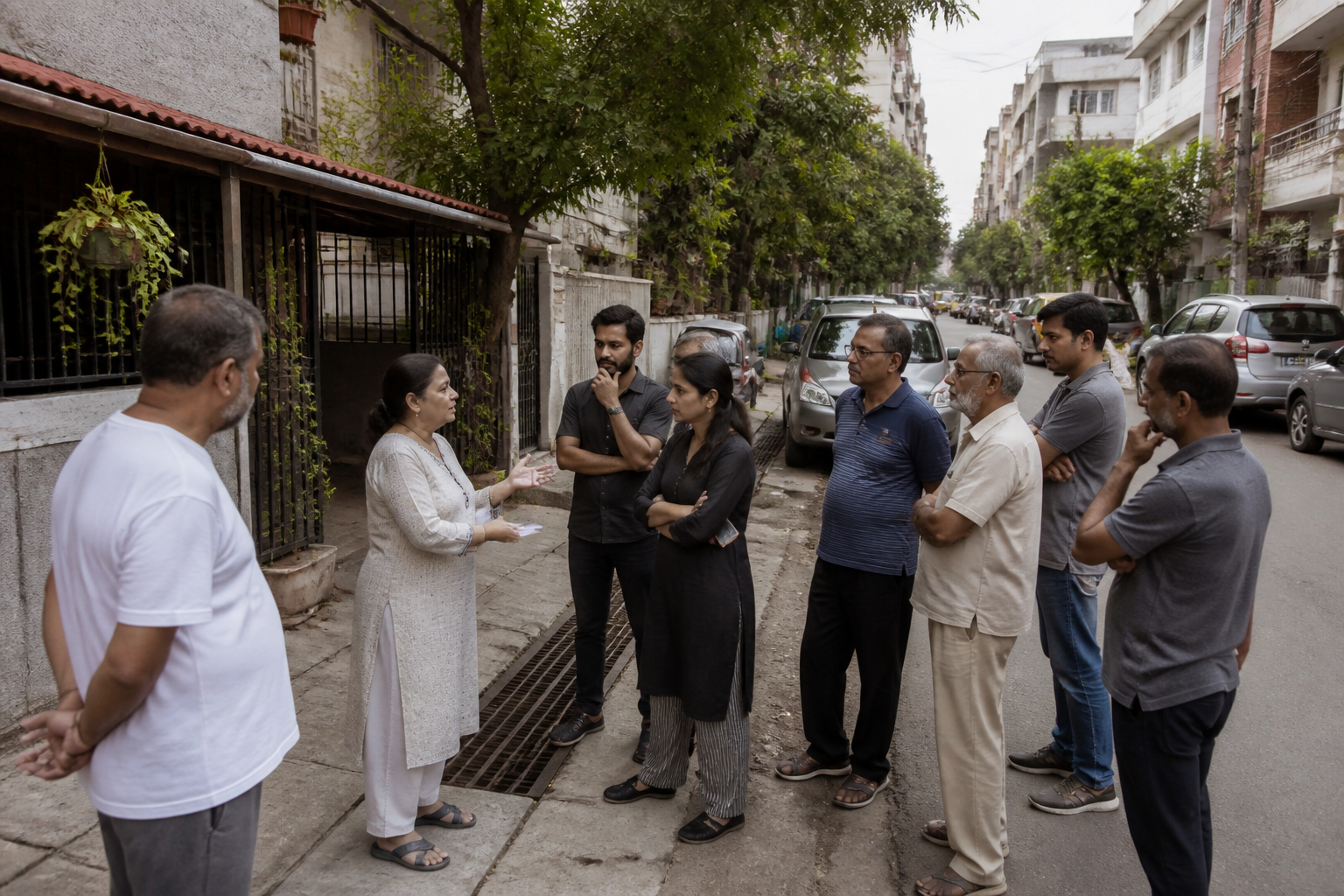
A proposed homestay-cum-café in Bengaluru’s HRBR Layout has brought a familiar urban conflict into the open: where does residential use end and commercial activity begin? Residents of 5th A Main Road are opposing Blossomly House over concerns about noise, pollution, parking, visitor movement and an alleged encroachment of a rajakaluve. The property owner, however, says the facility is intended as a no-smoking space with a library for young people and is not designed to inconvenience neighbours.
The dispute is important because the proposed property combines two uses that can affect a neighbourhood differently. A homestay introduces short-term visitors and a changing occupant profile into a residential setting, while a café creates regular customer movement, service activity, waste, exhaust and parking demand. The controversy therefore extends beyond whether one establishment should open. It raises questions about how Bengaluru’s expanding service economy is being accommodated within established residential layouts.
Residents have described the area as primarily residential and say the proposed facility could alter the character of the street. According to the report, they fear that a steady flow of visitors could increase conversations, gatherings, smoking and movement at different times of the day. Resident KR Prabhakar said that if 20 to 30 or more people gathered at the premises, neighbouring households could face nuisance and health concerns. He also pointed to the possible increase in noise as customers entered, left, talked and assembled at the property.
Parking is a second layer of the conflict. Residents said nearby roads were already facing commercial activity and pressure on available parking. A café and homestay can generate different parking patterns from a conventional residence: customers may arrive for short visits, staff may require longer-term parking, and guests may stay overnight. The supplied report does not establish the property’s expected capacity, parking provision or traffic assessment, but the residents’ objections show how even a relatively small commercial conversion can become a street-level governance issue when road space is limited.
The disagreement also reflects the difficulty of regulating activities that do not fit neatly into one category. A conventional residence, a homestay, a café and a mixed-use property may each be subject to different permissions or compliance requirements. Residents have written to the Bengaluru North City Corporation seeking verification of zoning, land-use compliance and clearance related to the rajakaluve. Their request places the dispute within the formal administrative system rather than leaving it solely as a conflict between neighbours and a property owner.
The rajakaluve allegation adds an infrastructure and public-safety dimension. The report says residents have raised concerns over an alleged encroachment beside the property, but it does not establish whether an encroachment has occurred or whether any authority has confirmed it. That distinction matters. Drainage corridors are not simply private boundary questions; any dispute involving them requires examination of records, site conditions and the responsible civic authority. In this case, residents are seeking clarity from the corporation, while the available report does not record a final administrative finding.
The owner’s response illustrates the other side of Bengaluru’s changing urban economy. Sachin Jain said the café was intended to “give back something to the society” and rejected the suggestion that the project was highly commercial. He said the premises would be a strict no-smoking zone and that he planned to include a library alongside the homestay. His explanation presents the facility as a curated social and cultural space rather than a conventional café, but the residents’ objection is centred on the activity generated outside the property as much as on the owner’s stated intention inside it.
This is the central planning question in the HRBR Layout dispute: should permissions be assessed mainly by the operator’s stated purpose, or by the likely external impact on the surrounding street? A library, a no-smoking policy or a quieter format may shape how a facility functions, but they do not by themselves answer questions about visitor volume, operating hours, parking, deliveries, waste, exhaust systems or access. The supplied report does not provide those details, which is why the residents’ demand for permission and compliance checks is significant.
The former leader of opposition of the erstwhile Bruhat Bengaluru Mahanagara Palike who joined the protest said the area was purely residential and that commercial development would not be allowed. That position reflects a strict land-use argument. Yet the report also indicates that residents believe commercial activity is already increasing on neighbouring roads. This suggests that the dispute is not only about a single proposed property, but also about cumulative change: one establishment may appear manageable in isolation, while several establishments can gradually alter parking availability, street noise and the everyday use of a residential area.
For Bengaluru’s civic administration, such disputes require more than a yes-or-no decision on one establishment. The relevant questions include which land-use permissions apply, whether the proposed combination of accommodation and food service is compliant, whether the property has adequate parking and whether the exhaust and drainage arrangements meet applicable requirements. The report identifies the Bengaluru North City Corporation as the authority approached by residents, but it does not record the corporation’s response or any final decision on the project.
The conflict also shows why neighbourhood-level participation becomes important when land uses change incrementally. Gomathy Venkatesan, who said she had lived in the area for 35 years, alleged that her objections were not taken into consideration and that she was told to bear the issues, stay or vacate. That account is attributed to the resident and is not independently adjudicated in the supplied material. It nevertheless demonstrates the trust deficit that can emerge when long-term residents feel that decisions affecting their street are being made without adequate consultation.
At the same time, the owner’s statement shows why blanket opposition can become difficult to apply in a city where residential and commercial functions increasingly overlap. Bengaluru’s neighbourhoods contain home-based work, short-term accommodation, cafés, clinics and other services. The question is not simply whether urban areas should change, but whether that change is governed through clear rules that account for cumulative impacts. The HRBR Layout case puts that unresolved question at street level.
The evidence currently confirms a live dispute, not a final finding that the proposed homestay-cum-café is illegal or that its operation will cause the effects feared by residents. Residents have raised specific concerns and sought verification from the civic authority. The owner has offered a different description of the project and denied that it is intended to create inconvenience. The next decisive information will be the corporation’s position on zoning, land-use compliance, the rajakaluve issue and the permissions required for the combined homestay and café use. Until then, the case remains a clear example of how Bengaluru’s changing property uses are testing the boundaries of residential neighbourhood governance.
