


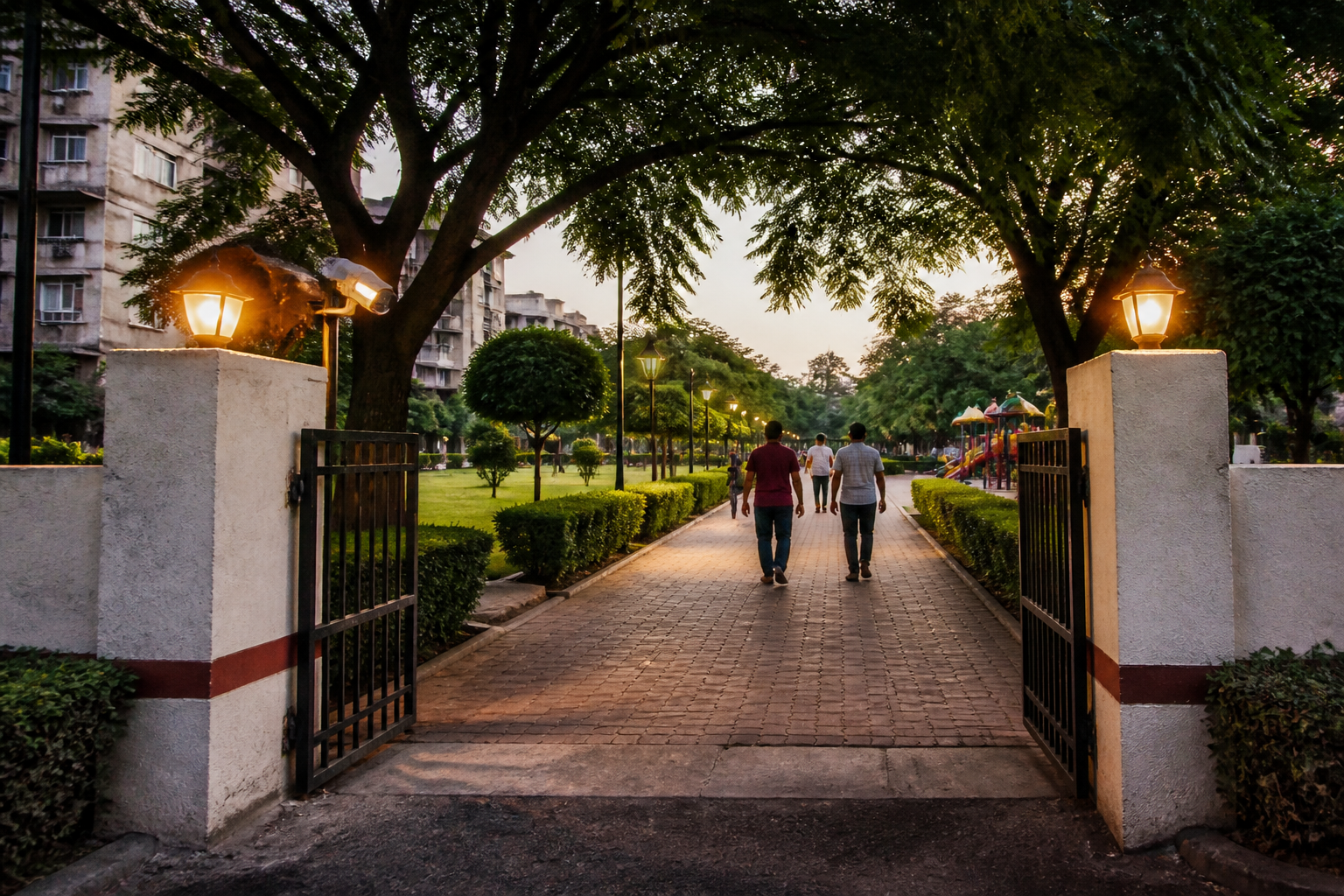
The Municipal Corporation of Delhi’s plan to make neighbourhood parks safer is built around a practical problem: security cannot be separated from the everyday condition of public space. The proposal includes CCTV cameras, guards, contact boards and police patrols, but the corporation’s own audit process shows that safety also depends on lighting, vegetation, boundary walls, entrances, staffing and routine maintenance.
The MCD has directed senior horticulture officials to inspect parks every one to two weeks and has begun a wider audit using a field inspection form covering 15 safety parameters. The exercise is based on directions from Lieutenant Governor T S Sandhu. Officials have been asked to complete the inspection proforma within a week, while work on some of the identified problem areas has already started.
This is more than a surveillance proposal. It is an attempt to create a regular administrative system for identifying risks in parks that are spread across residential neighbourhoods and vary considerably in size, use and physical condition. The audit is expected to record whether a park is properly illuminated, whether vegetation blocks visibility, whether abandoned or unused structures are present, and whether boundary walls, gates and entry points are secure.
The checklist also covers lighting near toilets and approaches, dark or blind spots, thick bushes that could conceal a person, children’s play areas and parking spaces. Officials are required to examine the deployment of security personnel, unauthorised gatherings or activities, whether a park becomes deserted, and whether residents have reported incidents such as snatching, fights or harassment. Vulnerabilities created by the surrounding area are also part of the assessment.
That breadth is significant because a park’s safety is rarely determined by one intervention. A camera may record an incident, but it does not illuminate a dark path. A guard may deter unauthorised activity, but cannot compensate for a broken gate or dense vegetation that blocks sightlines. Police patrols may improve response, but their effectiveness will depend on access, coordination and whether risks are identified before an incident occurs.
An MCD official said recurring problems had been found across parks and that preventive measures would be planned after the survey. In the immediate term, officials have been instructed to prune bushes and hedges, remove green waste, repair boundaries and entrance gates, and coordinate with other departments for proper lighting. These measures place basic maintenance at the centre of the safety response.
The proposed scale is considerably larger than the corporation’s current security deployment. The MCD maintains more than 15,000 parks, including a large number of small neighbourhood spaces. Its proposal covers CCTV cameras at prominent points in 1,000 parks, at least two security guards in each of those parks, display boards with officials’ contact details, and coordination with Delhi Police for regular patrolling.
At present, security guards are deployed in only 43 parks spread over two acres or more. The MCD has argued that most of its parks are located in residential areas and surrounded by houses, reducing the need for guards. The source report also records another explanation: a fund crunch has contributed to the limited deployment of security personnel. The difference between the existing arrangement and the proposed programme therefore raises an implementation question about whether the plan is a targeted upgrade or the beginning of a much wider recurring expenditure.
The proposal will be sent to the Delhi government, which will examine its feasibility. That step matters because the immediate announcement is not the same as an approved or funded programme. The corporation will need a dedicated budget allocation, and the proposal will have to move from inspection to procurement, installation, staffing, operations and maintenance. Each stage creates a separate administrative requirement.
CCTV is a particularly clear example. The MCD official quoted in the report said installing cameras was not the main challenge. The more difficult questions involve operating and maintaining them, creating logistics for the system, and deciding how footage will be recorded. Without clarity on who monitors the feeds, how long recordings are retained, how faults are reported and which department responds to incidents, the cameras could become equipment without a dependable safety system around them.
The possible role of resident welfare associations adds another layer. Some RWAs may be interested in accessing parks or taking responsibility for their maintenance. In some cases, they may already have cameras facing park entrances as a deterrent. This suggests that neighbourhood-level participation already exists in parts of the system, but it also raises questions about standardisation, accountability and access. A camera installed by a local association and a camera installed through a municipal programme may not follow the same operating or maintenance arrangements.
The staffing figures show why the safety plan cannot be separated from the MCD’s wider horticulture capacity. The corporation has around 4,100 staff, including approximately 3,000 contractual multi-tasking staff, against 6,422 sanctioned posts. The gap is not presented as a direct measure of park security, but it helps explain the administrative pressure surrounding inspection, pruning, waste removal, repairs and monitoring across thousands of sites.
Councillors have repeatedly raised shortages of horticulture staff in standing committee and House meetings, according to the report. That institutional context is important. A safety audit can identify a blind spot or an overgrown hedge, but the value of the audit depends on whether the responsible department has enough personnel, equipment and funds to correct the problem and check it again later.
The proposed model also exposes the difficulty of managing parks as both ecological spaces and public facilities. Officials cautioned that security measures must be balanced with ecological concerns. Excessive artificial lighting can disrupt the biological clocks of birds, interfere with migration patterns and affect their survival. The issue is therefore not simply whether parks should be made brighter, but where lighting is necessary, how it is designed, and how safety can be improved without treating the entire park as a continuously illuminated hardscape.
This trade-off is especially relevant because the proposed audit includes thick bushes, vegetation that obstructs visibility and dark areas. The immediate response could involve pruning or additional lights, but the source material does not establish that every dense or unlit area is unsafe or that uniform clearing would be appropriate. The ecological caution indicates that the corporation will need location-specific decisions rather than a single template applied to all parks.
The numbers also reveal the scale of the governance challenge. The MCD’s park network is more than 15 times larger than the 1,000 parks included in the current CCTV and guard proposal. Even if the first phase is implemented, most parks would remain outside the stated coverage. At the same time, the corporation says many parks are small and situated within residential areas, meaning that size, surrounding housing and patterns of use may influence the level of security required.
The audit approach could help create that differentiation if it is used consistently. A park that is busy throughout the day, includes toilets and children’s play equipment, or has reported incidents may require a different combination of lighting, patrolling and staff presence from a smaller, quieter green space. The 15-parameter proforma provides a possible common basis for comparison, but the supplied information does not yet indicate how the findings will be ranked, published or converted into funded work orders.
The institutional arrangement is similarly distributed. MCD officials are responsible for horticulture and park conditions. The Delhi government will examine the feasibility of the proposal and may need to consider the requested budget allocation. Delhi Police would be involved in regular patrolling, while RWAs may have a role in access, maintenance or existing camera systems. The plan’s success will therefore depend on coordination between agencies with different responsibilities and resources.
For residents, the immediate changes are expected to be visible first through maintenance: trimmed hedges, removed green waste, repaired boundaries and gates, better lighting and information boards carrying officials’ contact details. These are relatively direct interventions. CCTV installation, guard deployment and regular police patrols require longer-term operating arrangements, and the source does not state when the proposal will be approved or implemented.
The central lesson from the MCD’s plan is that public-park safety is an operational issue before it becomes a technology issue. Cameras and guards are the most visible elements of the proposal, but the audit puts equal emphasis on routine inspections, physical upkeep, staffing and coordination. The programme will need a dedicated budget, a defined maintenance model and clear responsibilities if the proposed equipment and personnel are to remain functional.
The next formal step is for the MCD to send its proposal to the Delhi government for a feasibility examination. Until that process is completed, the 1,000-park plan remains a proposal rather than a confirmed citywide rollout. The audit and the corporation’s initial maintenance instructions will indicate whether Delhi’s park-safety response develops into a funded operating system or remains a series of corrective measures across an unevenly maintained network.

