


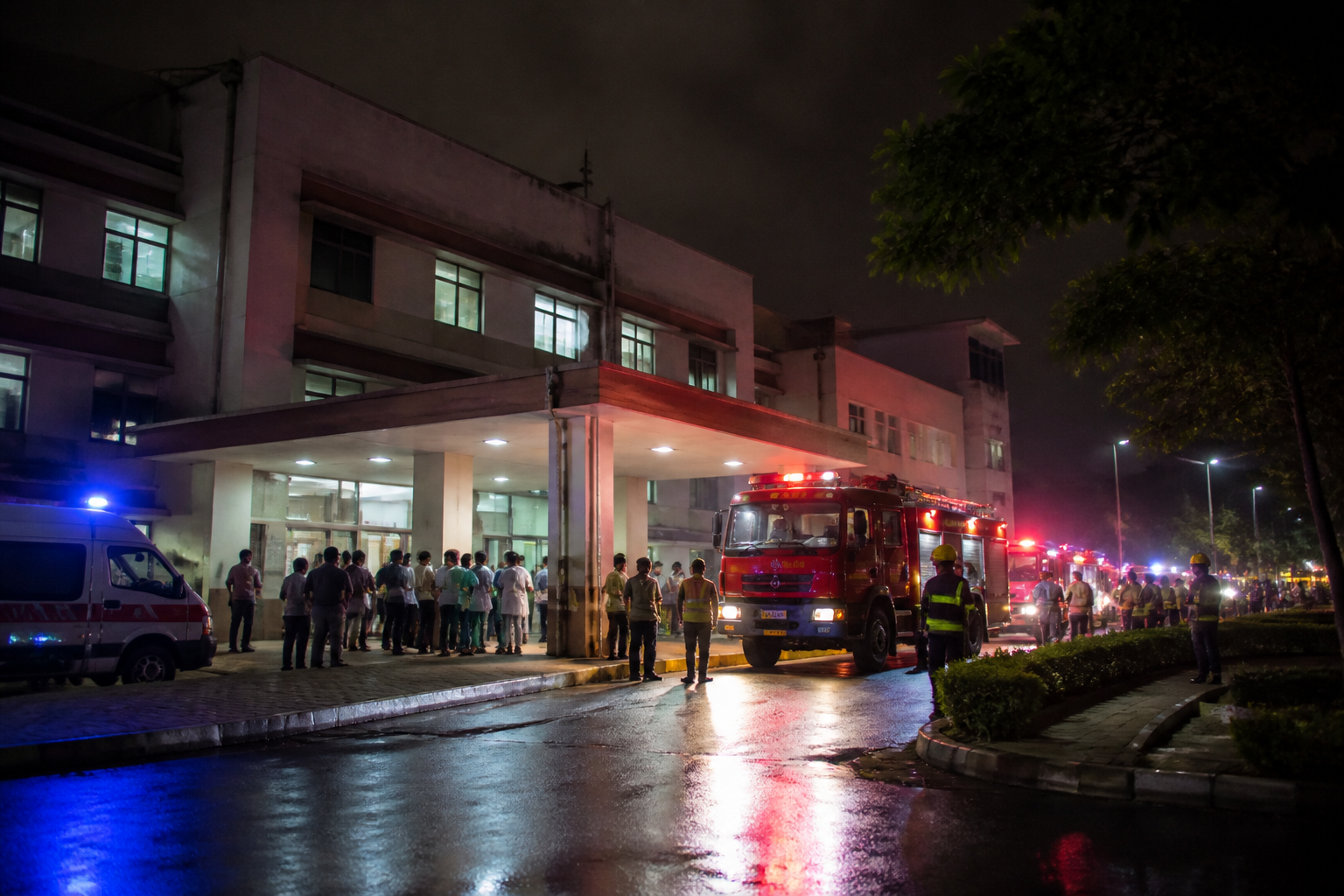
The Amravati District Women’s Hospital fire that killed three infants in its Neonatal Intensive Care Unit has moved beyond the question of how the blaze began. Freshly presented CCTV footage and renewed demands for an independent inquiry have placed attention on the hospital’s emergency-response chain: whether alarms were noticed, whether staff could act quickly, whether fire equipment was effective and why the government’s inquiry report has not been made public.
The fire occurred on August 24 at about 2.50 am, according to former minister of state Sunil Deshmukh, who presented CCTV footage to the media and demanded a thorough probe. Deshmukh alleged that the footage showed two nurses sleeping in a lobby outside the ward and failing to wake when the fire alarm rang three times. He also said red warning lights flashed before an explosion was heard. These are allegations based on Deshmukh’s reading of the footage and are not independently established in the supplied report.
Deshmukh said the fire began when a ventilator exploded inside the NICU. According to his account, the nurses woke up screaming after hearing the explosion, while other hospital staff rushed to the ward and attempted to control the blaze with small fire extinguishers. The footage, as described in the report, therefore raises questions not only about individual response but also about the design and reliability of the hospital’s fire-safety system.
In a neonatal intensive care unit, the margin for delay is exceptionally narrow. Infants depend on medical equipment, continuous monitoring and rapid intervention by trained staff. A fire emergency in such a setting requires more than an alarm or extinguisher in isolation. It depends on a connected system in which alarms are audible and visible, staff are alert and trained, equipment is functional, evacuation routes are usable and external responders can reach the facility quickly.
The available account does not establish whether the hospital’s alarm system functioned according to its design, whether staff had received recent emergency training or whether fire-safety drills had been conducted. It also does not establish the condition, number or placement of the extinguishers used by the staff. Those unanswered questions are central to determining whether the tragedy resulted from an isolated equipment failure, a breakdown in emergency procedures or wider institutional shortcomings.
Deshmukh additionally alleged that the hospital’s fire-control system was of inferior quality. He said fire brigade tenders arrived only at about 3.30 am, a claim that raises a separate question about the response time between the reported outbreak at 2.50 am and the arrival of external fire services. The supplied report does not provide an official timeline from the hospital, fire brigade or state government to confirm the arrival time or explain the delay.
That gap matters because emergency response is an institutional process. Hospitals operate within a broader public system involving health authorities, municipal or local fire services, building safety requirements and facility-level management. A hospital may possess alarms and extinguishers, but their public-safety value depends on maintenance, staffing, clear responsibility and regular testing. The incident has brought these operational links into focus without yet providing enough public evidence to assess where the chain failed.
The state government did initiate an official response. Health minister Prakash Abitkar travelled to Amravati and inspected the hospital after the fire. On the same day, an 11-member high-level committee headed by the commissioner of the National Health Mission was constituted. The committee has submitted its inquiry report to the government, according to the report, but the findings have not been made public.
The committee’s composition and mandate, as described in the supplied material, are limited. The report does not state which departments or technical agencies were represented, whether the panel examined the CCTV footage, whether it inspected the ventilator and fire-control equipment, or whether it recorded statements from nurses, doctors, hospital administrators and fire-service personnel. It also does not say whether the committee was empowered to recommend disciplinary action, criminal investigation, equipment replacement or changes to hospital safety protocols.
The non-publication of the inquiry report has become part of the controversy. Chief minister Devendra Fadnavis recently told journalists that the report would be released soon and would silence the opposition. That statement indicates that the government considers publication imminent, but the supplied report does not provide a release date or the findings themselves. Until the document is made public, the official explanation for the fire and the government’s assessment of responsibility remain unavailable for independent scrutiny.
The difference between an allegation and an established finding is especially important in a case involving hospital workers. Deshmukh’s presentation of the CCTV footage has intensified demands for accountability, but the footage’s interpretation, the precise sequence of events and the performance of the alarm system must be assessed through a formal inquiry. A public report should clarify what the cameras show, what the alarms recorded, when staff became aware of the fire, what action followed and how the response compares with the hospital’s approved emergency procedures.
The incident also exposes a recurring governance problem in public infrastructure: responsibility is often distributed across multiple institutions, while accountability is expected from one visible authority. A hospital administration may manage day-to-day operations, health departments may control staffing and procurement, fire authorities may oversee safety compliance and government committees may investigate failures after an incident. Without a transparent record of responsibilities, it becomes difficult for families and citizens to know who was expected to prevent the failure and who must correct it.
The available facts show that three infants died in the NICU fire, that a ventilator explosion was identified by Deshmukh as the trigger, that CCTV footage was presented to the media, and that the state formed an 11-member committee whose report has been submitted but not released. They do not yet establish the technical cause of the explosion, whether the alarms functioned properly, whether the nurses heard or ignored the alarms, why fire services allegedly arrived at 3.30 am, or whether the hospital’s fire-control system met required standards.
Those distinctions should guide the next stage of public scrutiny. The government’s inquiry report, once released, will need to be read alongside the CCTV footage, equipment inspection records, fire-service logs and the hospital’s emergency protocols. It should also make clear whether corrective action has been ordered and whether similar safety checks are being carried out in other public hospitals with neonatal and intensive-care facilities.
For now, the Amravati case remains a test of whether a fatal hospital fire will produce only a post-incident explanation or a transparent examination of how safety systems are designed, maintained and monitored before disaster strikes. The immediate official milestone is the publication of the high-level committee’s inquiry report, which the chief minister has said will be released soon.

