


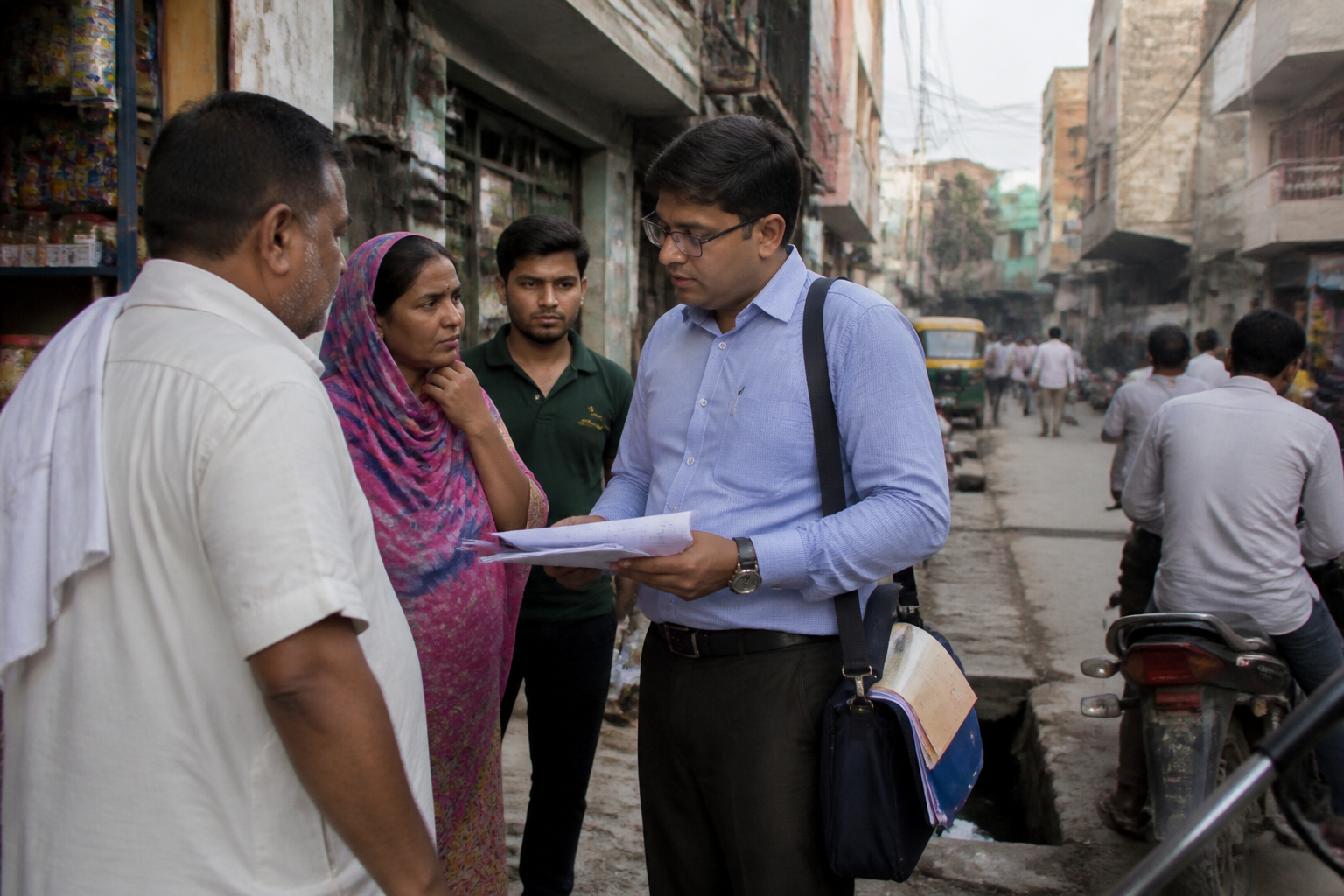
Delhi’s Special Intensive Revision of electoral rolls is being carried out not in a clean database or a neatly numbered neighbourhood, but through narrow lanes where houses are difficult to locate, properties have been subdivided without updated registration and residents often rely on shopkeepers or relatives to identify one another. The experience of booth-level officer Inamul Hasan, reported by The Indian Express, shows how a formal voter-verification exercise collides with the informal physical structure of the city.
Hasan’s working day captures the scale of that collision. After teaching Urdu to Classes 6 to 10 and invigilating a three-hour examination at a government school in Sarai Kale Khan, he began his work as a booth-level officer in the same area. His task was to serve notices to electors and conduct hearings for those required to establish their eligibility for inclusion in the final voter list, scheduled for release on December 4.
His first assignment was to find House 76. The notice was addressed to Shubham Basishta and two members of his family, Mamta and Geeta Devi. Hasan had been working in the area for around three months, but had never seen the house. Calls to Shubham went unanswered, and residents in the lane said there was no House 76. The only visible house number appeared to be 86T, linked by residents to a large ancestral khasra that had gradually been subdivided.
The search then moved through the neighbourhood’s informal information network. A banner near a shop suggested where House 76 might be located. A resident directed Hasan to a samosa shopkeeper, who in turn pointed him towards a grocery shop owned by one of Shubham’s relatives. After several attempts, Hasan found the cousin in a cramped shop and completed the documentation for Shubham and his family.
This is more than an anecdote about a difficult field visit. It illustrates a basic administrative problem: electoral records require stable and identifiable addresses, while parts of Delhi’s urban fabric operate through inherited land references, informal subdivisions and social familiarity. The report does not establish how widespread this condition is across the capital, but Hasan’s assigned area shows how the absence of clear physical identifiers can turn a routine notice into a prolonged search.
The setting described in the report is also important. In the lanes of Kale Khan, cars, motorcycles, tempos, cows, dogs and goats compete for limited space. Open drains run beside broken roads and water-filled potholes. These conditions do not directly determine whether a person appears on the voter list, but they shape the practical environment in which public administration takes place. A field worker moving through such an area cannot rely on a simple sequence of numbered houses or uninterrupted access.
The administrative burden is visible in the numbers attached to Hasan’s assignment. Of 519 electors allotted to him, notices had been issued to 137. He still had to serve notices to 30 people and conduct hearings for another 100. In only three hours on the ground, he distributed five notices and conducted two hearings. The work involved locating people, explaining documentation requirements, completing acknowledgement forms, photographing forms, uploading records and photographing recipients with their notices.
The process also depends heavily on the officer’s ability to answer individual questions. Electors repeatedly called Hasan to ask which documents they needed, when and where they had to appear for a hearing, and what they should do next. In one case, a nearby shopkeeper named Parvesh arrived with a notice and asked what documents were required. Hasan explained that two documents could be submitted from options including an Aadhaar card, PAN card, bank account proof, birth certificate or school marksheet. Because Parvesh had his Aadhaar card and passbook with him, Hasan conducted the hearing immediately.
That episode shows how administrative access is often shaped by timing and proximity. A resident who happens to meet the booth-level officer, has the required documents available and can complete the process at a nearby shop may move through the system more easily than someone who cannot locate the officer, understand the notice or reach a hearing. The report does not provide a comparison between residents who completed the process and those who did not, but it records the multiple points at which practical obstacles arise.
Hasan’s workload is not limited to the revision exercise. He is a government schoolteacher who began his day at 5 am, reached school by 7.30 am and spent the morning teaching and invigilating. When he returned home around 6 pm, more than 200 examination papers were waiting to be checked. The SIR assignment therefore operates as an additional public duty layered onto an existing workload rather than as an isolated administrative role.
That arrangement has consequences for the capacity of the process, even without assuming an outcome. Hasan’s account, as reported by The Indian Express, raises questions about how much time a booth-level officer can devote to each elector when the assignment includes field searches, hearings, documentation, digital uploads and repeated queries. The report also records the irritation of a shopkeeper who asked whether people were expected to shut their shops and spend the entire day completing the process.
The institutional structure visible here is one in which the state reaches residents through temporary, localised human contact. The booth-level officer is the link between the electoral system and the neighbourhood. Yet the officer is not working with a fully legible city. House numbers may be absent, addresses may be known by older land references, and local knowledge may be necessary to identify a resident. The result is an administrative process that depends not only on official records but also on shopkeepers, relatives and residents who can interpret the area’s social geography.
This dependence on local knowledge can make administration possible, but it also exposes the limits of formal systems when they encounter informal urbanisation. A property may be physically occupied and socially well known while remaining difficult to identify through a conventional address. A family may be recognised through kinship or a business location even when its house cannot be found by number. The report does not establish the legal status of these properties or explain why the addresses were not updated; it does show that the gap between lived residence and administrative description is operationally significant.
The story also connects electoral administration to the wider question of how Indian cities record occupancy, property and identity. The same address can matter differently to different institutions: as a voter’s residence, a property location, a service connection or a local landmark. When these systems do not align, frontline workers must reconcile them manually. In Hasan’s case, finding one elector required a chain of directions across streets and shops rather than a straightforward visit to a numbered dwelling.
The evidence supplied in the report cannot establish whether the broader revision will produce exclusions, corrections or additions to the voter list. It does not provide a citywide count of untraceable addresses, the number of officers facing similar conditions or the final number of notices resolved. Those questions remain outside the material available here. What the report does establish is the intensity of the work required before a notice can become a completed hearing or an updated record.
Delhi’s SIR is therefore also a test of administrative legibility. The exercise requires the electoral system to identify people accurately, reach them physically and process their documentation within a defined schedule. In Sarai Kale Khan, each of those steps depends on time, local knowledge, accessible records and an officer already carrying another public responsibility. The immediate milestone is the release of the final voter list on December 4, but the deeper issue is whether the city’s official systems can keep pace with the complex, shifting and unevenly documented places where its residents live.

