


Delhi’s voter list revision has moved from a data-cleaning exercise to a test of whether a highly mobile city can keep its electoral records accurate without excluding eligible residents. By October 20, authorities had received 4,56,913 Form 6 applications to add names to the electoral roll, but only about 1.15 lakh had been disposed of, according to a report by Jagran – New Delhi.
The figures follow the publication of a draft electoral roll on August 31 that removed approximately 47.56 lakh names. The ongoing response includes fresh applications, household verification and special Sunday camps intended to help residents add their names, correct records and raise complaints. The process is therefore not only about restoring names. It is also exposing how difficult it is for election administration to track citizens who rent homes, change addresses for work or struggle to complete online procedures.
The central administrative challenge is straightforward: electoral rolls are maintained against addresses, while Delhi’s population is constantly moving between neighbourhoods and districts. A resident who changes accommodation may remain eligible to vote in the city but become difficult to verify at the old address. A worker who is away during the day may not meet a booth-level officer during a household visit. An elderly couple may remain at the same location but still find their records marked incorrectly. The cases described in the report show how these separate problems can converge in a revision exercise.
The scale of the applications also indicates that the deletion of names and the subsequent correction process are unfolding together. Of the total Form 6 applications received by October 20, around 2.12 lakh were submitted by August 30 and nearly 2.45 lakh between August 31 and October 20. Form 6 is used to seek inclusion of a name in the electoral roll. The figures therefore reflect both applications made before the draft list and a substantial wave submitted after the deletions became visible.
The reported disposal figure has also changed sharply. The website of Delhi’s Chief Electoral Officer had displayed only 1,238 disposed Form 6 applications up to October 11. By October 20, the figure had risen to about 1.15 lakh. Election officials attributed the earlier number to incorrect data uploaded on the website and said it had subsequently been corrected. For citizens and observers, this is more than a technical discrepancy: public confidence in a revision depends partly on whether the data showing progress can itself be understood and trusted.
The numbers need to be read alongside the verification workload. Around 33.12 lakh notices were issued because records could not be matched with the 2002 electoral roll or because of discrepancies in the details. Officials cited in the report said more than 80 per cent of these cases had been resolved. That suggests that a large part of the administrative effort is being directed at reconciling legacy records, documentary details and current claims at the same time.
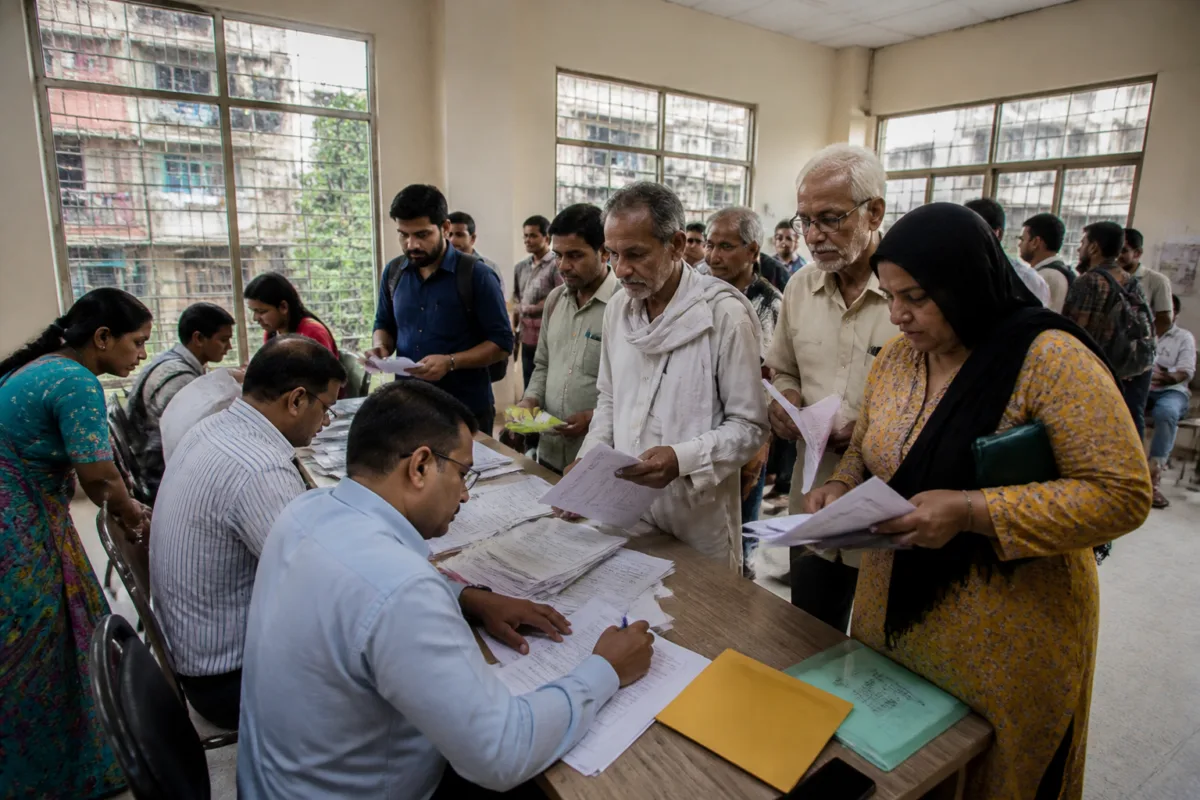
This is where the institutional mechanics of the process become important. Booth-level officers are expected to verify voters at the local level, while the electoral administration processes applications and updates the roll. Special camps provide a physical location where residents can submit applications, documents and complaints. Online forms offer a potentially faster route, but the report records difficulties in completing Form 6 digitally. The system consequently depends on multiple channels, each reaching a different section of the population.
The experience of renters is particularly revealing. A booth-level officer in Pilanji village told the newspaper that around 95 per cent of the area’s population consists of tenants. People who work during the day are often absent when officers visit their homes. Those who have moved may not be found at their previous address, making verification difficult even when they remain residents of Delhi and continue to have a legitimate claim to enrolment.
The report cites the case of 26-year-old Bhupendra, who moved from Pilanji village to Laxmi Bai Nagar. His name was removed from the draft list because of an address-related issue. After he was unable to complete the online Form 6 process successfully, he had to visit a camp. His experience illustrates the gap between a formally available digital service and a service that is usable for a citizen navigating a move, a work schedule and a documentation problem.
A different problem emerged in Jamia Nagar, where elderly residents Naimuddin and his wife were recorded under a permanent-transfer category even though they said they had submitted the enumeration form. They were advised to submit Form 6 again. The case shows that a voter can face exclusion not because of a deliberate refusal to participate, but because the administrative interpretation of a form or address does not match the resident’s account.
These examples also show why a voter list cannot be treated as a static database. It is a continuously maintained public record that must reflect births, deaths, migration, address changes, corrections and new eligibility. In a city with a large tenant population and substantial movement for employment and housing, the quality of the list depends on the ability of institutions to maintain contact with residents as they move through the urban system.
The revision process places particular pressure on the relationship between physical and digital administration. Online applications can reduce travel and help authorities receive claims at scale, but they cannot by themselves solve problems of documentation, address history or mistaken classification. Physical camps can provide assistance, yet they may be difficult to attend for people with jobs, caregiving responsibilities, disabilities or limited awareness of the schedule. Household verification can reach residents directly, but it is less effective when homes are vacant during working hours or when residents have already moved.
The report’s account suggests that these channels are being used as complements rather than substitutes. Camps allow residents to submit applications and seek help in one place, while door-to-door verification creates an opportunity to reach elderly people, workers and those who have shifted address. The administrative question is not which channel should replace the others, but whether the channels are coordinated well enough to prevent a resident from being lost between them.
The data also points to a communication problem. Many residents may not know that their names have been removed, may not understand which form applies to their situation or may assume that a previous submission has already resolved the issue. The source notes that low awareness, employment and other daily responsibilities prevent several people from attending camps. This means that the success of the revision cannot be measured only by the number of applications received or disposed of. It also depends on whether eligible residents know that action is required and can complete it without repeated visits.
The reported correction of the website figures adds another layer to the governance challenge. Administrative data is not merely an internal management tool during a public revision. It is also how residents, political parties, civil society groups and journalists assess whether claims are being processed. When a public dashboard shows 1,238 disposals and is later revised to approximately 1.15 lakh, officials may have an explanation, but the system still needs to make the correction clear enough for the public to follow the change.
There is also a structural tension between preventing duplicate or ineligible entries and avoiding the removal of eligible voters. The reported notices linked to missing matches in the 2002 roll or discrepancies indicate the scale of scrutiny being applied to the records. Such scrutiny may be necessary for maintaining an accurate roll, but the subsequent burden falls on individual residents to establish their eligibility, correct an address or contest a classification. The process therefore has both a data-integrity objective and an access objective, and the two must operate together.
For Delhi’s urban administration, the immediate milestones are the continued disposal of Form 6 applications, the resolution of notices and the completion of verification through camps and household visits. The source does not establish the final number of names that will be restored or the number of applications that will be rejected. It also does not provide a complete breakdown by neighbourhood, age group, tenant status or application outcome. Those gaps matter because aggregate figures can conceal areas where residents face greater difficulty accessing the process.
What the available evidence confirms is that the revision has generated a substantial demand for corrections and fresh enrolment, while officials are simultaneously working through millions of records and notices. It also confirms that address mobility, limited access to online forms, daytime absence from homes and inaccurate classifications are not peripheral issues. They are central to whether electoral administration can remain responsive in a city where residence is often temporary, shared or frequently changing.
The next stage will show whether the combination of camps, door-to-door verification and corrected administrative data can convert applications into resolved cases without leaving eligible residents behind. Until the process is complete, the most important measure is not simply how many records have been processed, but whether Delhi’s final electoral roll reflects the people who actually live in the city and are entitled to participate.

