


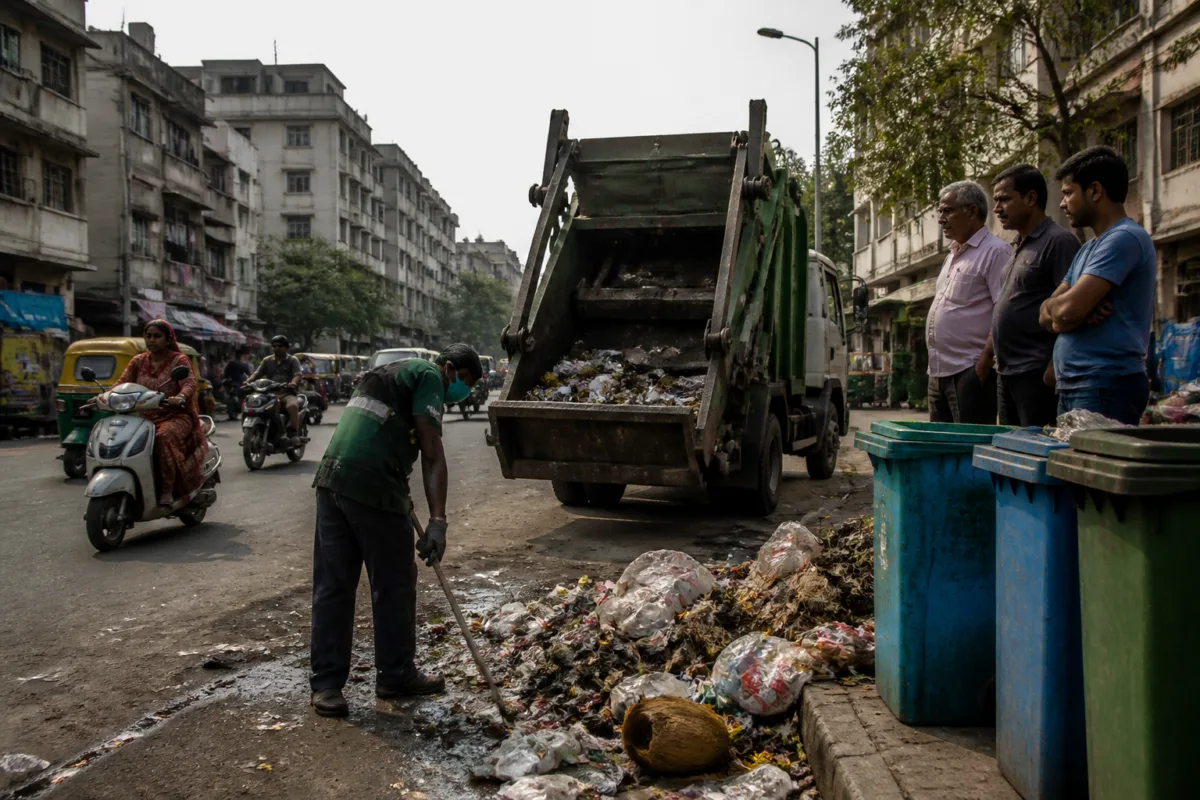
Gujarat Congress has launched a public survey challenging the findings of Swachh Survekshan 2025-26, asking residents of Ahmedabad, Surat and Vadodara to assess how clean their cities are through a QR code-based questionnaire. The party said it will collect responses until 16 December and publish its own findings after the exercise.
The move follows the announcement of the national cleanliness survey awards at Vigyan Bhavan in Delhi, in the presence of President Droupadi Murmu. According to the report, Ahmedabad and Sanand secured the top position nationally in the Swachh Jodi category, while Ahmedabad, Surat and Vadodara were recognised in different cleanliness categories.
Gujarat Congress media coordinator Hemang Raval said the official survey did not make its online data public, including details about the people who participated and the methodology used to determine the rankings. He alleged that the results did not reflect the actual sanitation conditions experienced by residents in several parts of the cities.
The Congress questionnaire will use questions similar to those asked in the central cleanliness assessment. Residents will be invited to submit their views through the QR code, with the party saying the responses will be used to assess the real-world cleanliness of the award-winning cities. The party said the survey would run for one month and that its results would be released after 16 December.
Raval also alleged that the site inspections conducted for the national assessment may not have covered representative locations. He claimed that survey teams were shown selected areas and that important aspects of waste management, including recycling facilities and source segregation, were not adequately reflected. These claims were made by Gujarat Congress and were not independently established in the supplied report.
The Congress leader further alleged that dry and wet waste were not being collected separately in Ahmedabad. He claimed that although some garbage vehicles had two sections, they did not contain internal compartments to keep the waste streams separate. The allegation raises questions about whether sanitation rankings capture the full chain of municipal waste management, from collection and segregation to processing and recycling.
Raval also cited an agenda document and alleged that payments connected to a feasibility survey for public toilets, a miniature model and design work were made without tenders. He said the amounts mentioned were Rs 15,000 for checking the feasibility of public toilets, Rs 40,000 for preparing a miniature and Rs 1 lakh for design work. The report did not include a response from the Ahmedabad Municipal Corporation on these allegations.
Gujarat Congress chief spokesperson Dr Manish Doshi said citizens should feel the improvement in sanitation in their daily lives rather than rely only on official rankings. He alleged that cleanliness was more visible in areas such as Judges Bungalow and Sindhu Bhavan Road than in other parts of Ahmedabad, where residents continued to see waste accumulation.
Doshi also questioned how the large budgets of the state’s municipal corporations were being used and called for greater public accountability. He referred to claims about air pollution and access to clean water in Ahmedabad, although the supplied report did not provide the underlying sources or methodology for those figures.
The QR-based survey will remain open until 16 December, after which Gujarat Congress has said it will announce its assessment of the cleanliness conditions in Ahmedabad, Surat and Vadodara.

