


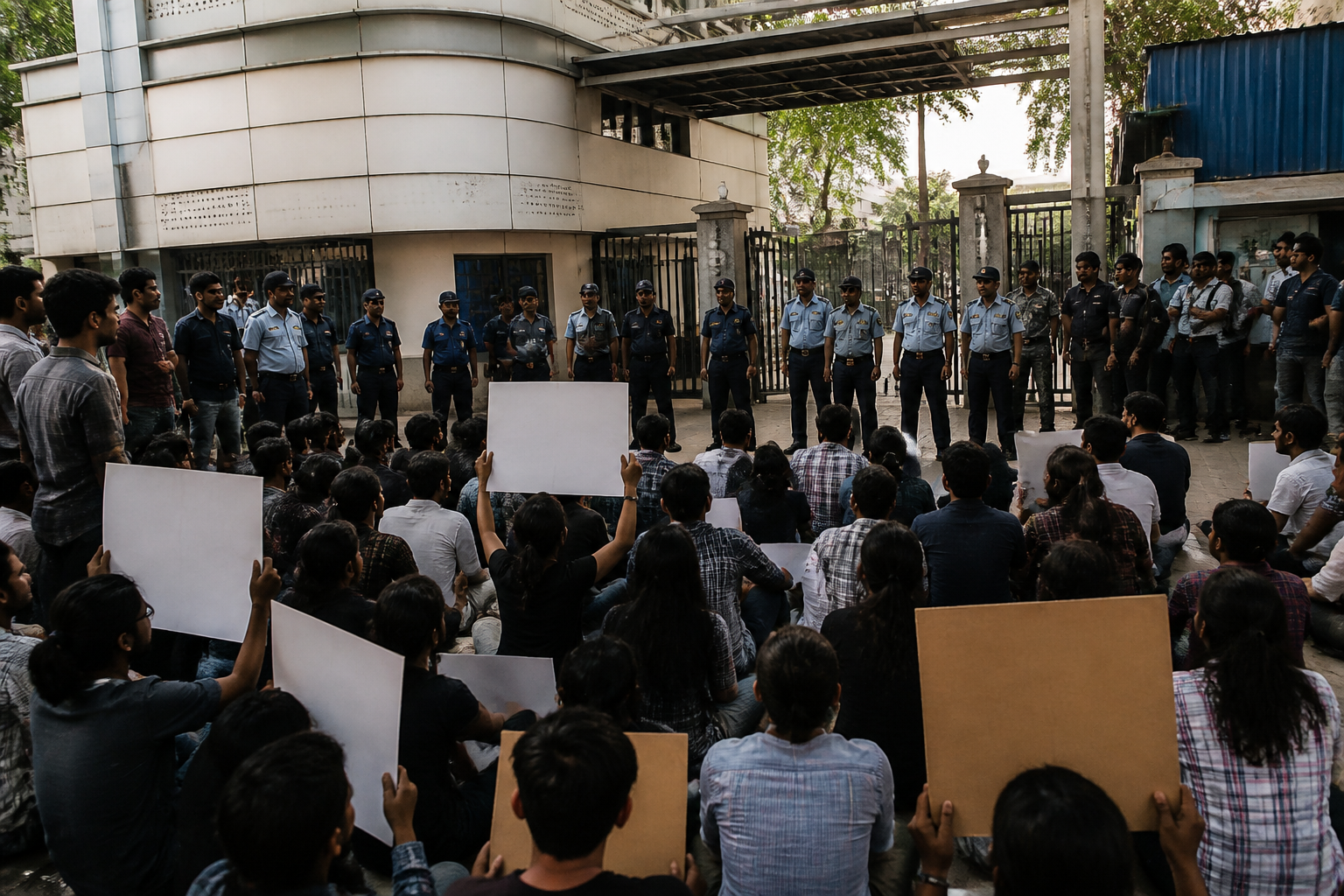
The SRFTI campus violence in Kolkata has moved beyond a clash between organisers and students. The solidarity meeting held at the Satyajit Ray Film and Television Institute on Tuesday showed how an immediate security incident can quickly become a wider dispute over who controls an educational campus, how outside groups enter it and whether students have safe access to both classrooms and housing.
The incident began on Sunday, when violence broke out during a programme organised by the Akhil Bharatiya Grahak Panchayat Paschim Banga Pranta after it rented an auditorium inside SRFTI. According to the Indian Express report, organisers and students confronted each other, leaving several people injured on both sides. Three FIRs have been filed. Students have been boycotting classes and demanding greater security.
The facts reported so far establish the immediate sequence, but they also reveal an unresolved institutional question: how should a specialised residential educational campus manage external events when those events bring politically affiliated groups into proximity with students? Students and supporters at Tuesday’s meeting repeatedly returned to that question, asking who permitted the programme and how the crowd entered the premises.
The concern is not limited to the violence itself. Students said those living outside the campus were frightened and felt unsafe. They also said first-year students were not given hostel accommodation and had to stay outside. Their demands therefore combine an immediate request for protection with a longer-standing concern about access to institutional housing.
That distinction matters. Campus safety is often treated as a question of gates, guards and police complaints. In this case, the student account reported by the Indian Express links safety to the daily geography of education: where students live, how they travel, when they return, and whether they can depend on the campus as a secure environment. Students staying outside may be more exposed to threats around the campus perimeter, although the supplied report does not establish the exact location or circumstances of every reported injury.
The student union’s president, Blossom Hazarika, described the previous two days as stressful and said students were still recovering from the trauma. A student said many should have been working on assignments and shooting floors instead of protesting. These statements point to an academic disruption that goes beyond the physical incident. For students at a film and television institute, coursework can involve equipment, sets, production schedules and collaborative work. A protest or class boycott may therefore affect practical education differently from a routine lecture-based programme, though the report does not quantify the academic or financial impact.
Tuesday’s meeting also transformed the dispute into a public campaign. Filmmakers, artistes, Left leaders and students from other institutions, including Jadavpur University, gathered at SRFTI to express solidarity. Banners carried messages such as “Stop saffron terror in educational institutions” and “No stone can break our will”. These slogans reflect the political framing adopted by participants, but they should be distinguished from the independently established facts about the Sunday programme, the injuries, the FIRs and the class boycott.
Several speakers alleged that the incident formed part of a broader pattern of attacks or pressure involving educational institutions. Professor Manas Ghosh of Jadavpur University’s film studies department described the solidarity as unconditional and said institutions such as SRFTI, Jadavpur University and Jawaharlal Nehru University represented democratic and constitutional values. SFI West Bengal secretary Debanjan Dey alleged “systematic terror” and accused the RSS and BJP of targeting campuses. Those are political allegations made at the meeting; the supplied material does not independently establish the broader claims.
The more concrete institutional issue raised by Dey was the permission process. He questioned how an outside organisation was allowed to hold a Sunday programme inside SRFTI after renting an auditorium, and sought clarity on who granted permission and how the crowd entered the premises. This is a governance question rather than merely a political one. Educational campuses commonly contain spaces that can be used for public, cultural or institutional activities, but the permission system must also define the conditions under which outside participants may enter, what security assessment is required and who remains responsible when an event becomes contentious.
The report does not state which SRFTI authority approved the event, what contractual or security conditions governed the auditorium rental, whether the organisers submitted a participant list, or whether the institute had assessed the possibility of conflict. It also does not provide the number of people injured, the sections of the FIRs, the police response timeline or the current status of any investigation. These gaps are central to understanding accountability and should not be filled with assumption.
Actor and filmmaker Chaiti Ghoshal said the presence of politically affiliated wings inside an educational institution was concerning. She said students from across the country came to SRFTI to study and questioned who had abused or threatened students outside the gate. Her comments place the incident within the specific character of SRFTI as a national institution whose students may be far from their home cities and support networks. The report, however, does not provide a complete account of the institute’s student demographics, accommodation capacity or existing security arrangements.
The hostel issue is especially important because it changes the boundaries of institutional responsibility. Students said first-year students were not provided hostel accommodation and had to live outside. The report does not explain whether this is due to limited capacity, allocation rules, construction constraints or another policy. It also does not indicate how many first-year students are affected. Still, the demand shows that accommodation is being treated by students as part of the safety system, not as a separate welfare benefit.
For a campus such as SRFTI, security therefore has at least three layers. The first is control over entry and exit, including the conditions under which external organisations can use institutional spaces. The second is the handling of conflict once an event is under way, including communication between organisers, students and campus authorities. The third is the residential and neighbourhood context in which students live when they are not inside the campus. The Sunday clash has brought all three layers into the same dispute.
The presence of three FIRs indicates that the incident has entered the formal criminal justice process, but an FIR is not a finding of guilt. The supplied report does not identify the accused, the offences registered or whether arrests have been made. Likewise, the fact that injuries were reported on both sides does not by itself establish responsibility. Any institutional review will need to distinguish between the conduct of students, outside participants, organisers and security personnel rather than treating the campus as a single undifferentiated site of conflict.
The question of external political activity on campuses is also broader than the claims made by any one group at Tuesday’s meeting. The report records criticism of the presence of politically affiliated groups and counterclaims about attacks on educational institutions, but it does not establish a general trend. What it does show is the difficulty of maintaining a shared institutional space when an auditorium rental brings an outside audience into a campus where students already perceive security as inadequate.
That difficulty is partly administrative. A campus event policy must make clear who can hire institutional facilities, whether political or advocacy-linked organisations are eligible, what safeguards are mandatory, and how quickly permission can be withdrawn if conditions change. It must also specify who communicates with students before an event and who handles complaints afterwards. Without transparent procedures, questions about access can become questions about favouritism, selective enforcement or the loss of institutional autonomy.
The immediate student demands provide the clearest measure of what remains unresolved. Students are asking for security, while also seeking hostel accommodation for first-year students. They have boycotted classes after the violence. Supporters have offered public solidarity. The authorities’ response, as presented in the supplied report, does not include a detailed account of any new security plan, a hostel commitment, an independent inquiry or a review of the auditorium permission process.
The SRFTI episode therefore raises a structural issue that cannot be answered only by counting injuries or filing police complaints. A safe campus depends on physical access controls, transparent administrative decisions, adequate accommodation and credible mechanisms for responding when students report threats. The Sunday violence has made those links visible, but the available information does not yet establish how the institute will address them.
The next developments to monitor are the police investigation into the three FIRs, the institute’s explanation of the event permission and entry arrangements, the response to the students’ security demands, and any decision on hostel accommodation for first-year students. Until those details emerge, the central question remains open: whether SRFTI will treat the incident as an isolated clash or as evidence that its campus governance and student safety systems require a broader review.
