


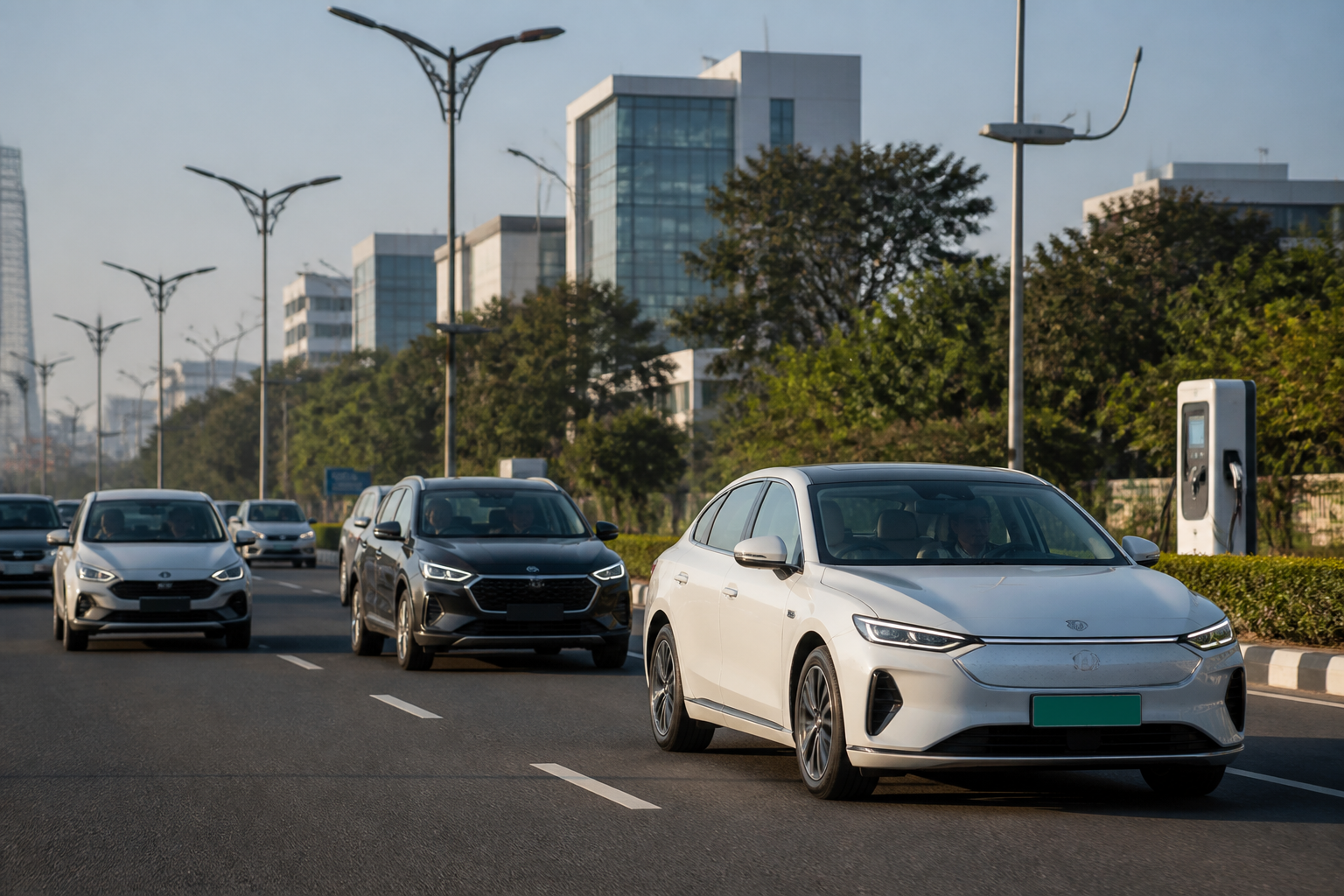
India’s newly notified CAFE 3 norms could change how automakers decide between battery-electric vehicles, hybrids, ethanol-compatible vehicles and other lower-emission technologies. The framework gives compliance value to several powertrains instead of treating the transition to cleaner mobility as a single-technology race, while still assigning the highest credit multiplier to battery electric and range-extender vehicles.
That design matters because fleet-emission rules do more than set a technical target. They influence which vehicles manufacturers develop, which factories receive investment, how suppliers plan capacity and what technologies eventually reach urban buyers. Under CAFE 3, the compliance framework will apply through March 2032, giving companies a five-year period in which product planning and investment decisions must account for multiple possible routes to lower calculated emissions.
The Economic Times report says the norms allow less-polluting technologies, including hybrids, plug-in hybrids, range extenders and ethanol-compatible vehicles, to earn compliance credits alongside pure electric vehicles. Companies that do not meet the required fleet averages will face debits, which can be traded or bought. This creates a market-based compliance mechanism: manufacturers can improve their own fleet performance, use the value of eligible technologies or manage shortfalls through credit transactions.
The central change is the recognition of different powertrains within one compliance structure. Battery electric vehicles and range-extender electric vehicles receive the highest super-credit multiplier of 3. Plug-in hybrids and strong hybrids running on flex-fuel ethanol receive a multiplier of 2.5, while strong hybrids receive 1.6 and flex-fuel ethanol vehicles receive 1.1. A multiplier allows one qualifying clean vehicle to count as multiple vehicles when a company’s fleet average is calculated.
The structure does not remove the advantage given to zero-emission vehicles. Instead, it places battery EVs and range-extender EVs at the top of the credit hierarchy while creating additional pathways for manufacturers whose portfolios include other lower-emission technologies. For automakers, the practical question is no longer only how quickly they can expand pure EV sales. It is also how the mix of technologies can meet the fleet target, manage investment risk and satisfy market conditions through the duration of the rules.
Rajat Mahajan, partner and automotive sector leader at Deloitte, told the Economic Times that there would be substantial scenario planning and that original equipment manufacturers would have to rethink their product portfolios over the next five years. That planning will involve choices about the timing of new models, the balance between different powertrains and the degree to which companies rely on compliance credits.
The consequences will not be uniform across manufacturers. Puneet Gupta, director at S&P Global Mobility, said the compliance flexibility could be particularly significant for Tata Motors, Mahindra & Mahindra and Vinfast, which have invested heavily in pure battery EVs and largely stayed away from hybrids. He said the framework could derail their pure-BEV ambitions. The report does not establish that these companies will abandon electric vehicles, but it indicates that their investment strategies may face a wider set of compliance considerations.
For European automakers such as Volkswagen-Skoda, Renault and Stellantis, and Korean companies including Hyundai and Kia, the framework could offer another route to meet tighter fleet carbon-dioxide targets without immediately committing to large-scale local EV investments, according to Gupta. This is an important institutional effect of the norms: the rules may influence not only the technology sold to consumers, but also the timing and scale of local manufacturing commitments.
CAFE 3 also gives value to smaller efficiency interventions. Start-stop systems, tyre-pressure monitoring, regenerative braking, LED lighting and efficient air-conditioning can each reduce calculated emissions by 1 gram of carbon dioxide per kilometre, subject to a total benefit cap of 9 grams per kilometre. These measures are less visible than a new electric model, but they create another layer of compliance engineering across a company’s existing vehicle range.
This provision broadens the role of vehicle design and component efficiency in meeting the fleet standard. It means that compliance is not limited to the powertrain installed under the bonnet. Systems that reduce energy use during starting, braking, lighting, cooling or tyre operation can also affect a vehicle’s calculated emissions, although the overall benefit from these features remains capped.
The approach therefore combines three levels of intervention. The first is the powertrain itself, with battery EVs, range extenders, hybrids and ethanol-compatible vehicles receiving different credit values. The second is fuel compatibility, particularly through flex-fuel ethanol provisions. The third is incremental efficiency, where individual vehicle systems contribute small reductions within an aggregate limit. Together, these mechanisms create a portfolio-based compliance model.
For cities, the importance of this framework lies in how it could shape the vehicles that form the urban fleet. Passenger vehicles are a visible part of road transport, and decisions made by manufacturers affect the availability of electric, hybrid and fuel-flexible models in metropolitan markets. The supplied report does not provide city-level pollution data, sales forecasts or estimates of how many vehicles will shift under CAFE 3. It does, however, show that the regulatory design will influence the investment choices behind future vehicle supply.
The framework also exposes a policy tension. A wider compliance route can give automakers flexibility when charging infrastructure, vehicle prices, supply chains or consumer demand make a single technology difficult to scale. At the same time, a broad menu of credits can make the transition more complex for regulators and consumers. The value assigned to each technology will determine how companies balance immediate compliance with longer-term investment in zero-emission mobility.
Industry responses indicate that manufacturers view the norms as providing greater planning clarity. Maruti Suzuki said the framework recognises multiple powertrain technologies and fuels, while Rahul Bharti, its senior executive officer for corporate affairs, described the credit and debit mechanism as an improvement over CAFE 2. Tata Motors Passenger Vehicles managing director and chief executive Shailesh Chandra said the continued recognition of zero-emission technologies reinforces the role of electrification. Mahindra automotive business president Velusamy R said the norms strike a pragmatic balance between environmental objectives and what is achievable for industry, and welcomed technology credits, cleaner-fuel benefits and EV super credits.
These responses reveal the regulatory bargain embedded in CAFE 3. Automakers receive more than one route to compliance, while the framework continues to reward technologies with lower calculated emissions. The result is neither a pure EV mandate nor an open-ended approval of conventional vehicles. It is a graded system in which different technologies carry different compliance value.
The five-year horizon through March 2032 will make portfolio sequencing especially important. Companies will need to assess whether to concentrate investment on battery EVs, add hybrids or plug-in hybrids, expand ethanol compatibility, improve conventional vehicle efficiency, or combine these approaches. The credit market may become part of that calculation because non-compliant companies can face debits that are traded or bought.
What remains uncertain from the available evidence is how the rules will alter vehicle prices, consumer demand, manufacturing capacity or emissions in individual cities. The report also does not quantify the likely number of credits or debits, identify company-level compliance positions or set out the implementation response of each manufacturer. Those questions will become clearer as companies translate the notification into product and investment plans.
CAFE 3 therefore represents a shift in the way India’s automotive transition is organised. Its strongest signal is the continued premium for battery and range-extender electric vehicles. Its broader consequence is that hybrids, ethanol-compatible vehicles and incremental efficiency technologies now have a formal place in the compliance calculation. For India’s urban mobility system, the outcome will depend on how automakers use that flexibility—and how regulators monitor whether a wider route to compliance still delivers sustained reductions in fleet emissions.
