


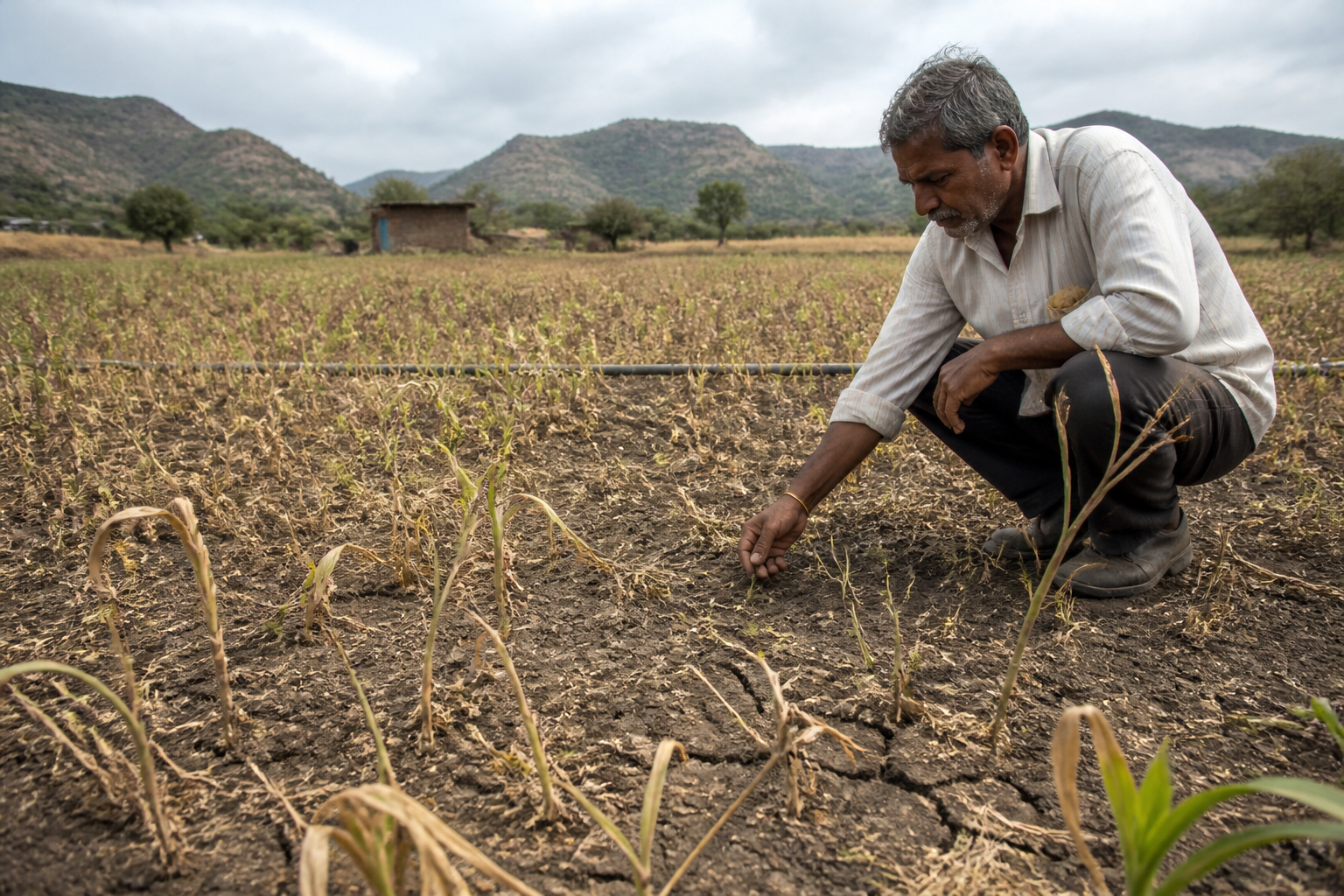
The Maharashtra government has expanded Pune district’s drought-affected talukas from eight to ten, adding Junnar and Ambegaon after an assessment of rainfall gaps and crop stress. Crop-loss inspections, known as panchnamas, will now be conducted in the two newly included talukas, bringing them within the drought-relief framework.
The state has increased the total number of drought-affected talukas across Maharashtra from 265 to 305. In Pune district, drought criteria had earlier been applied in Baramati, Shirur, Daund, Purandar, Indapur, Khed, Bhor and Rajgad. Junnar and Ambegaon have now been added following a review of the developing drought conditions.
The decision follows prolonged breaks in rainfall during the kharif season. According to the report, Baramati, Shirur and Daund recorded a 51-day rainfall gap, while Purandar recorded a 50-day gap and Indapur a 48-day gap. Rainfall variation and the length of dry spells were among the factors used to initially apply drought criteria in the eight talukas.
The shortage of rain has affected crop growth, reduced moisture in the soil and increased the requirement for irrigation. Farmers have also reported difficulties in providing timely water to fields because of problems with electricity supply. The combination of additional irrigation costs and weak crop growth has increased pressure on farm households in the affected areas.
For Junnar and Ambegaon, the inclusion in the drought-affected list is significant because the next stage will involve recording crop losses at field level. Pune district collector Jitendra Dudi said inspections of crop damage in the two talukas would be carried out as soon as possible. The assessments are expected to form the basis for implementing assistance measures, although the report does not specify the amount or timeline of relief for individual farmers.
Farmers in Junnar said the rainfall gap had left crops without adequate moisture and increased the cost of attempts to protect them. Pallavi Pate, a farmer from Junnar, said farmers were having to spend more on water to save crops and that loss assessments needed to be completed on time so that assistance could reach them. Sachin Bade, another Junnar farmer, said farmers were facing the twin challenge of arranging irrigation and meeting rising cultivation costs.
The availability of water is also emerging as a concern for the rabi season. Bade said water access would be important for the next crop cycle and called for drought-related measures to be implemented quickly. The immediate administrative milestones are the completion of crop-loss panchnamas in Junnar and Ambegaon and the subsequent processing of assistance under the applicable drought-relief measures.

