


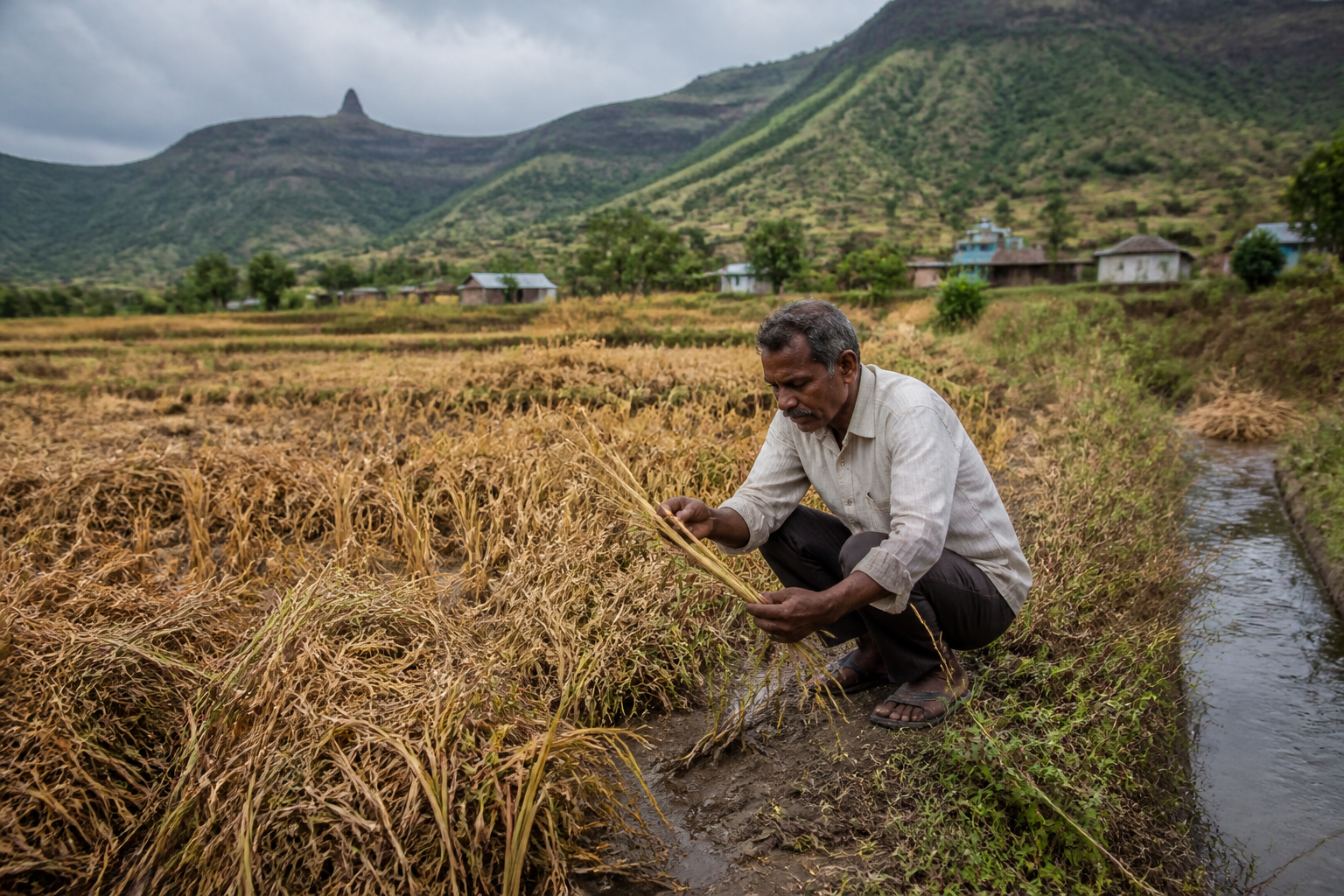
Mulshi taluka in Pune district has been left out of Maharashtra’s newly expanded list of drought-affected talukas, triggering anger among farmers who say rice and other crops have dried up because of inadequate rain and water scarcity. The state government added 40 talukas to the list, including Ambegaon and Junnar in Pune district, but excluded Mulshi.
The exclusion has raised questions over how drought criteria are being applied to a taluka whose geography varies sharply between regions. Farmers and local representatives have argued that the standard criteria do not adequately reflect crop losses in Mulshi’s hilly areas, where agricultural conditions differ across the taluka.
Mulshi Tehsildar Vijaykumar Chobe said crop-loss assessments, or panchnamas, had not yet been ordered for the taluka. He said the administration would conduct the assessments once instructions were received from senior authorities. The statement indicates that the process for formally recording crop damage was still pending when the latest drought list was announced.
The controversy centres on the government’s use of Trigger One and Trigger Two criteria to determine whether a taluka qualifies as drought-affected. Local representatives said Mulshi did not meet the prescribed criteria, but argued that the criteria should be set aside and the taluka included in the drought list because of the actual condition of crops and farmers.
MLA Shankar Mandekar said he had met the district collector on Wednesday, October 14, to renew the demand for Mulshi’s inclusion. According to Mandekar, the collector would send a proposal to the state government. He also said the district collector had directed the Sub-Divisional Officer for Maval-Mulshi to conduct crop-loss assessments in the taluka and that a water rotation had been released for crops.
The demand has also received support from local political representatives. Mahadev Kondhare, taluka chief of the Nationalist Congress Party—Sharadchandra Pawar, said his party and the Shiv Sena—Uddhav Balasaheb Thackeray had submitted a letter to the district collector seeking Mulshi’s inclusion. He alleged that the government had failed to respond to the demand.
Local representatives have described the impact as particularly severe in the hilly parts of Mulshi. Former Mulshi panchayat samiti chairman Tukaram Temghare said crops in 70% of the taluka’s area had withered. The report did not provide an official crop-loss estimate or explain the precise data used to determine Mulshi’s exclusion from the state list.
The immediate administrative steps are the preparation of crop-loss panchnamas and the submission of a proposal for reconsidering Mulshi’s status. Until those steps are completed, farmers in the taluka remain outside the newly announced drought-affected list, even as district authorities assess the reported damage and manage water releases for agriculture.

