


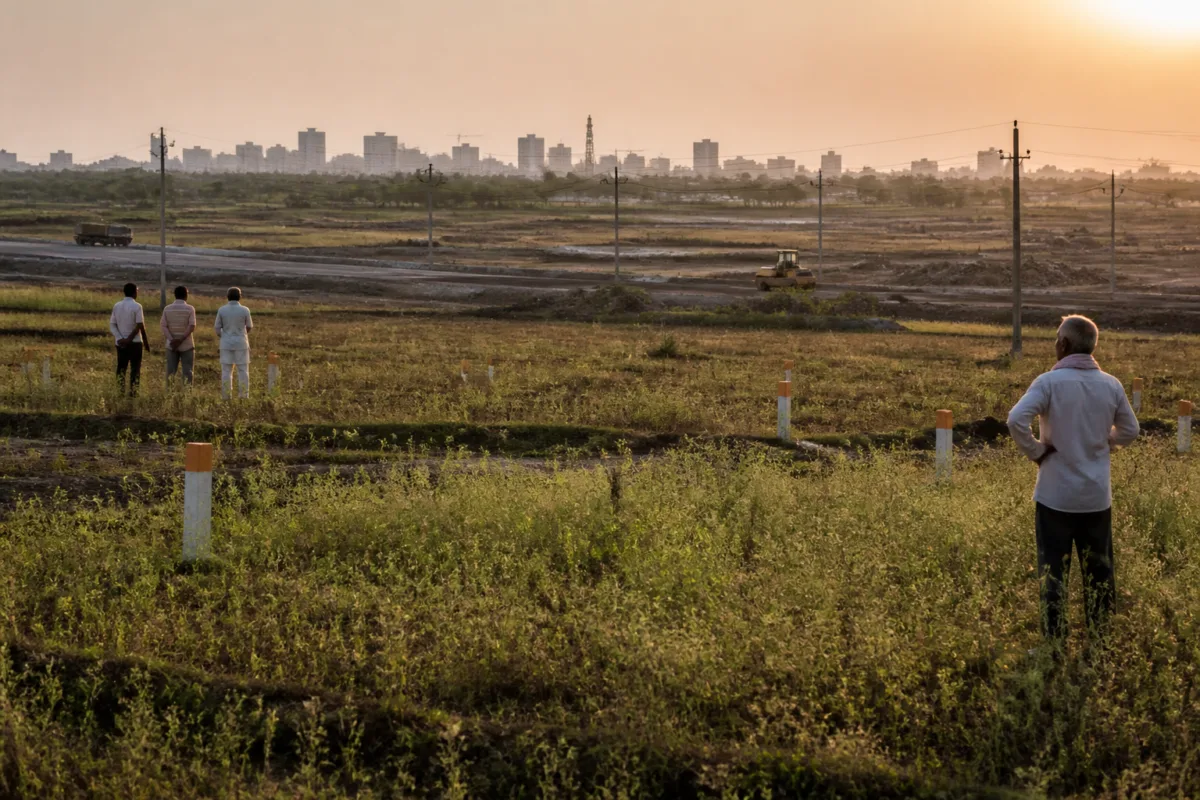
The New Nagpur land acquisition has moved from a planning proposal to a substantial financial and administrative exercise, with the Nagpur Metropolitan Region Development Authority (NMRDA) acquiring 893 acres and paying Rs2,160 crore to farmers. Yet the project remains dependent on securing another 600 acres from 165 landowners, exposing the central difficulty of building a large planned urban district: the city can be designed on paper, but its land must still be assembled through negotiation, compensation and, if necessary, statutory powers.
The project is proposed across Godhani (Rithi) and Ladgaon (Rithi) villages in Hingna taluka. It requires 676 hectares, of which 12 hectares is already owned by the government. The remaining 664 hectares must come from private landowners. The distinction is important because the project’s progress is not determined only by the authority’s ability to prepare a layout or announce development phases. It depends first on whether fragmented private holdings can be brought into a common urban planning framework.
According to the reported details, 202 farmers have agreed to surrender land through direct purchase. The compensation distributed to them totals Rs2,160 crore. The arrangement followed resistance to the initial compensation proposal, with farmers arguing that ready reckoner rates did not reflect prevailing market prices. They demanded compensation at five times the ready reckoner rate and had threatened agitation if their demand was not accepted.
A meeting chaired by guardian minister Chandrashekhar Bawankule subsequently decided to offer five times the ready reckoner rate, along with a developed plot measuring 1,500 square feet for every acre surrendered. NMRDA then began acquiring land through direct purchase. Farmers whose land has been acquired have received letters confirming their entitlement to additional plots, which are to be allotted within the New Nagpur project after the layout is finalised.
This arrangement creates a hybrid compensation model. Farmers are not being offered only a cash payment for land. They are also being promised a future asset within the planned development. That additional plot is intended to address the gap between the immediate compensation received for agricultural land and the potential value created when the same area becomes part of an urban project. However, the benefit remains linked to a future layout, meaning its location, development conditions and delivery depend on subsequent planning and implementation.
The unresolved portion of the acquisition shows why negotiated land assembly is difficult even when compensation is substantially increased. The remaining 165 farmers control around 600 acres, and NMRDA is continuing efforts to persuade them to surrender their land voluntarily. The project therefore faces a coordination problem: a relatively small number of landowners can affect the continuity of a much larger development area.
The authority had earlier said the five-times compensation package would remain available only until the end of September. That offer has now been extended to encourage greater participation, although no new deadline has been announced. The extension indicates that the compensation package has not, by itself, resolved the issue. It may have enabled the first phase of agreements, but it has not produced consent across the entire acquisition area.
NMRDA has also indicated that the remaining land could be acquired through the statutory process if farmers do not come forward voluntarily. Under that route, farmers would receive compensation at four times the ready reckoner rate under the reported terms. They would also lose the additional benefits available through the direct purchase arrangement, including the developed plot linked to each acre surrendered.
The reported legal route is Section 19 of the Right to Fair Compensation and Transparency in Land Acquisition, Rehabilitation and Resettlement Act, 2013. This gives the dispute an institutional dimension beyond the immediate question of price. The authority must balance its responsibility to assemble land for a planned project with the rights and expectations of landowners whose property is being brought into an urban development framework.
The difference between the two routes is also significant for the project’s legitimacy. Direct purchase depends on consent and offers a package designed to make participation attractive. Statutory acquisition, by contrast, allows the authority to proceed when voluntary agreement cannot be reached, but it removes some of the negotiated benefits. The reported terms therefore create a clear incentive for voluntary surrender while retaining a compulsory mechanism for completing the land assembly.
New Nagpur is planned in three phases over the next 15 years and is expected by the state government to become a major urban and economic development hub in the Nagpur metropolitan region. The long implementation period means that the immediate acquisition question is only the first test. Once land is assembled, the authority will still need to finalise the layout, allot the promised developed plots and sequence the project’s infrastructure and development phases. The supplied report does not establish the detailed infrastructure timetable, financing structure or proposed land-use distribution for those phases.
That absence of detail matters because land acquisition and urbanisation are not separate processes. A project can acquire land without immediately creating a functioning urban district. Roads, utilities, public facilities, development controls and connections to the existing metropolitan region will determine whether the area operates as a coherent extension of Nagpur or remains a collection of planned parcels awaiting implementation. The present information confirms the scale of land assembly, but not the full delivery framework that will follow it.
The compensation figures provide one measure of the project’s scale. NMRDA has already paid Rs2,160 crore for 893 acres, while the total requirement is linked to 676 hectares, including government-owned land. The reported figures cannot by themselves establish the project’s total cost because they do not include infrastructure, servicing, administration or future development expenditure. They do, however, show that land procurement alone has become a major public financial commitment.
The project also illustrates the limits of using ready reckoner rates as the sole reference point in areas on the edge of metropolitan expansion. Farmers’ objection was that the official rates did not represent prevailing market prices. The eventual five-times offer was therefore a response to a valuation dispute as much as a compensation decision. When agricultural land is being assembled for urban development, the question is not simply what the land is worth in its current use, but how its value changes when public planning and infrastructure create new development potential.
At the same time, the compensation package does not eliminate uncertainty for either side. The authority must secure the remaining land and deliver the promised developed plots after the layout is finalised. Farmers who accept the direct purchase arrangement must therefore assess both the immediate payment and the future benefit. The report does not provide the allotment schedule, the terms governing those plots or the infrastructure commitments attached to them.
For NMRDA, the immediate milestone is completion of the remaining acquisition. Until the 600 acres controlled by the 165 outstanding farmers is secured, the authority’s ability to implement the full New Nagpur plan remains constrained. For farmers, the decision involves choosing between an extended voluntary package and the possibility of statutory acquisition with different compensation and benefit terms.
The evidence currently establishes a project advancing through a costly negotiated process, but not yet a project ready for full physical development. New Nagpur’s next phase will depend on whether NMRDA can close the remaining land gap, finalise the layout and translate compensation commitments into the developed plots promised to participating farmers. Those steps will determine whether the proposed 15-year urban expansion can move from land assembly to implementation.

