


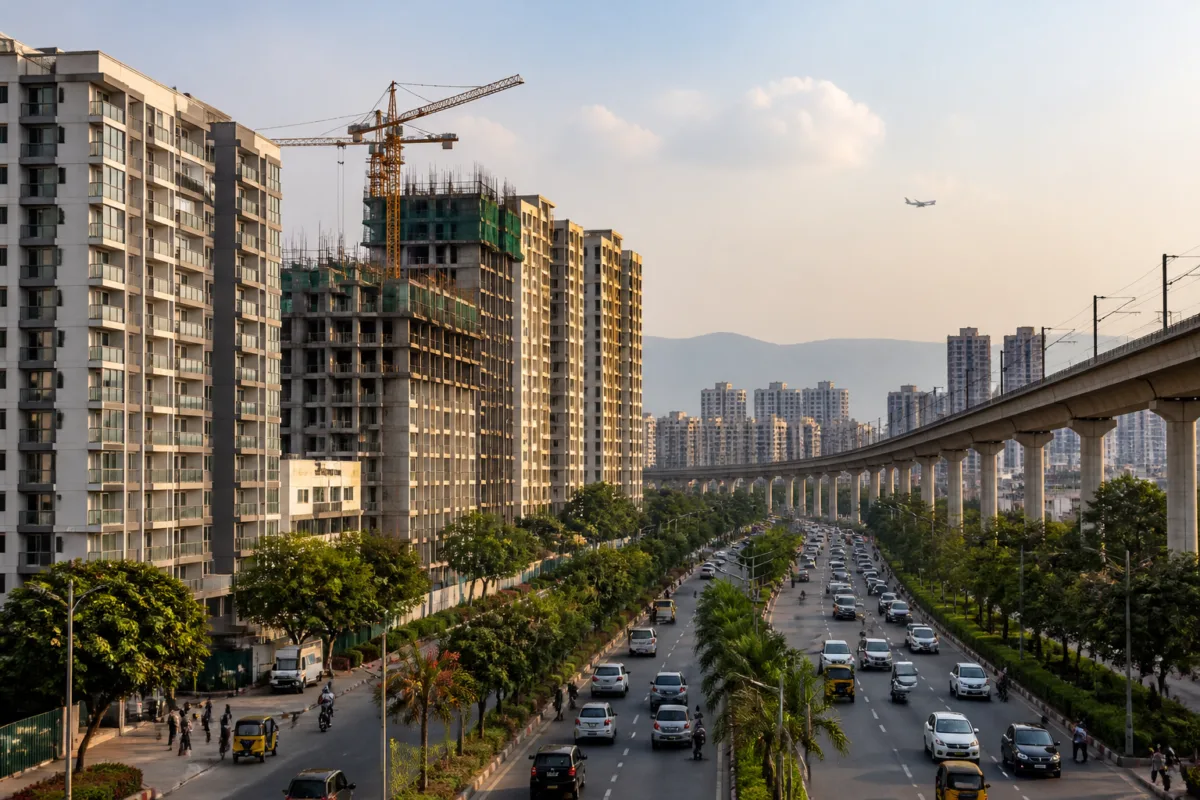
Navi Mumbai’s real estate market is entering the festive season with a demand story shaped by two forces beyond conventional home buying: the relocation of Mumbai residents from buildings undergoing redevelopment and the growing influence of the Navi Mumbai airport. Together, the trends are linking Mumbai’s redevelopment cycle with new housing, rental and hospitality demand across Panvel, Kharghar, Taloja and Ulwe.
The account, reported by the Times of India, is based on observations from real estate market representatives. Manohar Shroff, senior vice-president of the Maharashtra Chamber of Housing Industry’s Navi Mumbai unit, said demand for rental housing had increased because of redevelopment projects in Mumbai. Mukesh Lakhani of Max Realty said residents from Andheri, Goregaon and Matunga were shifting to Navi Mumbai as their buildings entered redevelopment.
This makes the reported festive-season improvement more than a simple seasonal sales narrative. It points to an urban connection in which decisions taken inside Mumbai’s older housing stock are creating demand in a neighbouring planned city. Residents temporarily or permanently displaced by redevelopment need homes, transport access and local services. Navi Mumbai, meanwhile, is being positioned as a market capable of absorbing at least part of that movement.
The evidence supplied does not quantify how many households have moved, how long they are staying, or what proportion of the reported demand is temporary rental demand compared with permanent purchases. It also does not provide changes in rents, sale prices, vacancy levels or registration volumes. Those gaps matter because redevelopment-related relocation can produce very different market effects depending on whether households are seeking short-term accommodation during construction or making a long-term move away from Mumbai.
The reported locations show the geography of the emerging market. Panvel, Kharghar, Taloja and Ulwe are identified as areas where residential towers and hospitality properties are seeing greater interest. Their connection to the airport is central to the market narrative presented by the industry representatives. Shroff said the airport’s presence had contributed to more hospitality properties and residential towers in and around these locations.
That relationship illustrates how infrastructure can influence real estate before the full urban system around it is measured. An airport does not create demand only for airport-linked buildings. It can also change how developers and residents assess accessibility, employment potential and the future role of nearby neighbourhoods. In this case, the source links the airport to both hospitality demand and new residential construction, while separately linking Mumbai redevelopment to rental demand.
However, the material available does not establish the scale or timing of the airport’s effect. There are no passenger numbers, flight schedules, hotel occupancy figures, construction completions or employment estimates in the report. The airport should therefore be understood here as a reported market signal rather than a quantified driver of Navi Mumbai’s real estate performance.
The redevelopment connection is more immediate at the household level. When a Mumbai building is taken up for redevelopment, existing residents may need to find accommodation elsewhere while construction proceeds. The representatives cited in the report specifically name residents from Andheri, Goregaon and Matunga as part of this movement. Their reported shift to Navi Mumbai suggests that the housing market is functioning across municipal and metropolitan boundaries rather than within isolated local markets.
For residents, this movement involves more than the availability of a flat. A temporary relocation can affect commute times, school access, family support networks and proximity to work. The source does not provide evidence on these experiences, but the locations named indicate that housing decisions are being made within a larger metropolitan geography. A home that appears affordable or available in Navi Mumbai may still impose new transport and time costs on a household whose employment remains in Mumbai.
The institutional structure behind this demand is also important. Redevelopment in Mumbai is generated through building-level projects, agreements with residents, developers and the applicable regulatory framework. The resulting relocation demand is not planned as a single metropolitan housing programme. It emerges project by project, as individual buildings move into construction. Navi Mumbai’s market then responds through rental listings, new residential supply and related services.
This creates a coordination question. Mumbai’s redevelopment process may displace residents temporarily, while Navi Mumbai’s housing market absorbs them through private rentals and sales. The supplied report does not indicate whether municipal authorities in either city are tracking this movement or whether affordable rental supply is being created specifically for redevelopment-affected households. It also does not establish whether the available homes are concentrated near public transport, employment centres or social infrastructure.
The reported demand for pre-lease properties adds another layer to the market. Shroff said such properties were in good demand, while attributing part of the interest to corrections in the share market. The report does not define the scale of this demand or explain how market-linked investment activity is affecting pre-leased commercial or other real estate assets. This claim is therefore best read as an industry observation rather than as a demonstrated market trend supported by transaction data.
The festive season may amplify these existing forces. Lakhani said sales and rentals were expected to improve during Diwali because of the relocation of residents from Mumbai redevelopment projects and the broader market conditions described by the representatives. But the underlying demand drivers are not limited to a festival calendar. Redevelopment creates a pipeline of households seeking accommodation, while airport-related expectations can influence where developers build and where investors look for future activity.
That distinction matters for interpreting the market. A festival-led increase in enquiries or transactions would represent a short-term change in activity. A sustained relocation flow from Mumbai would represent a structural change in metropolitan housing demand. The source identifies both seasonal improvement and longer-running redevelopment and infrastructure factors, but it does not provide enough evidence to determine whether the reported festive boost will become a lasting shift.
Navi Mumbai’s role in this process is also changing in the account presented by the market representatives. It is not described only as an alternative residential location. It is presented as a connected real estate market serving several functions: temporary housing for redevelopment-affected Mumbai residents, new residential development associated with airport-led expectations, hospitality accommodation and pre-leased property investment.
Those functions can compete for land and influence the type of development that appears in different nodes. Residential towers may serve relocated households, commuters or investors. Hospitality properties may serve airport users and business activity. Pre-leased assets may attract buyers seeking rental income rather than direct occupation. The report names these categories but does not provide a breakdown of supply, demand or occupancy, so their relative importance remains unestablished.
The policy landscape is consequently broader than a single airport or a single festive sales period. It includes Mumbai’s redevelopment system, the metropolitan movement of displaced residents, land and construction decisions in Navi Mumbai, rental housing availability and the infrastructure required to connect new residents to jobs and services. Responsibility is likely to be distributed across housing regulators, municipal bodies, planning agencies, developers and market intermediaries, although the supplied material does not identify specific administrative interventions or government schemes.
The most significant evidence in the report is therefore directional rather than statistical. Named industry representatives report stronger rental demand, increased interest in hospitality properties and residential towers, movement from specific Mumbai neighbourhoods, and better festive-season prospects for sales and rentals. What remains unavailable is the data needed to test the scale of these claims: household counts, rental growth, sales registrations, project completions, airport activity and transport impacts.
For urban observers, the central question is whether Navi Mumbai is becoming a pressure-release market for Mumbai’s redevelopment cycle or whether it is entering a broader phase of airport-led real estate expansion. The two processes may overlap, but they have different consequences. Redevelopment-linked demand is tied to the pace and geography of construction in Mumbai. Airport-linked demand depends on connectivity, commercial activity and the development of surrounding districts. Treating both as one market trend could conceal important differences in who is moving, why they are moving and what kind of housing they need.
The available evidence confirms that market participants are seeing stronger activity in Navi Mumbai during the festive season and are linking it to Mumbai redevelopment, the airport and selected growth nodes. It does not yet establish the scale, affordability or durability of that change. The next useful indicators will be rental and sales data, the number of redevelopment-affected households relocating to Navi Mumbai, airport-linked hospitality performance and the distribution of new housing across Panvel, Kharghar, Taloja and Ulwe.

