


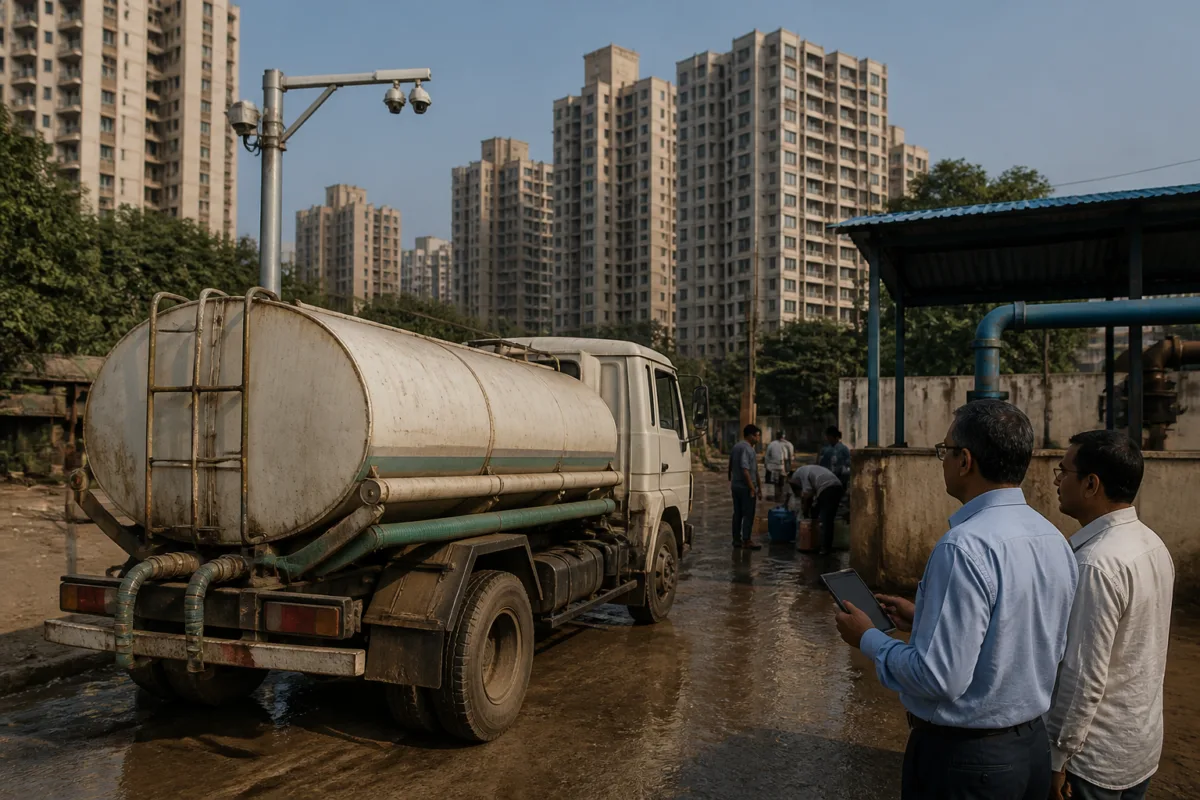
CIDCO has deployed GPS tracking on all 34 water tankers supplying residential buildings in Navi Mumbai and installed CCTV surveillance at 11 major filling stations to curb misuse and improve the monitoring of potable water distribution amid prevailing scarcity.
The measures are intended to record tanker movements, verify delivery locations and maintain accurate daily distribution records across CIDCO nodes. CIDCO said restrictions have also been imposed on the use of tanker-supplied water, with developers prohibited from using it for construction activities.
Housing societies could also lose their tanker water supply if water supplied through the system is found to be used in swimming pools. CIDCO said confirmed irregularities would attract penalties as well as stringent legal and penal action.
The GPS systems fitted on the tankers are designed to allow CIDCO to monitor their routes and delivery points. The CCTV cameras at the 11 filling stations will support surveillance and help maintain records of the quantity and movement of water being distributed each day.
CIDCO is developing a digital water-monitoring portal that will combine GPS tracking with OTP-based access. Until the portal becomes operational, daily updates are being maintained through Google Sheets, according to the report.
The intervention comes as Navi Mumbai faces water shortages and concerns over equitable distribution between residential areas. CIDCO is coordinating with the Maharashtra Jeevan Pradhikaran to address shortages in Kalamboli and has corresponded with the Navi Mumbai Municipal Corporation regarding regular and adequate water supply.
CIDCO’s vigilance department is also examining earlier complaints related to water distribution. The authority has urged housing societies in its nodes to cooperate with the monitoring process and use potable water carefully.
The new system places tanker operations within a broader administrative chain involving CIDCO, the filling stations, housing societies, MJP and NMMC. Its immediate focus is to establish a verifiable record of where tankers travel, where water is delivered and how the supply is used. CIDCO said further action will follow after complaints and suspected irregularities are examined.

