


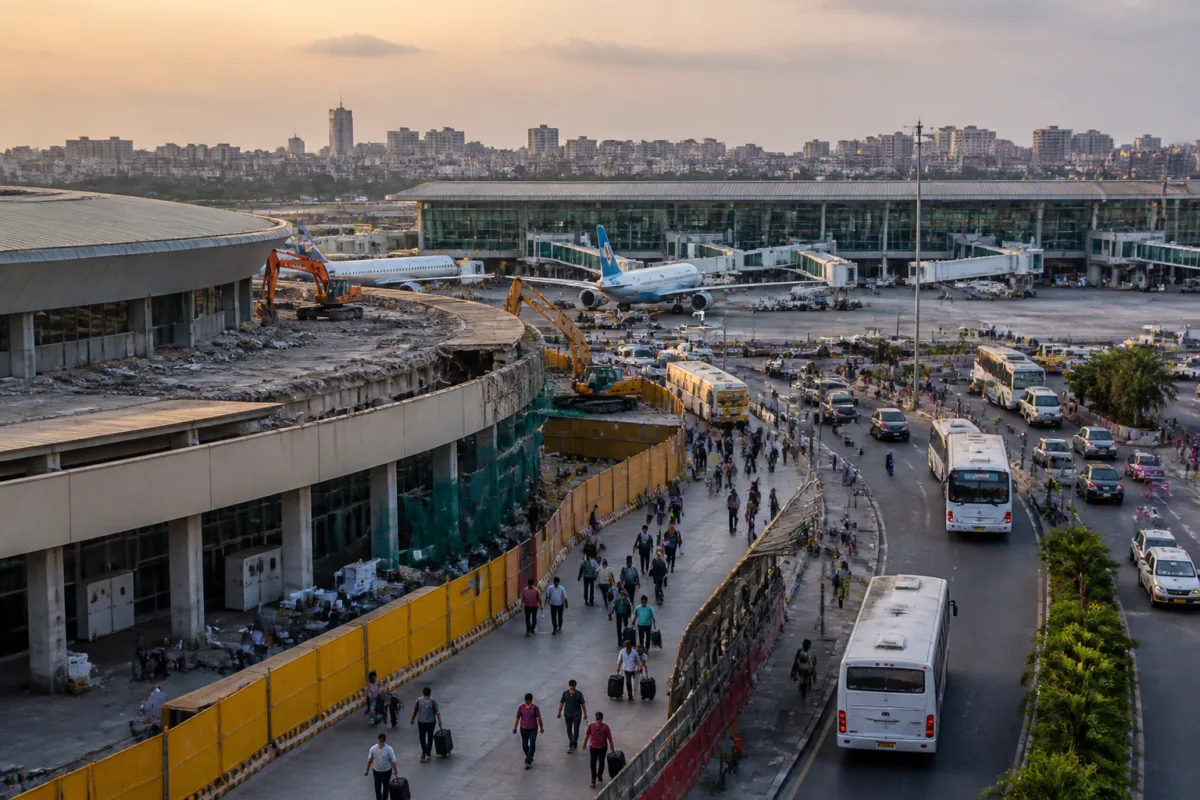
Mumbai airport capacity is set to fall from 55 million passengers a year to about 40 million by October 2027, when Terminal 1 is scheduled to shut completely for redevelopment. The decision will shift a substantial share of Mumbai’s domestic traffic towards Navi Mumbai International Airport and expose how little spare capacity the Mumbai Metropolitan Region may have during the transition.
The change is more consequential than a temporary terminal closure. Terminal 1 currently handles about 15 million passengers annually, or roughly 41,000 passengers a day. Once it is withdrawn, Mumbai airport will operate through Terminal 2 alone. Terminal 2 is currently described as having annual capacity of about 40 million passengers, with a planned increase to 45 million after its north-west pier is completed in March 2029.
That sequence creates a difficult capacity gap. Mumbai’s two terminals handled 55 million passengers in the last financial year, according to the report. From October 2027, the airport’s stated capacity would be approximately 40 million passengers, a reduction of 27% even as demand for air travel is expected to continue rising. The immediate operational question is not simply whether a new terminal is being built, but where existing passengers will be accommodated while construction takes place.
The issue has emerged because the redevelopment plan for Terminal 1 appears to differ from the phased approach that airlines had understood. Earlier communications from Adani Airport Holdings Ltd, including a press release issued on October 3, referred to the “phased redevelopment of T1”. Airlines understood this to mean that portions of the terminal would be demolished and rebuilt sequentially, allowing some part of the facility to remain operational.
The report says a presentation made by AAHL to airlines indicated that demolition would be phased, but reconstruction would begin only after the entire terminal had been demolished. Under that plan, one-third of Terminal 1 would be demolished from April next year, followed by the displacement of five million domestic passengers annually. The remaining portions would then be removed, with the complete terminal expected to be demolished by March 2028.
AAHL confirmed to the Times of India that Terminal 1 would be shut completely for redevelopment. Its spokesperson said the new terminal would have capacity for 20 million passengers. The company also said the combined capacity of the Mumbai Metropolitan Region would be 60 million passengers for a short period, combining Mumbai airport’s 40 million with Navi Mumbai airport’s 20 million annual capacity. That figure would rise to 65 million after the completion of Mumbai Terminal 2’s north-west pier and eventually to 80 million when Terminal 1 is redeveloped by 2030.
The numbers show why Navi Mumbai is central to the plan. The complete closure of Terminal 1 would displace approximately 15 million domestic passengers a year. Most of these passengers would have to use Navi Mumbai airport, whose Terminal 1 has an annual capacity of 20 million passengers but is currently estimated to handle about six million passengers. The available headroom may therefore appear sufficient at the start, but the report says the terminal is expected to reach saturation within a year if the displaced traffic moves there.
This makes the metropolitan airport system dependent on several projects being completed on schedule. Mumbai Terminal 2 must absorb part of the traffic during the initial phase, while international flights at T2 are planned to be reduced by one-third from summer 2027. The report says this shift would move five million international passengers, largely to Navi Mumbai airport, creating space for passengers displaced by the first phase of Terminal 1’s redevelopment.
The arrangement also illustrates the limits of looking at airport capacity only through aggregate regional figures. A combined Mumbai Metropolitan Region capacity of 60 million passengers may sound higher than Mumbai airport’s current 55 million, but passengers cannot use capacity as an undifferentiated pool. Domestic and international operations are not automatically interchangeable, airlines must adjust schedules and airport access differs sharply between the two sites. The practical capacity available to a passenger depends on terminal allocation, flight timings, airline operations and the ability to reach the airport.
The shift also changes the relationship between Mumbai airport and Navi Mumbai airport. Navi Mumbai was expected to provide additional capacity for the wider region, but the Terminal 1 redevelopment schedule turns it into an immediate pressure-release facility for an existing airport. That gives the new airport a role beyond gradual market expansion: it must absorb a large transfer of traffic while its own passenger base is still developing.
AAHL said Navi Mumbai Terminal 2 would be ready in 2030 with an additional capacity of 30 million passengers, followed by a further 20 million capacity addition in 2031. These planned expansions are important because Navi Mumbai Terminal 1 may have limited ability to absorb sustained diversion from Mumbai. The transition therefore depends not only on the opening of Navi Mumbai airport, but also on the timely delivery of its later terminal capacity.
The institutional arrangement is concentrated in the airport operator’s redevelopment and capacity decisions. AAHL controls the programme for Mumbai’s terminals and has presented the operational plan to airlines. Airlines, in turn, must revise their schedules and terminal allocations. The metropolitan system also depends on passengers being able to travel between Mumbai, Navi Mumbai and their respective airport catchments, although the supplied report does not provide details on road, rail or other access arrangements.
The redevelopment plan demonstrates why construction sequencing matters in live urban infrastructure. A phased rebuild can preserve some operating capacity while construction proceeds, but it may extend the period of disruption or constrain the design and construction process. A full closure can provide a clearer construction site, but it removes a large operating facility at once. At a congested airport, that choice becomes a regional mobility decision rather than an internal project-management decision.
The comparison with other airport redevelopments is also relevant. The report notes that Mumbai Terminal 2, Delhi Terminal 1 and Terminal B at New York’s LaGuardia airport were rebuilt in phases. These examples are cited to explain why airlines had expected Terminal 1 to remain partly operational during redevelopment. However, the supplied material does not establish that the projects had identical site conditions, passenger volumes, construction methods or institutional arrangements. The comparison supports the existence of an alternative sequencing model, but not a direct prediction about the outcome in Mumbai.
The central risk is a mismatch between construction milestones and passenger demand. If Terminal 1 closes before the replacement capacity at Mumbai and Navi Mumbai is fully available, the region could face a sharp reduction in effective capacity from the winter of 2027. Airline sources cited in the report warned of a severe capacity crunch if the major projects, particularly Terminal 1’s redevelopment, do not meet their deadlines.
The regional capacity figures also reveal a narrow margin for delay. Mumbai airport’s capacity is expected to rise from 40 million to 45 million in March 2029, while Navi Mumbai’s larger terminal additions are scheduled for 2030 and 2031. Terminal 1’s redevelopment is expected to be completed by 2030. This means the region’s planned recovery depends on several overlapping milestones rather than one replacement terminal becoming operational immediately after another closes.
For passengers, the change may appear first through altered airline schedules, a greater number of flights from Navi Mumbai and longer or more complex journeys to the airport. For airlines, it will involve reallocating domestic and international operations between terminals and airports. For the region, it raises a broader planning question: whether airport capacity should be managed as a coordinated metropolitan network, with transport links and terminal functions planned together, or as separate projects whose capacity figures are added after the fact.
The available evidence confirms that Mumbai Terminal 1 is planned for complete closure and redevelopment, that the closure could reduce Mumbai airport’s annual capacity by 15 million passengers, and that Navi Mumbai is expected to absorb much of the displaced traffic. It does not establish the final airline schedules, passenger access arrangements or whether every announced construction milestone will be met. Those details will determine how severe the transition becomes. The next milestones to watch are the first phase of demolition from April next year, the planned Terminal 1 shutdown by October 2027, the completion of Mumbai Terminal 2’s north-west pier in March 2029 and the delivery of the replacement terminal capacity through 2030 and 2031.

