


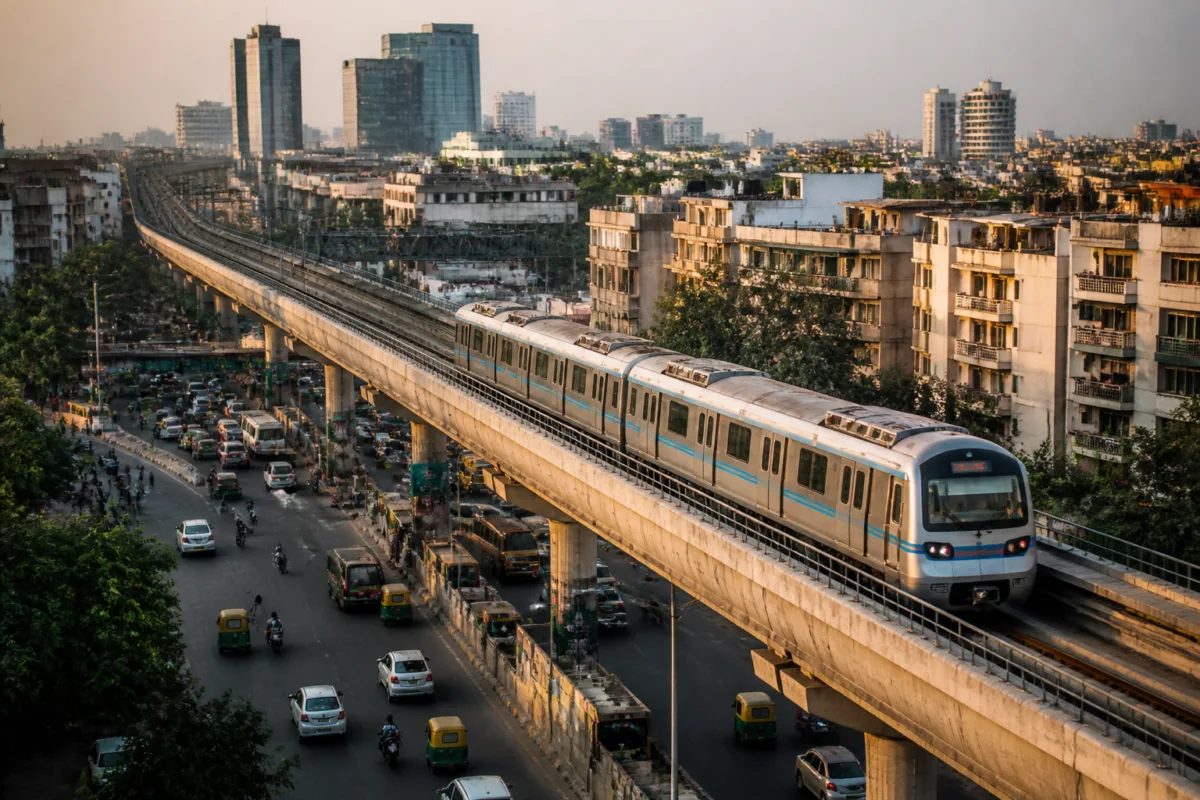
Delhi Metro Phase V(B) has proposed eight corridors that would extend public-transport access to outer Delhi, densely populated areas and the Delhi-Gurugram border, according to an RTI reply accessed by PTI and reported by The Realty Today. Seven corridors have received approval from the Delhi government and are awaiting clearance from the Centre, while the proposed Yashobhoomi Dwarka Sector 25–Rajiv Chowk corridor remains under the approval process.
The seven corridors that have received state-level approval would together cover about 65 stations. The routes include Dhaunsa Bus Stand in Najafgarh to Nangloi, Central Secretariat to Kishangarh, Samaypur Badli to Narela DDA Sports Complex, Kirti Nagar to Palam, Jor Bagh to Mithapur, Mayur Vihar Phase III to Shastri Park and Keshav Puram to Rohini Sector 34.
The proposals combine extensions of existing lines with new connections between residential districts, institutional areas, commercial centres and transport hubs. Their implementation, however, remains subject to the clearances and construction processes required before the corridors can become operational.
The 11.9-kilometre Dhaunsa Bus Stand–Nangloi corridor is proposed with nine elevated stations and interchange facilities at Nangloi and Dhansa Bus Stand. The alignment is intended to connect Naresh Park Extension, Ranhola, Bakkarwala, Baprola, Dichaon Kalan and Najafgarh Extension with the Metro network.
The 15.9-km Central Secretariat–Kishangarh corridor would have 10 stations, including nine underground stations. Interchanges are proposed at Central Secretariat, Moti Bagh, RK Puram and Kishangarh. The route would serve areas including New Moti Bagh, RK Puram sectors 1 and 7, Jawaharlal Nehru University and the Prime Ministers’ Museum.
The proposed Samaypur Badli–Narela corridor would extend the existing Yellow Line towards Narela across 12.9 km, with eight elevated stations. The 9.9-km Kirti Nagar–Palam corridor would extend the Green Line with six stations, including five underground stations.
Three other proposals would add further cross-city links. The Jor Bagh–Mithapur corridor would cover nearly 17 km and include 12 stations, seven of them underground. The Mayur Vihar Phase III–Shastri Park corridor would run 13.2 km and include eight stations, with an underground stretch of about 9 km. The Keshav Puram–Rohini Sector 34 corridor would cover 16.3 km with 12 elevated stations.
The eighth proposal, linking Yashobhoomi in Dwarka with Rajiv Chowk in Gurugram, is the most significant cross-border connection in the package. The report said the corridor is still under the approval process. If approved and subsequently built, it would create a direct Metro connection between the Dwarka area and a major Gurugram commercial district. The source material does not provide an approved construction schedule or completion date for this corridor.
The Phase V(B) proposals come alongside projects already being advanced under earlier expansion phases. Under Phase V(A), construction is under way on the RK Ashram Marg–Indraprastha, or Central Vista, corridor. The Aerocity–IGD Airport Terminal 1 and Tughlakabad–Kalindi Kunj corridors are at the tendering stage, with completion targeted in stages by September 2029.
Under Phase IV, the remaining sections of the RK Ashram Marg–Janakpuri West and Aerocity–Tughlakabad corridors are targeted for completion by December 2027. The Lajpat Nagar–Saket G Block and Inderlok–Indraprastha corridors are under construction, with a December 2030 target. The Rithala–Kundli corridor is at the tendering stage and is also scheduled for completion by December 2030, according to the report.
The proposed network would improve access for residents only as individual corridors move beyond planning and approvals into construction, commissioning and regular operations. The number of stations and proposed interchanges indicates a focus on extending the reach of the existing network, but the available report does not establish projected ridership, project costs, land requirements or detailed timelines for the Phase V(B) corridors.
Real-estate executives quoted in the report linked the proposed Yashobhoomi–Gurugram connection with stronger accessibility for residential and commercial areas. Robin Mangla, president of M3M India, said improved connectivity could support Gurugram’s premium and luxury housing markets. Santosh Agarwal, executive director and chief financial officer of Alpha Corp Development, referred to possible benefits for established residential areas such as Sector 15. Ashish Tandon, chief business officer of Origen Realty, said improved public-transport integration could strengthen the Dwarka Expressway micro-market.
Those assessments are industry views and do not constitute an official projection of property-price or development outcomes. The immediate public-interest issue is the status of the proposed corridors: seven await central clearance after approval by the Delhi government, while the Yashobhoomi–Rajiv Chowk link remains under consideration. Further details on approvals, funding, alignment, construction schedules and expected passenger demand will determine how much of the proposed connectivity is ultimately delivered.

