


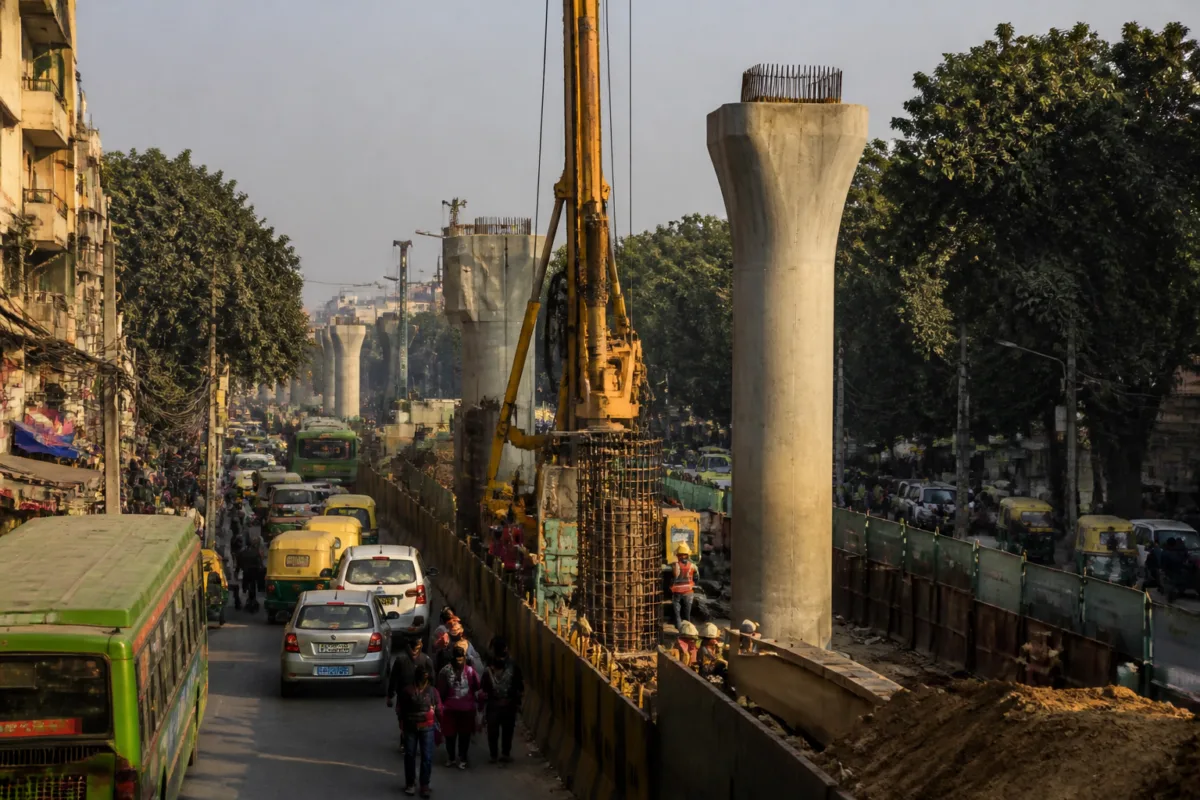
The proposed 8.385-km Delhi Metro corridor between Lajpat Nagar and Saket G Block is moving through construction, offering a new east-west connection across South Delhi while creating an interim period of road, utility and access disruption for neighbourhoods along the alignment.
The corridor is part of Delhi Metro Phase IV and has eight elevated stations, according to a report by MagicBricks. The route is planned to connect Lajpat Nagar, Andrews Ganj, Greater Kailash-1, Chirag Delhi, Pushpa Bhawan, Saket District Centre/Saket Court, Pushp Vihar and Saket G Block.
The project is intended to connect with existing metro services at key points. Lajpat Nagar would provide access to the Pink and Violet lines, while Chirag Delhi would connect with the Magenta Line. At Saket G Block, the corridor is planned to join the wider Golden Line network, which the source describes as extending towards Tughlakabad and Aerocity.
MagicBricks reports that the Union Cabinet approved the corridor in March 2024 as part of Phase IV. Ground-breaking and test-pile work near Pushpa Bhawan reportedly began in December 2025. Construction packages, utility shifting and civil works are being executed in stages, while safety approvals, trial runs and commissioning remain pending before passenger services can begin.
The corridor has an approved cost of about Rs 8,399 crore, according to the report, which also places the target for completion around June 2029. These dates and project milestones describe the current reported plan; passenger operations would still depend on completion of construction, testing and the required safety clearances.
A distinctive feature of the proposal is its planned three-coach configuration. The source describes it as India’s first three-coach metro corridor, with each coach designed to accommodate roughly 300 passengers. That would give a train an approximate capacity of 900 passengers. The line is planned to be fully elevated, with 74-metre platforms sized for the shorter trains.
The reported initial ridership estimate is between 60,000 and 80,000 passengers a day, rising to more than 1.2 lakh passengers a day by 2041 as services and frequency develop. These projections indicate the corridor is being planned for significant local demand, even though its shorter trains differ from the longer formations used on many established Delhi Metro routes.
For commuters, the main change would be a direct rail connection between several busy South Delhi areas that currently depend heavily on buses, autos and private vehicles. The stations would serve markets, offices, courts, hospitals and residential colonies around Lajpat Nagar, Greater Kailash, Chirag Delhi, Pushpa Bhawan and Saket. Interchanges at Lajpat Nagar and Chirag Delhi would also broaden access to the existing metro network.
The implementation phase is likely to be most visible at street level. The report says residents and businesses near the alignment may face noise, barricading, traffic diversions and restricted access while construction continues. These impacts would be particularly relevant in commercial areas and around junctions where pedestrian movement, deliveries and road traffic already compete for limited space.
The corridor could also influence housing and rental demand near its stations, particularly in areas where access to employment, healthcare, education and retail is already strong. However, the source presents these as likely real-estate effects rather than confirmed market outcomes. Any change in property values or rents would depend on the final station access, opening date, service frequency and the quality of pedestrian connections around each station.
The project therefore carries two distinct timelines for South Delhi. During construction, residents and shopkeepers must contend with temporary disruption and changing traffic arrangements. After commissioning, the corridor is intended to provide additional metro capacity, new interchanges and a more direct alternative to road travel. Its public value will ultimately depend on whether construction, utility relocation, testing and safety approvals remain aligned with the reported target of June 2029.

