


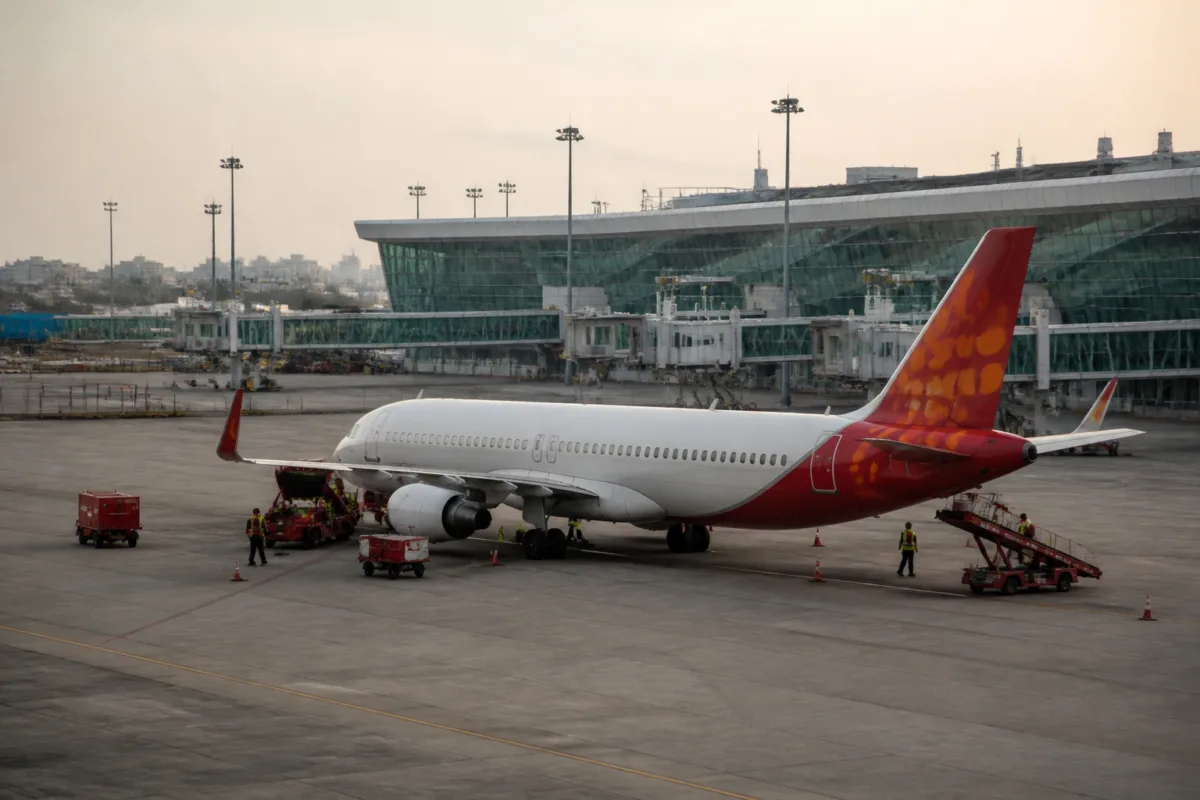
The Federation of Indian Pilots (FIP) has asked the Ministry of Civil Aviation to direct the Directorate General of Civil Aviation (DGCA) to restrict SpiceJet’s operating capacity if the airline cannot demonstrate that it has the financial and operational resources to safely operate its approved schedule.
In a letter dated November 22 to Civil Aviation Minister K Ram Mohan Naidu, the pilots’ body also sought verification of SpiceJet’s proposed ₹5,500 crore fundraising plan, including its source, timing and intended use. SpiceJet’s board approved the fundraising proposal last week as the airline faced financial difficulties.
FIP called for an immediate assessment of the airline’s financial health, aircraft availability, maintenance capabilities, employee salaries and crew strength. It said financial stress could affect aviation safety and operational reliability.
“If the airline is unable to demonstrate the financial and operational capacity to safely operate its approved schedule, its capacity should be suitably regulated in the interest of passenger safety and operational reliability,” the body said in the letter.
The request follows disruption at three major airports. According to airport-operator data analysed by Business Standard, at least 31 of the 42 SpiceJet flights scheduled at Delhi, Mumbai and Bengaluru airports on November 19 were marked as cancelled or not operating.
FIP’s letter also cited the airline’s reported domestic market share of 0.6 per cent in October, compared with roughly 21 per cent in 2014. SpiceJet has been dealing with unpaid dues to aircraft lessors and service providers, delayed employee salaries and grounded aircraft, according to the report.
The pilots’ body linked these financial pressures to human-performance risks. It said delayed salaries could contribute to financial anxiety, sleep disturbances, mental fatigue and reduced concentration among pilots, potentially increasing the risk of errors in safety-critical duties. FIP said the financial health of an airline and its operational safety should not be treated as separate matters.
The proposed review would examine the airline’s actual cash position, outstanding employee salaries, statutory and airport dues, payments to oil companies and aircraft lessors, availability of critical spares and aircraft insurance. It would also assess whether SpiceJet has enough pilots and other crew members to operate its approved schedule while complying with flight-duty-time limitations and mandatory rest periods.
FIP referred to DGCA’s Civil Aviation Requirement Section 3, Series S, Part I, which provides a framework for assessing the safety effects of financial stress at airlines. It called for mandatory annual financial-health and safety assessments of all scheduled airlines, with quarterly monitoring for carriers facing financial distress.
The body also questioned whether existing assessments adequately verify cash flows, outstanding liabilities, employee salaries and vendor payments rather than relying mainly on financial statements. It asked the DGCA to examine the effects of financial stress on crew welfare, maintenance standards, human factors and an airline’s safety management system.
Separately, FIP proposed measures to reduce operating costs, including rationalising state-level value-added tax on aviation turbine fuel, examining the fuel’s possible inclusion under the goods and services tax regime, and extending or reintroducing a 25 per cent reduction in landing and parking charges announced for domestic airlines in April. It also sought possible reductions or deferrals in navigation and other airport-related charges.
The pilots’ body proposed a government-backed working-capital support scheme for financially viable airlines facing temporary liquidity constraints. It said any assistance should be conditional on independent financial checks, a credible revival plan, promoter accountability, timely salary payments and compliance with safety obligations.
FIP urged the Ministry of Civil Aviation to convene a meeting with the DGCA, Airports Authority of India, Airports Economic Regulatory Authority of India, airlines and the pilots’ body. The report does not state that the government has accepted the requests or ordered capacity restrictions.

