


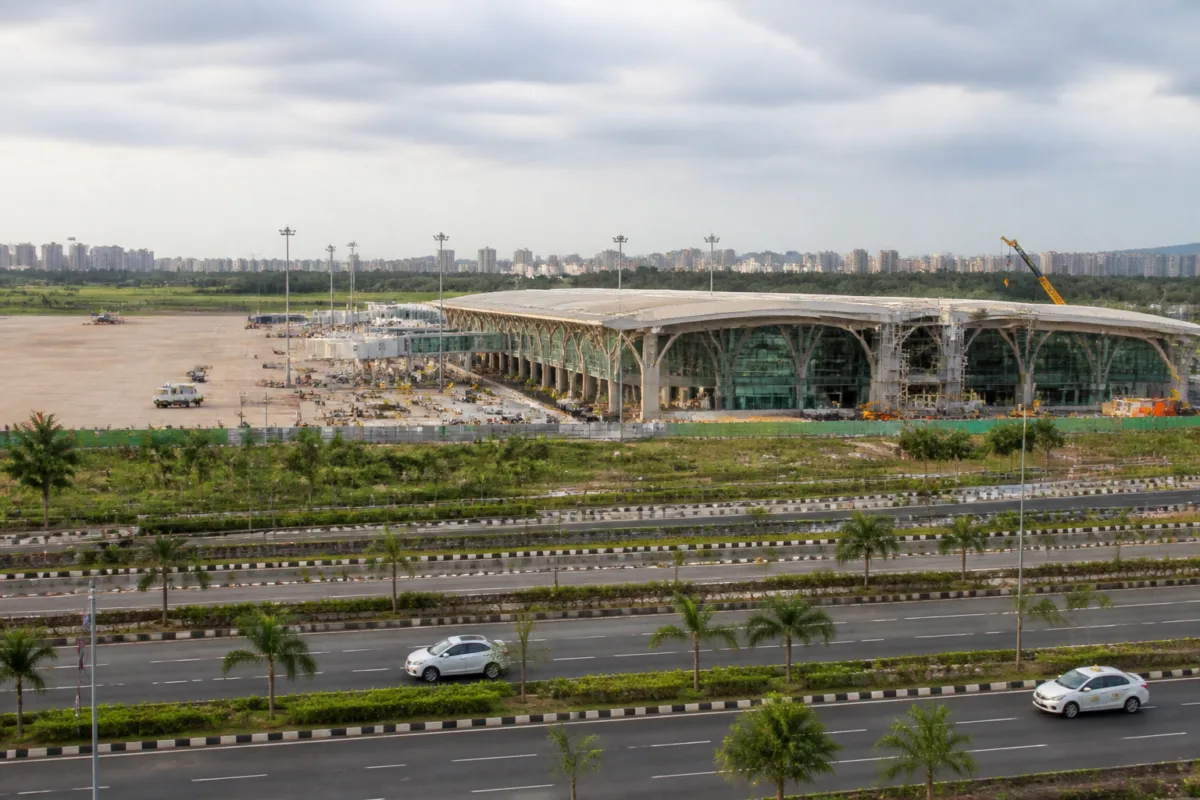
Navi Mumbai airport is approaching its most consequential test before Mumbai’s Terminal 1 is demolished: persuading international airlines that the new airport can operate as a complete alternative, not simply as a facility with spare runway and terminal capacity. IndiGo and the Air India Group have outlined selected transfers, but Lufthansa, Singapore Airlines and Emirates have not committed to moving their international operations from Chhatrapati Shivaji Maharaj International Airport (CSMIA).
That uncertainty matters because the shift is being driven by a temporary capacity problem across the Mumbai Metropolitan Region. Mumbai airport’s Terminal 1 is scheduled for demolition from April 2027 as part of a redevelopment expected to run until December 2030. The traffic displaced from the terminal cannot simply be absorbed by existing facilities without putting pressure on the airport’s airside and terminal systems. The proposed answer is to move a portion of international and domestic operations to Navi Mumbai International Airport (NMIA), then restore the temporarily relocated traffic to CSMIA after the redevelopment.
This is not a conventional airport opening in which airlines independently add routes in response to new demand. It is a coordinated redistribution of traffic between two airports serving the same metropolitan region. The success of that arrangement depends on more than terminal buildings and declared capacity. Airlines need predictable slots, passenger-processing systems, cargo facilities, catering, ground handling and reliable access for travellers and staff. The comments from foreign carriers show that these operational details are central to the transition.
Adani Airport Holdings Ltd (AAHL), which operates both airports, is seeking commitments ahead of the redevelopment. Chief executive Arun Bansal said discussions with international airlines were nearing completion and that arrangements with most carriers were expected to be finalised within a month. He said airlines operating from Mumbai’s Terminal 2 would have to choose between moving to NMIA or temporarily stopping flights to Mumbai when the demolition of Terminal 1 begins in the summer of 2027. He added that one or two airlines might decide not to operate from NMIA for a couple of years, but said this would have little impact on overall passenger numbers.
The position of Lufthansa illustrates the difference between an airport operator’s transition plan and an airline’s confirmed operating decision. Lufthansa Group said Lufthansa and SWISS flights from Frankfurt, Munich and Zurich would continue from CSMIA during the 2026-27 winter schedule, for which the necessary slots had been approved. The group is in dialogue with the Indian government and airport authorities, along with the International Air Transport Association, on further planning. Its statement confirms continuity for that schedule but does not commit the group to a later move to NMIA.
Singapore Airlines has similarly acknowledged the proposed redevelopment without announcing a change. The airline said it would provide updates on its Mumbai operations at the appropriate time. Emirates has been more direct about the conditions it believes must be met. Essa Sulaiman Ahmad, the airline’s senior vice-president for commercial operations for West Asia and the Indian Ocean, said NMIA would be difficult for airlines to shift to until the full ecosystem was built, citing catering facilities and cargo warehousing among the requirements.
That distinction between physical capacity and operational readiness is the central challenge for NMIA. AAHL expects the airport to reach its Phase 1 capacity of 20 million passengers annually by the end of financial year 2028, comprising 15 million domestic and five million international passengers. Bansal said the operator expected to reach a run rate of five million passengers per quarter in the first quarter of FY28. AAHL has also announced 18 additional international routes beyond one international route already operational.
The targets indicate the scale of traffic that the operator expects to build through a phased transfer of services. But capacity is a ceiling, not a guarantee of airline participation. A carrier’s decision is shaped by the complete journey around a flight: the availability of slots, aircraft turnaround arrangements, passenger connections, cargo handling, catering and access to the airport. Emirates’ public concern suggests that the development of these linked services will be as important as the construction of passenger terminals.
Domestic airlines have provided the clearest early commitments. IndiGo plans to progressively transfer 12 daily international departures from Mumbai airport to NMIA between February and July 2027, including a planned Kathmandu service. Air India Express is expected to begin four daily domestic flights from NMIA in December 2026, followed by international services to Oman and Kuwait from January 2027, subject to regulatory approval for Kuwait. Bansal said IndiGo, Air India Express and Akasa Air had agreed to move 18 international flights, adding around three million passengers per year of capacity at NMIA.
These commitments create an initial operating base, but they do not resolve the larger coordination problem. Mumbai International Airport Ltd (MIAL), the operator of CSMIA, has proposed shifting five million passengers annually, including international traffic, to NMIA during the redevelopment. Airlines have raised concerns about consultation, slot allocation and the operational implications of moving services between two airports in one metropolitan region. The Ministry of Civil Aviation earlier asked MIAL to defer its original transition plan and work with airlines on an agreed roadmap.
The request for airlines to submit transition plans by November 3 for the Northern Summer 2027 schedule makes the process time-sensitive. The airport operators and airlines must coordinate well before the April 2027 demolition because schedules, aircraft rotations, crew assignments, passenger communications and supporting contracts cannot be changed at the last minute without operational consequences. The fact that several major international carriers have not yet committed shows that the roadmap remains under negotiation.
The governance structure also makes the transition more complex. AAHL operates the airports and is pursuing airline commitments. MIAL is responsible for the redevelopment-related transition plan at CSMIA. The Ministry of Civil Aviation has already intervened in the sequencing of that plan, while airlines and IATA are participating in discussions over future operations. This is therefore not only a commercial decision by individual carriers. It is an administrative exercise involving airport capacity, government oversight, airline networks and the distribution of passenger traffic across the region.
The temporary nature of the proposed move adds another layer. MIAL has said international traffic shifted to NMIA during the redevelopment would be restored to CSMIA after the new Terminal 1 is completed. That creates a difficult proposition for carriers: they may need to shift operations to a new airport for several years and then potentially shift them again. The value of moving depends on whether the new airport can provide sufficient operational and commercial advantages during the interim period, while the cost involves changes to established passenger patterns and airline logistics.
NMIA’s wider development is continuing alongside the transition negotiations. AAHL has appointed an international consultant for the design of Phase 2 and is finalising the general contractor, with construction of Terminal 2 scheduled to begin in November. The operator’s Phase 1 target and additional route announcements show an effort to establish traffic quickly, while the redevelopment of CSMIA is creating an immediate reason for airlines to participate.
The evidence supplied so far confirms a clear division between domestic and international readiness. Domestic carriers have announced specific services and schedules. Major foreign airlines, by contrast, have either confirmed existing CSMIA operations for the 2026-27 winter season, deferred any announcement or questioned whether the supporting ecosystem at NMIA is ready. That does not establish that the international shift will fail, but it does show that the proposed redistribution has not yet become a fully agreed network plan.
The larger urban question is whether Mumbai can operate two airports as one metropolitan aviation system during a major construction programme. Terminal capacity can be measured in passengers per year, but airport integration is experienced through connections, access, processing time and service reliability. The transition will be judged not only by whether NMIA reaches 20 million passengers by FY28, but also by whether the two airports can divide and later recombine traffic without disrupting the city’s international connectivity.
The next milestones are the airline transition plans for the Northern Summer 2027 schedule, the expected conclusion of discussions with international carriers, the start of Terminal 1 demolition in April 2027 and the phased launch of additional NMIA services. Until those decisions are formalised, Navi Mumbai airport’s physical expansion is ahead of the broader commitment needed to make it a fully functioning second gateway for Mumbai.

