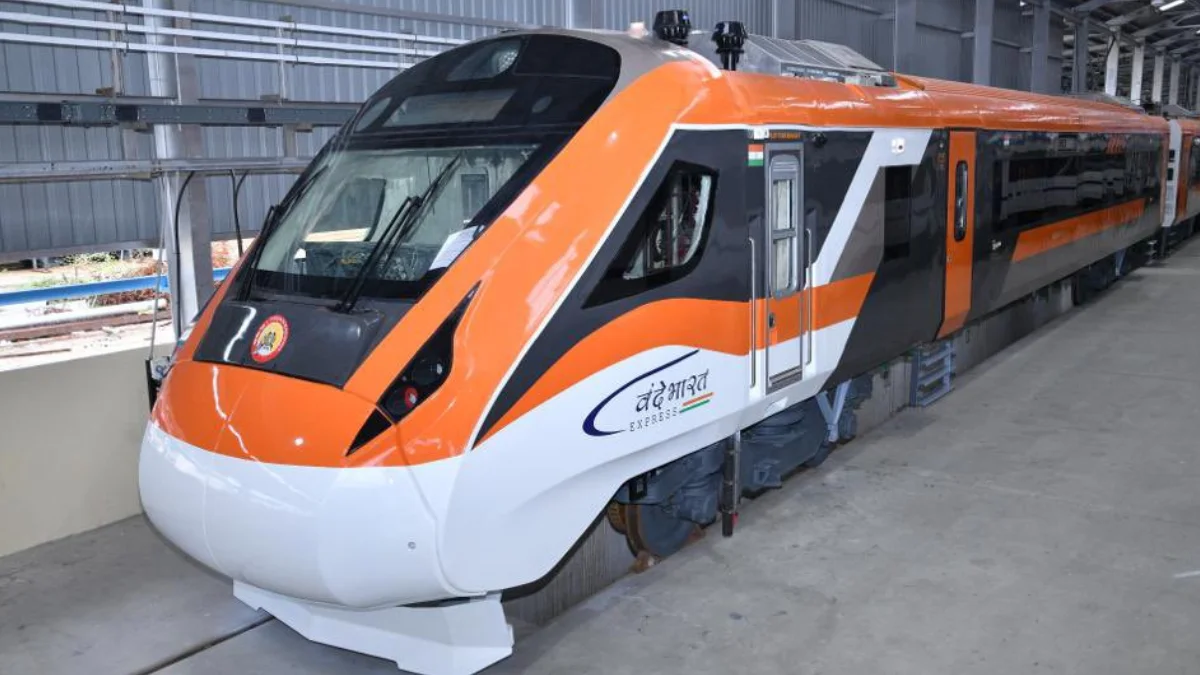
Mumbai’s premium intercity rail corridor has received a capacity upgrade, with authorities expanding the Vande Bharat service connecting the city to Ahmedabad into a longer train formation. The move reflects sustained passenger demand on one of western India’s busiest economic routes and signals a broader shift towards higher-capacity, high-efficiency rail systems. The updated configuration increases the train length to 20 coaches, adding more seating across both standard and premium categories. This development comes after a period of temporary capacity augmentation, which transport planners say consistently recorded high occupancy, prompting a permanent transition. The Mumbai Ahmedabad Vande Bharat now operates with enhanced carrying capacity, aiming to reduce waitlists and improve travel predictability.
Urban mobility experts view this step as part of a wider recalibration in India’s rail strategy, where frequency alone is no longer sufficient to meet demand. Instead, expanding capacity per trip is emerging as a more efficient solution in high-density corridors. For a route linking two major commercial centres, the upgrade carries implications beyond convenience, potentially strengthening business travel, regional trade, and labour mobility. The corridor spans nearly 500 kilometres and connects key industrial and commercial nodes, serving a diverse passenger base ranging from professionals and students to small business operators. With travel times significantly shorter than conventional rail services, the Mumbai Ahmedabad Vande Bharat has increasingly become a preferred option for time-sensitive journeys. Transport analysts note that such services can gradually shift travellers away from short-haul flights and private vehicles, contributing to lower per capita emissions. Data from the national rail network indicates a steady rise in ridership on semi-high-speed trains, with millions opting for these services annually. The growing share of longer train formations across routes suggests that infrastructure is being adapted to meet evolving commuter expectations.
Higher-capacity trains also allow operators to optimise energy use per passenger, aligning with long-term sustainability goals in the transport sector. From an urban development perspective, improved intercity connectivity plays a crucial role in decentralising economic activity. Faster and more reliable links between cities like Mumbai and Ahmedabad can support the growth of satellite business hubs, reduce pressure on megacities, and enable more balanced regional development. Planners emphasise that such upgrades must be complemented by last-mile connectivity within cities to maximise their benefits. The Mumbai Ahmedabad Vande Bharat expansion also underscores the importance of continuous investment in rail infrastructure, particularly as cities grapple with congestion, pollution, and rising travel demand. While premium services cater to a specific segment, their operational efficiencies can inform broader upgrades across the rail network.
Looking ahead, the focus is likely to remain on scaling capacity, improving service reliability, and integrating intercity transport with urban transit systems. As demand continues to rise, the success of such interventions will depend on how effectively they balance speed, accessibility, and environmental considerations.